IP office, Korea Consumer Agency release joint probe results on cosmetics patent misrepresentation
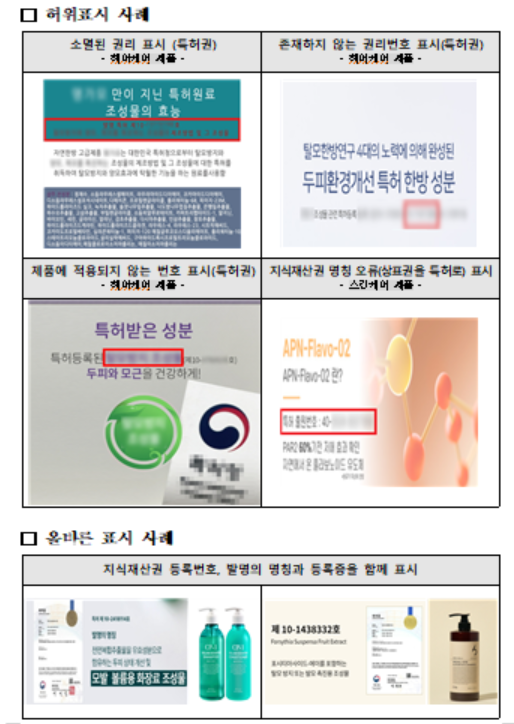
A probe into intellectual property markings on cosmetics sold online has uncovered 634 cases of false labeling, including products displaying expired rights as valid.
The Korean Intellectual Property Office and the Korea Consumer Agency jointly announced the findings Monday.
The investigation examined approximately 10,000 cosmetics product listings posted between May 1 and June 12 — roughly six weeks — across seven online shopping platforms, including Naver Shopping.
Because cosmetics are frequently purchased without in-person inspection and applied directly to the body, accurate information on ingredients, functions and effects is critical. The two agencies launched the joint probe particularly because labels such as "patented ingredient" can heavily influence consumer purchasing decisions.
Patent rights accounted for the vast majority of violations. Breaking down the findings by rights type, false patent markings made up 626 cases, or 98.7 percent of the total, followed by design rights at 6 cases (0.9 percent), and utility model rights and trademark rights at 1 case each (0.2 percent).
By violation type, the most common was displaying an expired right as valid, which accounted for 514 cases (81.1 percent). Listing a nonexistent rights number followed at 73 cases (11.5 percent), and marking a product as having a pending application when none existed accounted for 30 cases (4.7 percent).
By product category, hair care products recorded the highest number of violations at 242 cases (38.2 percent), followed by skin care at 97 cases (15.3 percent), body care at 91 cases (14.3 percent) and cleansing products at 67 cases (10.6 percent). Products that emphasize functional benefits such as hair loss prevention or highlight specific ingredients appear more prone to false IP markings, likely to appeal to consumer purchasing instincts.
The intellectual property office notified sellers of the violations found in this probe and completed corrective measures. It also plans to track each seller's violation history and refer repeat offenders to a formal administrative investigation.
The joint probe was conducted under an MOU between the intellectual property office and the Korea Consumer Agency, marking the second such exercise following a similar investigation into kitchenware last year. Particularly notable was the participation of the "Citizens' Advertising Watchdog," a group of ordinary members of the public who helped identify suspected false markings on major online shopping platforms, lending the investigation greater on-the-ground reach.
Watchdog members received training on correct IP labeling practices and major violation cases before independently searching for suspected false markings. The agencies expressed hope that the activity will raise public understanding of and attention to IP labeling, and naturally spread awareness of the importance of accurate markings.
The intellectual property office said it plans to continue working closely with the Korea Consumer Agency to correct false IP markings on products closely tied to everyday consumer life.
Kim Yong-hun, director general of the IP protection and cooperation bureau at the intellectual property office, said false IP markings "undermine fair trade order" and pledged to "keep working to correct false intellectual property markings so that consumers can make informed decisions."
kwonhl@heraldcorp.com