Companies with 1,000 or more workers show 61% compliance rate, but actual service participation stands at 28.4%
Negative perception of being labeled a pre-retiree and weak links to public employment services cited as key barriers
Program set to expand to firms with 500 or more workers next year, and those with 300 or more by 2029
![Lee Myeong-yong practices welding during a tailored mid-career retraining course for retired civil servants at Korea Polytechnics' Incheon campus. [Korea Polytechnics]](https://wimg.heraldcorp.com/news/cms/2026/09/07/news-p.v1.20250731.595cb63e46724ad4ac4be2941862b681_P1.jpg)
A government program designed to help workers aged 50 and older find new jobs before leaving their current positions is seeing actual participation rates stuck in the 20 percent range, with compliance among eligible companies hovering around 60 percent. Amid plans to extend the program to mid-sized and small and medium-sized enterprises, critics say improving its effectiveness should come first.
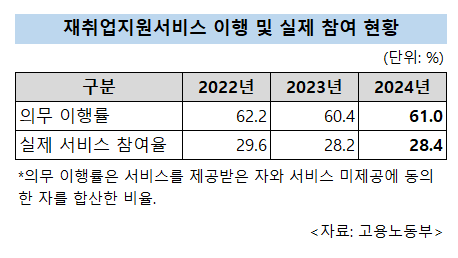
Data the Ministry of Employment and Labor submitted to the National Assembly Research Service on Monday showed that actual participation in the reemployment support service stood at 29.6 percent in 2022, fell to 28.2 percent in 2023, and edged up slightly to 28.4 percent in 2024. In practice, fewer than three in 10 eligible workers actually received the service last year.
The reemployment support service, introduced in 2020, requires companies with 1,000 or more full-time workers to provide career planning, job and entrepreneurship training, and job placement assistance to employees aged 50 or older who face involuntary separation. The program is considered a key pillar of support for middle-aged and older workers, given that the average retirement age from primary employment stands at 52.9.
Corporate compliance rates were 62.2 percent in 2022, 60.4 percent in 2023, and 61.0 percent in 2024. However, the compliance figures include cases where workers agreed to waive the service, not just cases where companies actually provided it.
As a result, a 32.6 percentage-point gap opened in 2024 between the compliance rate and the actual service participation rate — meaning that even when the program is counted as formally fulfilled, the share of middle-aged workers who actually receive career counseling, vocational training, or job placement services remains low.
The National Assembly Research Service said the low participation reflects a negative perception of being labeled a "pre-retiree," as well as insufficient links to public employment services. Because the program is seen as a one-time offering right before departure, it has not functioned effectively as a tool for career planning and job transition while workers are still employed.
The Ministry of Employment and Labor's current operating guidelines focus on quantitative benchmarks — at least 16 hours of career counseling and education, and job placement assistance at least twice a month for up to three months. Meaningful outcome measures, such as whether participants find jobs, how long they stay employed, and what wages they earn after reemployment, are not adequately assessed.
Quality standards for service providers are also limited, requiring only that agencies employ holders of relevant certifications or workers with at least two years of experience. As a result, some companies are reportedly outsourcing the service to the lowest-cost private contractors and meeting their obligations in name only — through online video lectures or resume editing sessions.
Despite these shortcomings, the ministry plans to gradually expand the program's mandatory scope through a proposed legislative amendment. The obligation will extend to employers with 500 or more workers in the second half of 2027, and to those with 300 or more workers in the second half of 2029.
The ministry is also pursuing a rename of the program to "career support service" and plans to let workers choose their own vocational training or work experience options. Under the proposed changes, employers who offer flexible working hours, leave, or financial support would be deemed compliant even without running a program directly.
Additional plans call for building a database of service records to link with job training and placement services at mid-career support centers, and for extending early career planning support to workers aged 40 and older who are still employed.
The National Assembly Research Service said addressing the program's reliance on minimal formal standards and its weak job-transition support function should take priority. "Before expanding the program's scope, the government must establish outcome indicators and a regular system for quality evaluation, monitoring, and feedback," it said.
fact0514@heraldcorp.com