
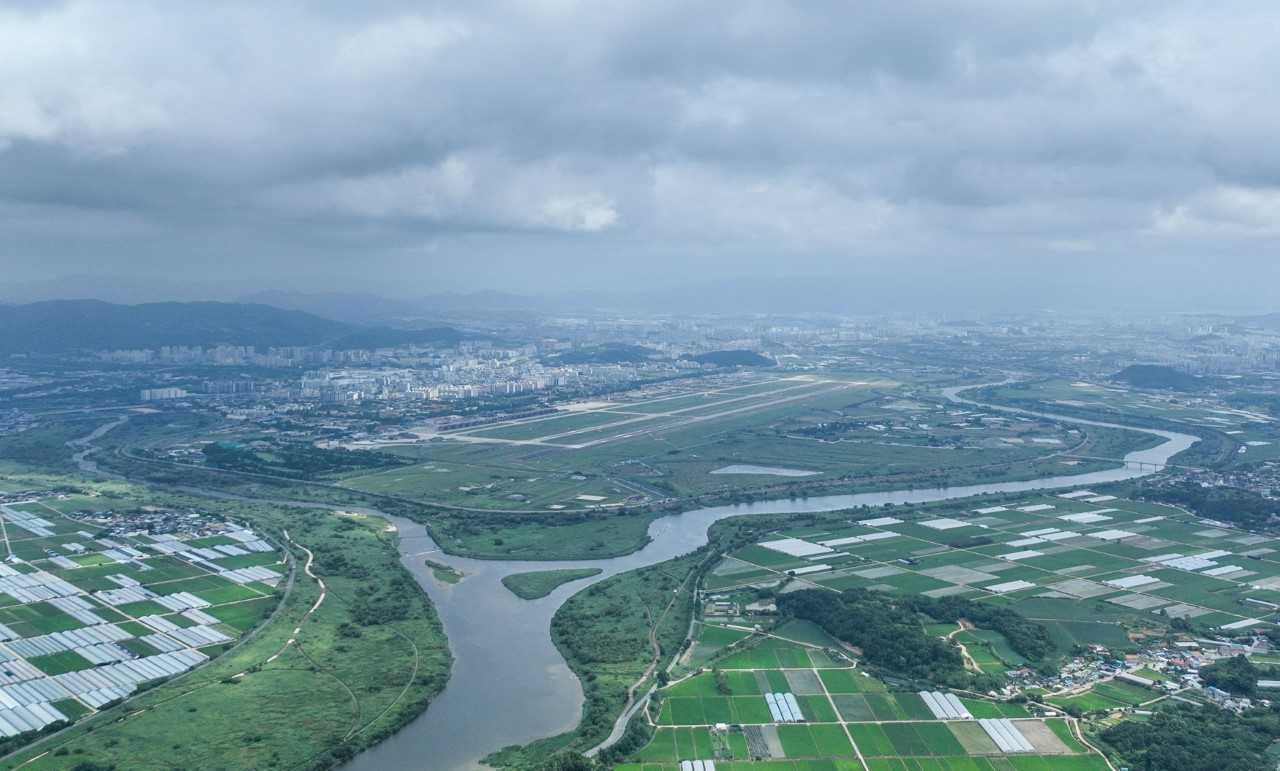
Sangmu District — the prime real estate of Gwangju, home to about 1.38 million residents — is poised for a major revival 30 years after its original land development.
The urban convergence zone in Sangmu District, Seo-gu, in the South Jeolla-Gwangju integrated special city is set to be developed as a support complex for the Honam region's semiconductor cluster.
The plan calls for research and development facilities, along with residential, commercial, education and cultural complexes, to be built in tandem with the adjacent Gwangju military airport semiconductor industrial complex.
The South Jeolla-Gwangju integrated special city is drawing up plans to develop the Sangmu District urban convergence zone into a semiconductor support complex.
An urban convergence zone is a mixed-use development project that concentrates jobs, residential units and leisure facilities in the downtown areas of major regional cities, taking advantage of existing transportation and cultural infrastructure.
An 852,000-square-meter site covering the Chipyeong-dong and Mareuk-dong areas of Sangmu District was designated an urban convergence zone in 2024. The city plans to invest 1.58 trillion won ($1.16 billion) through 2031 in projects spanning smart advanced specialization, medical and digital industries, MICE and cultural convergence.
Sangmu District has been assessed as having strong growth potential, with Gwangju City Hall, the Bank of Korea, businesses, and commercial and cultural facilities concentrated in the area, making it well suited for industry-academia-research linkages and clustering.
With a semiconductor industrial complex now planned for the adjacent military airport site, the city is working on a support complex to complement it.
The core concept is to place semiconductor fabrication facilities on the military airport site, while the adjacent Sangmu District urban convergence zone would provide research and development facilities along with residential, education and cultural amenities for chipmaker employees and workers in related industries.
The goal of establishing livable conditions for the semiconductor cluster by 2030 also aligns with the development timeline for the Sangmu District urban convergence zone.
The current plan for the urban convergence zone allocates 7,427 square meters for research facilities, 45,926 square meters for residential use, 18,383 square meters for commercial use and 113,463 square meters for cultural facilities.
The vision is to position the Sangmu District urban convergence zone as the connecting axis of an advanced industry belt running along the Yeongsan River waterfront — linking the Cheomdan industrial complex (AI), the military airport (semiconductor complex) and the Naju innovation new town (energy valley).
The Sangmu District urban convergence zone would serve as a mixed residential hub bridging the advanced industry belt and the existing urban core.
sij@heraldcorp.com




