
Micron opens Idaho memory fab construction site to media
CEO Mehrotra tours clean room in protective gear
Company stresses its status as America's only memory maker — a jab at Samsung, SK hynix
'Close ties with US customers, 8,000 jobs created'
Commerce Secretary Lutnick warns Samsung, SK hynix of additional tariffs
![Micron CEO Sanjay Mehrotra (center) tours the construction site of a memory fab being built in Boise, Idaho. [Sanjay Mehrotra SNS]](https://wimg.heraldcorp.com/news/cms/2026/09/04/news-p.v1.20260904.dcf8f5c727fa4e0683a2817ed00a7cef_P1.png)
As Samsung Electronics and SK hynix face mounting pressure from the US administration to expand their American production facilities, third-ranked Micron Technology has been making an increasingly bold push to position itself as the only US-based memory chipmaker.
Micron CEO Sanjay Mehrotra said in a recent CNBC interview that he is "very proud" that Micron, as an American company, is investing in the United States — an implicit dig at Samsung Electronics and SK hynix, which are under pressure to deepen their own US investments.
While Micron ramps up its domestic memory production capacity, Samsung Electronics is building a foundry factory in Texas and SK hynix is constructing an advanced packaging facility in Indiana. Neither Korean company has announced plans to build a memory fab on US soil.
Mehrotra conducted the CNBC interview at the construction site of Micron's Boise, Idaho, fab, which the company bills as the largest memory fab in US history, underscoring the significance of the project.
Photos released that day showed Mehrotra wearing a hard hat and work boots as he walked the Idaho construction site, and donning a cleanroom suit as he inspected an R&D clean room — images made public for the first time.
Micron is building two large fabs at the Boise site, each roughly the size of 10 American football fields.
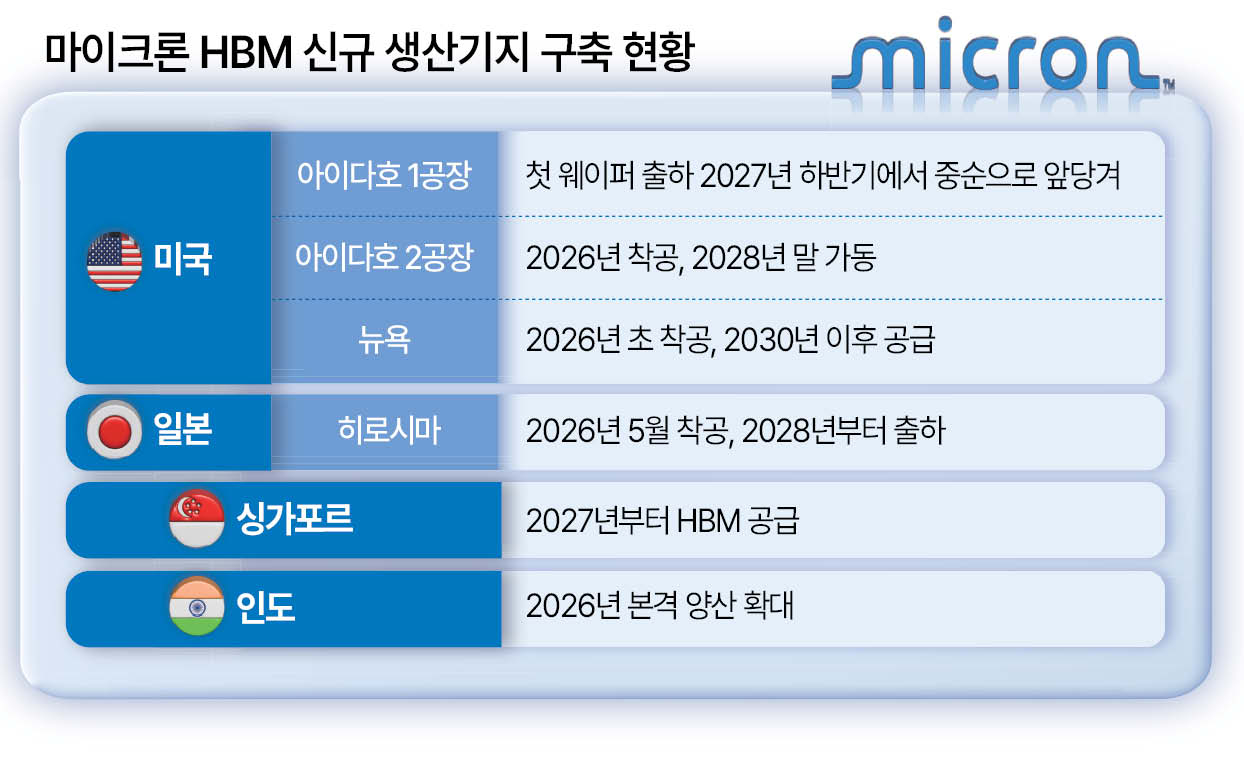
With orders surging faster than the company can fulfill them, Micron has moved up the planned start of operations at its first Idaho fab from the second half of 2027 to mid-2027. The second fab is scheduled to come online by the end of 2028.
Beyond Idaho, Micron is also building cutting-edge memory factories in Syracuse and Clay, New York, pouring massive capital into domestic production. The company's strategy is to invest $250 billion across the United States to build memory fabs simultaneously and close the wide production-capacity gap with Samsung Electronics and SK hynix.
"Because the US is leading AI innovation, being able to work closely with our customers is a unique strength for us," Mehrotra said, referring to the major American technology companies that are the primary buyers of memory chips.
His argument is that the memory fabs Micron is building on US soil will become its greatest competitive advantage, given that its key customers are all American big-tech firms.
He added that about 8,000 construction workers are currently employed at the Boise fab, and said customers "appreciate that Micron is investing in American workers."
![Micron CEO Sanjay Mehrotra (second from right) tours the clean room of a memory fab under construction in Boise, Idaho. [Sanjay Mehrotra SNS]](https://wimg.heraldcorp.com/news/cms/2026/09/04/news-p.v1.20260904.3e2f778b9fc94f9f870b878448def6d7_P1.jpg)
The United States is generally considered a difficult location for memory chip manufacturing, given high labor and operating costs that significantly reduce return on investment. A shortage of skilled workers familiar with semiconductor production processes is another widely cited constraint.
Micron appears to have recognized this challenge: last month, it opened a 5,544-square-meter semiconductor workforce training facility near its Idaho fab, with plans to train both Micron employees and workers from partner companies.
"There is no better innovation hub than the United States," Mehrotra said. "We will also build a $10 billion Micron Research campus in Boise to bring our partners together. Boise is becoming a hub for cutting-edge memory manufacturing."
He said data center customers are demanding 50 percent more memory than Micron can supply, and added that the memory supply crunch is expected to tighten further in 2027 compared with this year.
At a technology leadership forum hosted by investment bank KeyBanc Capital Markets on Aug. 10 (local time), Micron again took aim at Samsung Electronics and SK hynix, saying it is "the only company investing in front-end memory fabs in the United States."
![The construction site of Micron's memory fab being built in Boise, Idaho. [Sanjay Mehrotra SNS]](https://wimg.heraldcorp.com/news/cms/2026/09/04/news-p.v1.20260904.7cb5a54671604ef194cb5f0d7780a513_P1.jpg)
Sumit Sadana, Micron's chief business officer, said Samsung Electronics' US investment is focused on logic foundry, not memory, and that SK hynix's investment is likewise limited to packaging facilities. "Memory produced by Micron in the United States will command a price premium," he said.
Micron's remarks have drawn attention alongside recent signals from US Commerce Secretary Howard Lutnick, who has suggested introducing "targeted tariffs" aimed squarely at Samsung Electronics and SK hynix.
Speaking to CNBC on Wednesday (local time) on the sidelines of the G20 Innovation Ministers' Meeting in Chapel Hill, North Carolina, Lutnick said the administration would introduce "targeted and sophisticated tariff policies" in the semiconductor sector, ratcheting up pressure on the two Korean chipmakers.
"TSMC is building a $265 billion semiconductor factory in Arizona, and Micron is building a $250 billion memory factory," he said. "If you don't manufacture in the United States, you should be prepared to pay tariffs to access the world's largest market."
The message amounted to a warning to Samsung Electronics and SK hynix: build front-end memory production facilities in the United States — which carry greater benefits for local economies and job creation — or face heavy tariff penalties.
SK hynix left the door open to further memory fab investment in the US: at the groundbreaking ceremony for its Indiana advanced packaging fab on Aug. 27 (local time), President Kwak Noh-jung said the company would "continue to expand investment and cooperation in the United States going forward."
Samsung Electronics has officially announced plans to expand its second foundry fab in Taylor, Texas, but has yet to disclose any memory fab investment plans of the kind the US administration is pressing for.
joze@heraldcorp.com




