
Stores halved from 142 to 67, all under 3,300 square meters
Workforce restructuring of 4,000-plus idle staff seen as unavoidable
33% of public creditors yet to agree to installment repayment
Industry says deregulation, not just Homeplus effort, is key

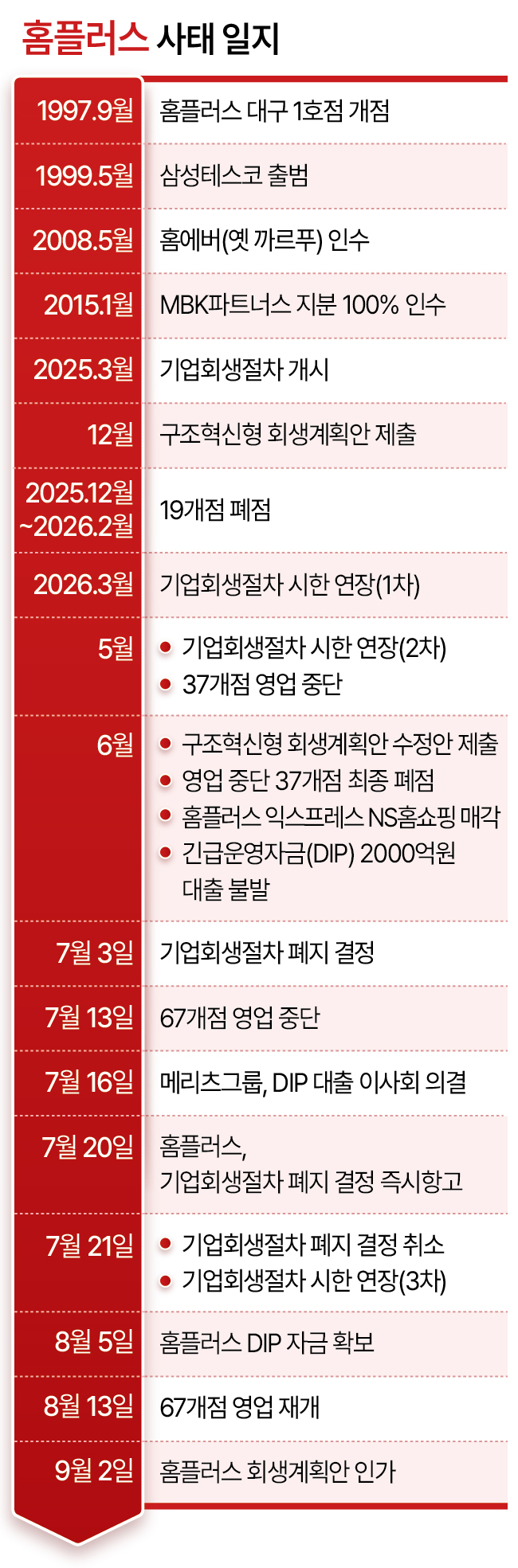
Homeplus has cleared its biggest hurdle. The Seoul Bankruptcy Court gave final approval to the retailer's rehabilitation plan on Wednesday, roughly a year and a half after the company first entered court receivership. Employees and suppliers who had been bracing for the worst ahead of the chain's 30th anniversary allowed themselves a moment of relief.
But the road ahead remains steep. During the rehabilitation process, Homeplus sold off its supermarket unit, Homeplus Express, which had been one of its most profitable arms, and its store count has shrunk to 67. The company must now prove it can compete in a brick-and-mortar retail market squeezed by e-commerce — all while meeting its court-mandated repayment schedule.
The most pressing challenge, according to industry sources, is workforce restructuring. The chain once operated 142 stores; that number has been cut roughly in half through the rehabilitation process. Its headcount, which once stood at around 20,000, has fallen to about 9,400 through voluntary redundancy programs and other measures — yet that figure is still considered high relative to the number of stores now operating. Homeplus has also reduced its selling floor space to under 3,300 square meters per store due to supply issues, and has adopted a Trader Joe's-style model focused on fresh produce and private-label products.
"A hypermarket store of about 6,600 square meters running three shifts needs around 90 staff," one industry official said. "With Homeplus cutting its floor space, the actual headcount needed will be even smaller." The official added that hypermarket operators across the board have been adjusting their workforces by increasing part-time staff as business conditions deteriorate, and that for Homeplus — fighting for its survival — cutting labor costs will be unavoidable.
A large number of Homeplus employees have been unable to return to work since the closure of 37 stores was decided in May, and are receiving furlough pay equivalent to 70 percent of their base salary. The number of idle workers is believed to reach as many as 4,000. Workforce restructuring is also seen as essential to securing the merger and acquisition of the remaining business unit outlined in the rehabilitation plan.
Homeplus is expected to enter consultations with its two labor unions, and significant pushback is anticipated — including demands that majority shareholder MBK Partners and Homeplus management share in the pain. The company has also yet to pay its employees' August wages.
![A Homeplus store in Seoul. [Herald DB]](https://wimg.heraldcorp.com/news/cms/2026/09/03/news-p.v1.20260716.c6a7d5126456418682e785d5872a0316_P1.jpg)
Homeplus must also execute the debt repayment plan laid out in its rehabilitation proposal. The company plans to sell 19 of its closed stores that it owns outright, raising 1.42 trillion won ($1.04 billion) by February 2028. Those proceeds will be used first to fully repay trust-secured bonds held by its largest creditor, Meritz Financial Group — a prerequisite for securing real estate-backed loans against the remaining owned stores. Homeplus then plans to use mortgage financing on 38 of its 67 remaining owned stores to repay outstanding debts in sequence.
Unpaid wages and severance totaling 63.3 billion won owed to current and former employees are to be 69 percent paid by February next year, with full repayment by February 2028. Unpaid supplier bills of around 503 billion won are to be repaid in installments over three years: 0.5 percent by February 2028, 20.3 percent by February 2029, and 79.2 percent by February 2030.
Kim Kwang-il, vice chairman of MBK Partners and the court-appointed administrator overseeing the rehabilitation, appeared in court Wednesday and said the primary plan was to secure profitability through fixed-cost reductions and the closure of loss-making stores, then use those gains to repay creditors. "After the rehabilitation plan is approved, we will sell the stores we own outright and then pursue an M&A of the company itself," he said.
Samil PwC, the court-appointed investigator, assessed the rehabilitation plan as feasible — on the condition that public creditors agree to installment repayment. According to Kim, the final consent rate among public creditors for installment repayment stands at 66.3 percent. That leaves the task of persuading the remaining 33.7 percent not to demand immediate lump-sum repayment. If they do, a liquidity shortfall would arise and the likelihood of the rehabilitation plan being carried out would drop sharply.
Homeplus is expected to push for a return to normal operations through large-scale discount events during the upcoming chuseok holiday season, the year-end period, and next year's seollal. However, industry officials and experts say Homeplus's own efforts will not be enough. They argue that the fundamentally uneven playing field — tilted in favor of e-commerce — must itself be corrected. The ruling party and government agreed earlier this year on the need to ease regulations on early-morning delivery by hypermarkets, but a bill to amend the Distribution Industry Development Act that included such measures ran into opposition from traditional market and small-business groups.
Seo Yong-gu, a professor at Sookmyung Women's University's business school, said that given the chance at rehabilitation Homeplus has received, a political and government decision to fully lift hypermarket early-morning delivery regulations — even temporarily, for just six months — is needed. "Excessive restrictions such as banning the sale of fresh produce under 10,000 won during early-morning delivery hours, included in the coexistence proposal, will only create new problems," he said.
soho0902@heraldcorp.com




