
US-Iran clashes send Wall Street's three major indexes lower
Oil prices, interest rates surge; Kospi expected to open in the red
'Other corporations' buy for 10th straight session on semiconductor giants' buybacks
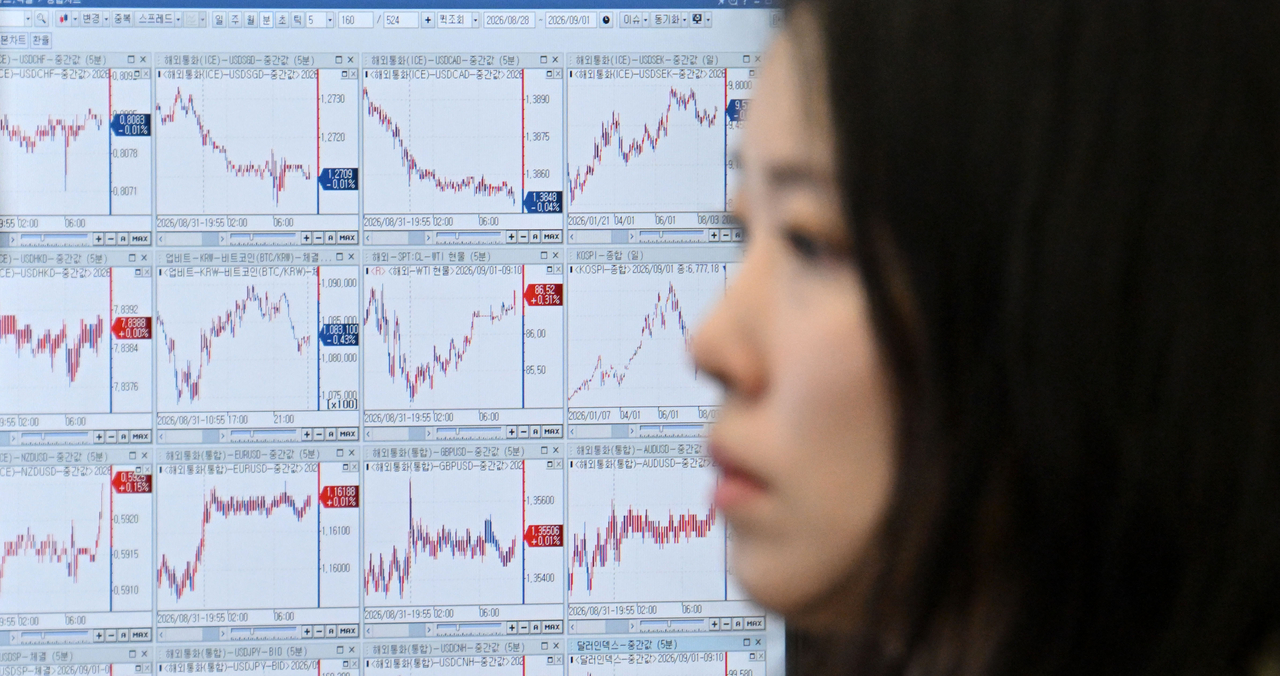
The Kospi, which has recently followed a pattern of early weakness giving way to late-session gains and closed higher for two consecutive days, is expected to open lower Wednesday as Wall Street fell overnight. However, ongoing share buybacks by Samsung Electronics and SK hynix could again push the index into positive territory during trading.
On Tuesday, the Kospi closed up 15.78 points, or 0.23 percent, at 6,835.80. The index opened down 35.73 points, or 0.52 percent, at 6,784.29 amid heightened Middle East tensions and at one point slid as far as 6,732.47, a decline of 1.28 percent.
The index recovered as buybacks by Samsung Electronics and SK hynix continued, steadily trimming losses before turning positive.
Individual, foreign and institutional investors all sold for a second straight session on the Kospi, but the "other corporations" category offset that pressure with net purchases of 1.67 trillion won ($1.21 billion), lifting the index.
The "other corporations" category has now bought for 10 consecutive trading sessions, driven by Samsung Electronics' buybacks for employee stock compensation and SK hynix's repurchases for share cancellation. Both semiconductor heavyweights — Samsung Electronics, up 0.38 percent, and SK hynix, up 1.14 percent — reversed early losses to support the index.
On Wall Street overnight, all three major indexes fell after news broke that US-Iran hostilities had resumed. The Dow Jones Industrial Average dropped 0.79 percent and the S&P 500 fell 0.71 percent, while the NASDAQ Composite declined 1.03 percent.
The selloff came after the United States launched additional airstrikes against Iran for the second time in two days, prompting retaliatory attacks from Tehran that weighed on investor sentiment.
Oil prices surged. Brent crude futures for November delivery settled up 4.60 percent at $94.65 per barrel, while West Texas Intermediate for October delivery rose 5.20 percent to $90.22. The yield on the 10-year US Treasury note continued to climb, reaching around 4.79 percent — its highest level since January 2025.
The Philadelphia Semiconductor Index fell 2.1 percent, and SK hynix's American depositary receipts dropped 2.31 percent.
The Kospi is expected to open lower Wednesday, pressured by the surge in US Treasury yields and rising oil prices. The MSCI Korea ETF, which reflects investor sentiment toward the domestic market, fell 2.80 percent.
Given that buying from the "other corporations" category has repeatedly turned the Kospi higher during the session in recent days, the same early-weakness-to-late-strength pattern could repeat Wednesday.
Market analysts believe that if Samsung Electronics and SK hynix maintain their current pace of buybacks, the market's downside should remain supported for roughly another month.
"Samsung Electronics has executed approximately 23.8 percent of its buyback program, and SK hynix appears to have completed about 24.4 percent," said Han Ji-young, a researcher at Kiwoom Securities. "Assuming the current buyback pace is maintained, we can expect a supply-demand safety net of about one month through mid-October," she added.
Dell Technologies, the US computer manufacturer, reported blowout earnings after the New York close in the early hours of Wednesday Korean Standard Time, which could also limit the Kospi's downside.
Dell's sales for the second quarter of fiscal year 2027 (May through July) came in at $46.97 billion, up 58 percent from a year earlier and above the market consensus of $44.92 billion. Adjusted earnings per share reached $7.04, surpassing the market forecast of $4.92 by more than $2.
Dell's share price had fallen 6.80 percent during the regular New York session, but the stock climbed more than 6 percent in after-hours trading.
yuni@heraldcorp.com



