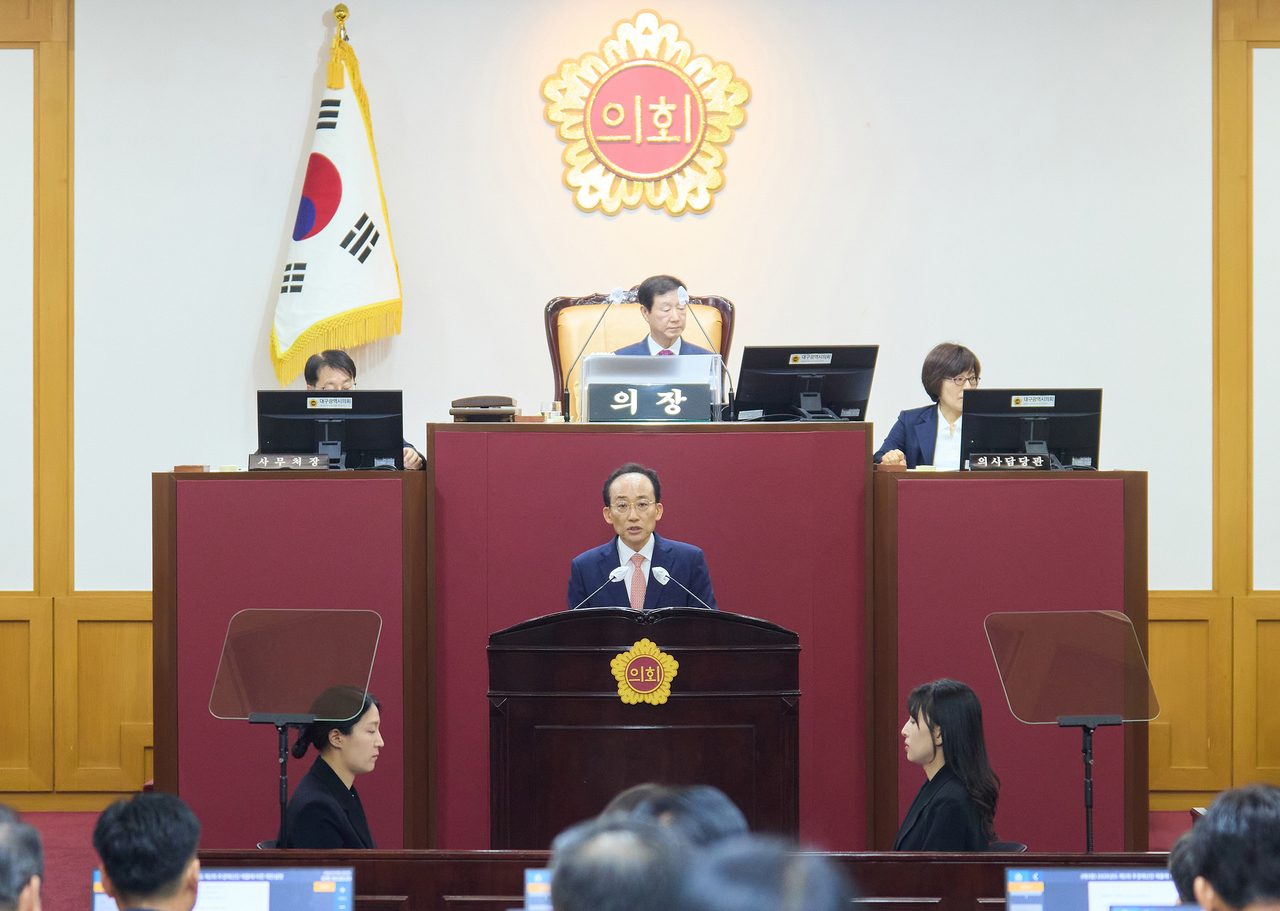
Daegu has submitted a second supplementary budget for 2026 totaling 12.61 trillion won ($9.17 billion) to the city council — a 406.5 billion won increase, or 3.3 percent, over the original budget — to support economic recovery and lay the groundwork for future growth, the city announced Tuesday.
The supplementary budget is the first additional spending plan under the city's ninth directly elected administration, aimed at realizing its governing vision of "change, growth and a better Daegu."
Given tight fiscal conditions, the city concentrated resources on key areas including the local economy, future industries, youth and talent development, disaster safety and welfare, and industrial complexes and transportation.
Funding sources include 119.2 billion won in net fiscal surplus, 49.1 billion won in national subsidies, 58.4 billion won in non-tax revenue and 109 billion won in local bonds.
Some 37.9 billion won will go toward support for small and medium-sized enterprises and small business owners to help revive the local economy. The city will add 1.2 billion won to its SME business stabilization loan program, expanding the total loan pool to 1.25 trillion won, and allocate a newly budgeted 1.4 billion won to cover guarantee fees on 250 billion won worth of loans.
The city has earmarked 43 billion won for future industries — including AI, robotics and next-generation mobility — and for driving AI adoption across industry sectors, along with 20.3 billion won for youth entrepreneurship, employment, local settlement and future talent development.
Public safety, childbirth support, childcare and healthcare will receive 54 billion won, while 119.5 billion won will be directed toward strengthening industrial complex competitiveness and expanding urban infrastructure including transportation and waterfront spaces. An additional 131.8 billion won has been set aside for essential projects directly tied to residents' daily lives, including legally mandated expenditures.
Of the 704.9 billion won that could not be included in the original budget due to funding shortfalls, the city has prioritized 235.6 billion won for this supplementary budget. The remaining 469.3 billion won will be phased in gradually, taking into account future fiscal conditions and project priorities.
The supplementary budget will go through deliberation at the 328th regular session of the Daegu City Council before receiving final approval on Sept. 16.
"We focused on reviving the local economy in ways that residents can actually feel, and on building a new foundation for Daegu's growth," Daegu Mayor Choo Kyung-ho said. "We will create new growth engines by concentrating investment in future industries such as AI and robotics, as well as key infrastructure."
kbj7653@heraldcorp.com