Defense ministries of three countries seek basic project data including price and production capacity
Formal export talks expected if RFPs follow
Romania demo completed in May; Hanwha Aerospace wins domestic UGV contract
Successful exports would mark new milestone for K-defense industry
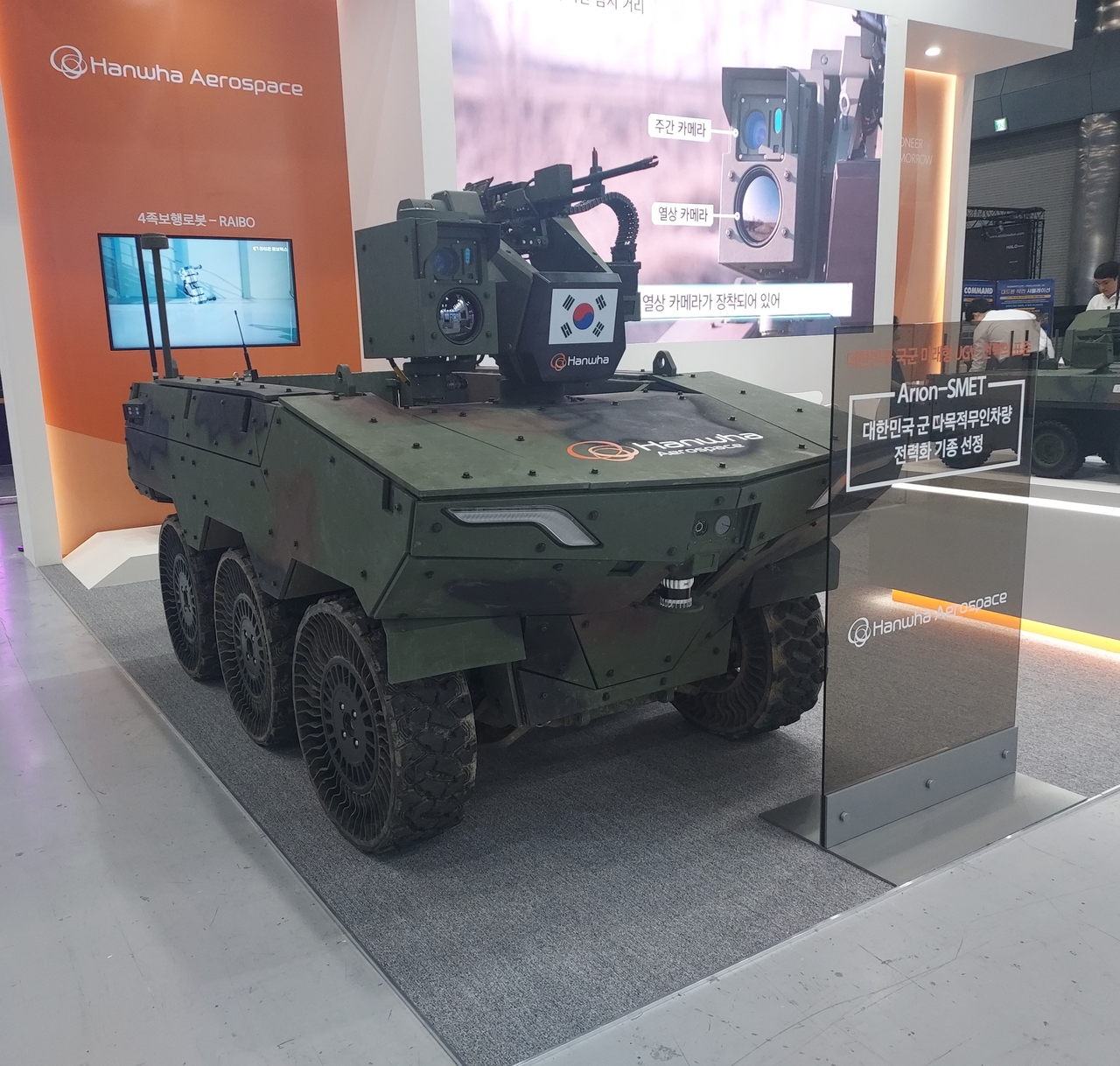
Interest in Hanwha Aerospace's multipurpose unmanned ground vehicles is growing in the global defense market. Canada, Finland and Romania have all sent inquiries to Hanwha Aerospace about pricing and production capacity. Analysts say successful exports could mark a turning point for South Korea's defense industry, which has relied heavily on conventional weapons.
The defense ministries of Canada, Finland and Romania recently sent requests for information, or RFIs, to Hanwha Aerospace regarding its multipurpose unmanned ground vehicles, according to industry sources Tuesday.
An RFI is an early-stage procedure for gathering basic project data such as pricing, delivery schedules, and design and production capabilities. If the three countries follow up with formal requests for proposals, or RFPs, full-scale export discussions are expected to begin. "It is difficult to officially name the countries, but it is true that we have received RFIs from foreign nations," a Hanwha Aerospace official said.
Romania's inclusion is generating particular anticipation, as it is a market Hanwha Aerospace has been closely watching.
Hanwha Aerospace completed an integrated manned-unmanned combined combat system demonstration in Romania in May — the first time a domestically developed South Korean military unmanned ground vehicle had demonstrated its capabilities on European soil. The company's GRUNT system, which participated in the demonstration, drew attention by successfully carrying out reconnaissance and surveillance missions in hazardous forward areas in coordination with drones.
Canada's inclusion is also drawing notice. Ottawa chose Germany's TKMS over Hanwha Ocean, a Hanwha defense affiliate, as its preferred negotiating partner for the Canadian Patrol Submarine Project in July, yet it continues to show sustained interest in South Korean defense products. Finland, meanwhile, has demonstrated strong confidence in Hanwha Aerospace's weapons systems, having already procured the K9 self-propelled howitzer.
Hanwha Aerospace recently won South Korea's domestic multipurpose unmanned ground vehicle contract. Its flagship entry, the Arion-SMET, can perform a wide range of missions — surveillance and reconnaissance, drone-based scouting, mine detection and fire support — through modular equipment. It can carry payloads of more than 450 kilograms and reach a top speed of 50 kilometers per hour on paved roads.
A successful overseas push by the Arion-SMET and similar systems is expected to set a new milestone for South Korea's defense industry. While K-defense has secured a string of trillion-won contracts over the past three to four years, the exported weapons have all been conventional systems such as self-propelled howitzers and tanks. With unmanned weapons playing an increasingly important role on modern battlefields, analysts have noted that South Korea's defense portfolio needs to evolve. A strong performance by Hanwha Aerospace in this space would further solidify the industry's standing in the global market.
Hanwha Aerospace plans to accelerate research and development to establish a stronger foothold in the unmanned strategic asset market. As part of that effort, the company aims to unveil a fully autonomous mission-capable unmanned platform by 2035.
The company also intends to expand its lineup beyond existing small unmanned ground vehicles such as the Arion-SMET, adding medium and heavy platforms — including the T-RCV, a tracked UGV weighing 15 tons, and the H-UGV class unmanned combat vehicle at 30 tons.
"We are currently devoting all our capabilities to building a mass production system for the multipurpose unmanned ground vehicles our military requires," a Hanwha Aerospace official said. "We will focus on the stable domestic fielding of the Arion-SMET while reviewing ways to meet demand from foreign countries in the future."
yeongdai@heraldcorp.com