Leading nations narrowly define scope of collective bargaining and industrial action
Japan explicitly designates equipment investment as management's exclusive prerogative
![A trainer aircraft of the 1st Fighter Wing prepares for takeoff at Gwangju Air Base, which has been designated as the site for the Honam semiconductor cluster. [Yonhap]](https://wimg.heraldcorp.com/news/cms/2026/08/31/news-p.v1.20260811.2dc5779fae344ec19df31bd3c444d618_P1.jpg)
As Samsung Electronics' labor union continues to push back against plans to build a semiconductor factory in a proposed integrated special city combining South Jeolla Province and Gwangju — one of three major national mega-projects — calls are growing for clearer guidelines establishing that workforce reassignments tied to new corporate investment are not subject to labor disputes.
While the United States and other major economies have used legislation and court precedent to define the boundaries of collective bargaining with precision, South Korea's comparatively vague standards are raising concerns that they could deepen labor-management conflicts across industries.
According to business circles Monday, an amendment to the Trade Union and Labor Relations Adjustment Act — commonly known as the "yellow envelope bill" — expanded the definition of labor disputes to include "business management decisions that affect working conditions," a concept critics say is broad and ill-defined.
Amid concerns over the scope of that language, the Ministry of Employment and Labor has issued interpretive guidelines to help determine what falls within the bounds of a legitimate labor dispute.
Those guidelines, however, stop short of offering clear direction on management decisions such as new investment or the construction of new factories — precisely the issues now at the center of the controversy — leaving the door open for further labor-management conflict, observers warn.
US, UK spell out bargaining scope to minimize costly disputes
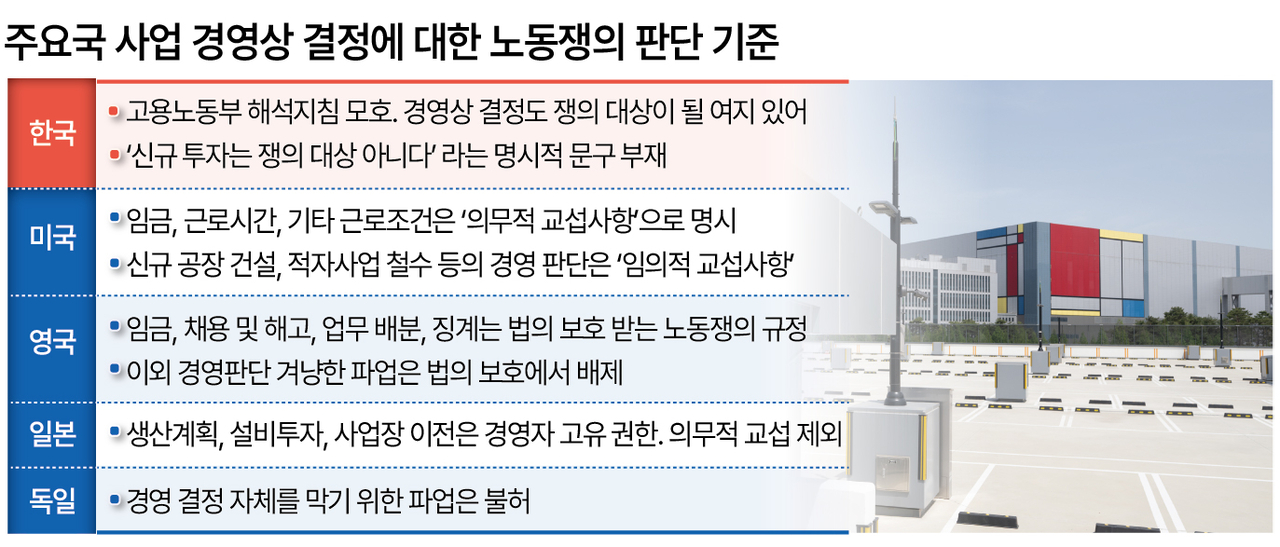
Major economies have made clear that management decisions — including investment, the opening or closing of factories, and business restructuring — are not matters subject to strike action.
The consequences of such decisions, however — including layoffs, job transfers and compensation — must be negotiated between labor and management. In effect, whether to build a new factory remains the company's call, but the resulting impact on workers must be addressed through follow-up negotiations.
In the United States, wages, working hours and other conditions of employment are designated "mandatory bargaining subjects" under the National Labor Relations Act, meaning companies cannot refuse a union's demand to negotiate over them.
By contrast, decisions such as entering new business lines, building new factories or exiting loss-making operations are classified as "permissive bargaining subjects." Companies may decline to negotiate over them even if a union requests talks, and unions cannot legally strike solely because such decisions were made without going through collective bargaining.
The United Kingdom's Trade Union and Labour Relations (Consolidation) Act enumerates a list of "protected industrial action" topics, covering pay and employment conditions, hiring and dismissal, work allocation and disciplinary matters.
A union's right to strike is protected only when a dispute concerns one of those listed topics. Strikes aimed directly at management decisions themselves — such as opposing the sale of a business unit or demanding the reversal of a factory closure — do not receive legal protection.
Japan, through court precedent, has similarly classified production planning, equipment investment and decisions on relocating workplaces as matters of "exclusive management prerogative," excluding them from mandatory bargaining. As a result, strikes carried out to demand the reversal of a factory closure are generally not recognized as legitimate.
Germany requires that workers' councils — bodies organized separately from unions — be informed and consulted in advance when major decisions such as plant closures are made. Companies must also draw up a "social plan," a compensation package covering severance payments and retraining support to cushion the economic blow to employees. Strikes aimed at blocking the management decision itself are not permitted.
'Labor ministry guidelines must include clear standards'
Voices are growing louder for South Korea to draw on the experiences of major economies and establish clearer boundaries around which management decisions are subject to labor disputes.
Revising the trade union law or establishing Supreme Court precedent would take years, so support is mounting for the Ministry of Employment and Labor to update its interpretive guidelines first — explicitly stating that management decisions such as new investment are not subject to labor disputes.
Specifically, advocates say the guidelines should set out concrete criteria distinguishing between workforce reassignments that entail significant changes to workers' status or conditions — such as mass layoffs or restructuring — and routine personnel redeployments that accompany ordinary investment or scale-up activities.
Clearer standards would prevent routine business activities such as new investment and expansion from being swept into the scope of labor disputes. They would also improve predictability for both labor and management, reducing drawn-out conflicts that drain resources on both sides.
"The point is not that major countries are unwilling to protect workers," a business community official said. "They protect workers by making the impact of a company's investment decisions on employees' lives a subject of negotiation and consultation. Business decisions should be left to the domain of management, and their effects should be addressed through negotiation."
joze@heraldcorp.com