Incheon customs officers arrest four for smuggling 1,024 used cars to sanctioned countries, disguised as third-country exports
Trade proceeds of 279.6 billion won laundered through virtual assets
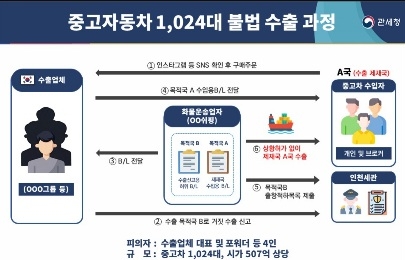
A group that illegally exported hundreds of billions of won worth of used cars to countries under international sanctions — and concealed the money trail by collecting trade proceeds in virtual assets — has been caught by Incheon customs authorities.
Incheon Main Customs said Monday it had arrested four people and referred them to prosecutors on charges of exporting 1,024 controlled used vehicles worth about 50.7 billion won ($36.8 million) to internationally sanctioned countries without authorization, and illegally receiving 279.6 billion won in trade proceeds through virtual assets.
The customs office also imposed an 11 billion won fine on the group for violations of the Foreign Exchange Transactions Act.
The investigation found that the suspects divided responsibilities among a foreign exporter, overseas brokers, freight forwarders and an unregistered foreign exchange operation to evade international sanctions and financial monitoring.
The group shipped controlled used vehicles with engine displacements exceeding 2,000cc to sanctioned countries while submitting falsified documents to customs declaring third countries as the destination.
During freight transport, the suspects listed a third country as the destination on documents submitted to customs while recording the sanctioned country on the actual shipping paperwork — a so-called "dual document" scheme designed to conceal the true final destination.
The payment method also differed from conventional illegal foreign exchange schemes.
Because international financial sanctions made normal bank transfers impossible, the group collected trade proceeds not in foreign currency but in virtual assets such as Tether (USDT), then moved the funds to the virtual asset wallets of an unregistered domestic foreign exchange operation.
The assets were subsequently sold on domestic virtual asset exchanges and converted into won, in an effort to obscure the actual flow of funds, customs officials said.
The case has drawn attention as a complex customs and foreign exchange crime that combined falsified export documents to circumvent international sanctions with virtual assets and unregistered foreign exchange transactions.
Incheon Main Customs received a tip-off in August last year and confirmed the long-running criminal structure through search and seizure operations at business premises, digital forensics, financial transaction analysis and virtual asset movement tracing.
The customs office said that when virtual assets are used to settle trade payments outside the normal foreign exchange reporting system, the practice not only undermines the transparency of financial flows but can also affect international cooperation on sanctions enforcement.
The Korea Customs Service said it had detected a total of 1.34 trillion won in trade security violations as of late July.
gilbert@heraldcorp.com