
Rep. Park Sung-hoon analyzes Korea Real Estate Board, Ministry of Statistics data
Home-buying timeline has grown by 5 years as prices soar
'Dream of owning a Seoul home on a salary is slipping further away'
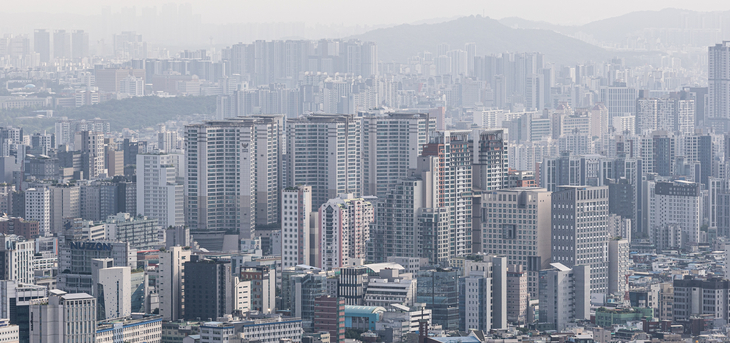
The homeownership ladder for ordinary salaried workers in South Korea is becoming increasingly out of reach, analysts and lawmakers say.
A new analysis finds that a salaried worker would need 12 years and five months of saving every single won of their income to afford a median-priced apartment in Seoul — a figure that stretches to 16 years when calculated on disposable income after taxes and social insurance contributions.
People Power Party lawmaker Park Sung-hoon, who represents Buk-gu in Busan and sits on the National Assembly's Political Affairs Committee, commissioned the National Assembly Research Service to analyze data from the Korea Real Estate Board and the Ministry of Statistics. The findings, released Friday, show that the median apartment price in Seoul this year stands at 971 million won ($703,000), while the average annualized income of urban wage-earning households is 78.12 million won.
Based on those figures, Park's office estimates that a household devoting its entire income to buying a home would need 12 years and five months to accumulate enough.
The timeline has fluctuated sharply over the past decade. It stood at 9.8 years in 2017, rose to 11.2 years in 2018 and 13.0 years in 2019, then held at 13.6 years in both 2020 and 2021 before peaking at 14.7 years in 2022. It eased to 12.3 years in 2023 and 11.9 years in both 2024 and 2025, but has climbed back to 12.4 years this year.
The divergence between home prices and wages tells the story. The median Seoul apartment sale price surged 69.9 percent from 523.16 million won in 2017 to 889 million won in 2025, while average annualized income for urban wage-earning households rose only 39.1 percent over the same period — from 53.58 million won to 74.51 million won. Home price growth outpaced income growth by roughly 31 percentage points.
Even under the unrealistic assumption that a household spends nothing at all, the time needed to buy a home lengthened by 2.1 years — from 9.8 years in 2017 to 11.9 years in 2025.
The picture is bleaker when disposable income is used as the baseline. Assuming a household puts all of its disposable income toward a home purchase, the time required soared from 12.2 years in 2017 to a peak of 18.6 years in 2022. It has since eased to 15.8 years in 2023, 15.2 years in 2024 and 15.3 years in 2025, but has risen again to 16.0 years this year.
While the median Seoul apartment price climbed 69.9 percent between 2017 and 2025, disposable income for urban wage-earning households grew by only 34.8 percent. As a result, the disposable-income-based home-buying timeline extended by 3.1 years, from 12.2 years to 15.3 years.
The analysis rests on a simplified assumption that households spend not a single won of their income or disposable income on living expenses, education or medical costs, directing everything toward a home purchase. Park's office noted that the figures also exclude mortgage interest and other financing costs, meaning the actual burden felt by households is likely far greater.
"The fact that you need to save every won of your salary for 12 years — or 16 years based on what you actually have to spend — just to buy a median-priced apartment in Seoul shows how distant the dream of homeownership has become for ordinary workers," Park said. "Home prices are rising far faster than incomes, and if the government keeps repeating the same cycle of tax and lending regulations alongside inconsistent supply measures, the housing ladder will only break further."
bigroot@heraldcorp.com




