
Muslim consumer market growing more than 6% annually
Country-specific strategies outlined for UAE, Indonesia, Malaysia
'KITA K-Halal Bridge' platform to support small businesses
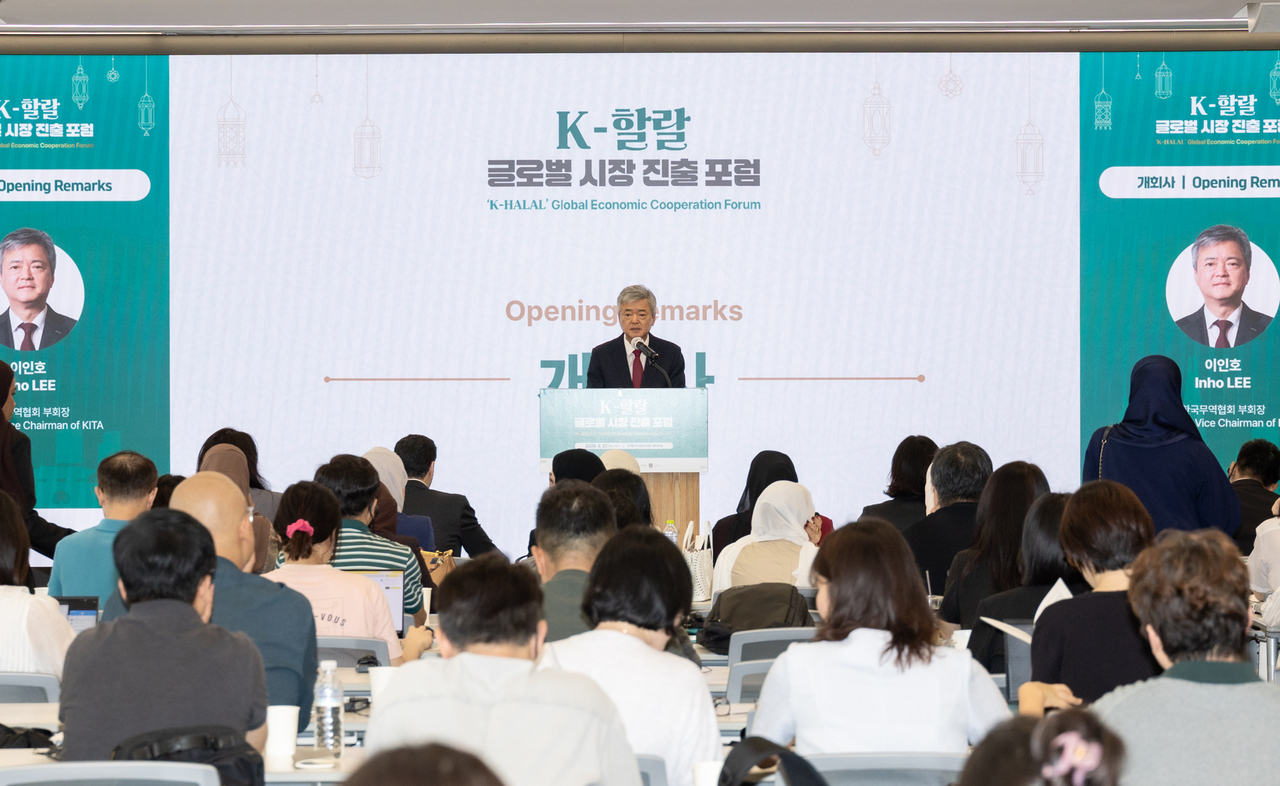
South Korean consumer goods companies gathered Thursday for an event designed to help them enter the halal market, which serves about 2 billion Muslim consumers — roughly one in four people worldwide. About eight in 10 consumers in major halal markets consider halal certification an essential factor when purchasing products.
The Korea International Trade Association (KITA) held the K-Halal Global Market Entry Forum on Thursday at Trade Tower in Samseong-dong, Gangnam-gu, Seoul. About 150 people attended, including KITA Vice Chairman Lee In-ho, UAE Ambassador to South Korea Jamal Abdullah Al Suwaidi, and representatives from companies interested in entering the halal market.
Muslims make up about 25 percent of the world's population, and the related consumer market is growing at an average annual rate of more than 6 percent. The global halal consumer goods import market alone is valued at around $400 billion a year.
"The halal market goes beyond religious standards to emphasize health and ethical consumption, and it holds strong growth potential driven by a young consumer base," Lee said. "We will spare no effort in supporting Korean consumer goods companies' entry into the halal market through the KITA K-Halal Bridge platform, leveraging our overseas network."
The forum stressed that companies must adopt different market-entry approaches depending on the country and product category — not simply obtain halal certification.
A KITA survey of consumers in five major countries found that 78.8 percent considered halal certification "essential" when buying consumer goods. However, the degree to which certification is valued varies by country, product category and consumer profile. Companies need product strategies tailored to local consumers and retail markets, not just certification.
Delma Firdaus, an analyst at DinarStandard Research, said South Korea has cultural familiarity built on K-content as well as competitive consumer goods. "When entering the halal market, companies should directly leverage their strengths in R&D, manufacturing and branding, while partnering with local distributors who have a deep understanding of the market," she said.
Strategies also differ by country. Joo Yuni, a director at Trade Partners, advised that the UAE serves as a re-export hub thanks to its logistics infrastructure, Indonesia offers a large consumer base that can anchor production, and Malaysia leads in halal standards — each requiring a distinct approach.
Jeong Min-jae, a director at EC21 R&C, said premium product competitiveness matters more in the Middle East, while the speed of response to regulatory changes — such as mandatory halal certification requirements — will be a key variable for market entry in Southeast Asia.
Indonesia is set to fully enforce mandatory halal certification from October. KITA held a separate seminar in June to help domestic exporters navigate the regulatory changes, providing guidance on certification procedures and response measures.
KITA opened K-Halal Bridge offices at its UAE and Jakarta branches in June as bases for halal market development. Through these offices, KITA supports market research, export consulting and cooperation with local governments and institutions, helping small and midsize consumer goods companies diversify their export markets.
kwater@heraldcorp.com




