![Pyo Chang-won, director of the Pyo Chang-won Institute of Criminal Science. [Captured from MBC Radio 'News High Kick with Jo Seung-won' YouTube]](https://wimg.heraldcorp.com/news/cms/2026/08/28/news-p.v1.20260828.f44aa36a272f42458227e9cd0206c07f_P1.png)
Although police have tentatively attributed the death of Jang Mi-ran — found dead 104 days after going missing on Jeju — to hanging, a forensic expert said Thursday that a fractured hyoid bone alone cannot rule out strangulation by another person.
Pyo Chang-won, director of the Pyo Chang-won Institute of Criminal Science, appeared on MBC Radio's "News High Kick with Jo Seung-won" on Thursday and said that because Jang's remains were found in a skeletonized state more than three months after she disappeared, determining the exact time and cause of death would be extremely difficult.
Asked whether the precise time of death could be established, Pyo said, "When decomposition has progressed to the point of saponification or skeletonization, estimating the time of death becomes nearly impossible."
He then drew a parallel with the 2014 case of Yoo Byung-eun, the former chairman of the Semo Group, whose badly decomposed body was found in a plum orchard in Suncheon, South Jeolla Province.
"As you may recall, the controversy surrounding Chairman Yoo dragged on for a very long time," Pyo said. "Even after prolonged decomposition, toxins can sometimes be detected in bone, and fractures or signs of trauma are immediately apparent — but without those, establishing the cause of death is very difficult."
Pyo particularly cautioned against concluding that Jang took her own life based solely on the fracture found in her neck area.
"There is a slender, easily fractured bone at the front of the throat called the hyoid," he said. "This bone can fracture not only in cases of death by hanging but also in cases of death by strangulation."
He added that while asphyxiation from compression of the throat could be inferred, "it has become forensically impossible to determine whether this was a self-inflicted hanging or whether someone else strangled the victim to death."
Pyo also addressed the police estimate that Jang died in the early hours of the morning after she went missing on the night of May 12, saying that assessment was based on circumstantial evidence rather than forensic analysis.
On why a corporal surnamed Bu, attached to the Jeju Western Police Station and facing charges of falsely closing Jang's missing persons report, selected "traffic accident death" as the reason for closing the case, Pyo said he could only speculate that Bu "had the intention of leaving absolutely no record, and thought that traffic accident death would be the most plausible and least problematic category to choose."
Pyo explained that classifying the case as a homicide or suspicious death would trigger follow-up procedures, whereas a "traffic accident death" entry, once deleted, leaves no trace in the records.
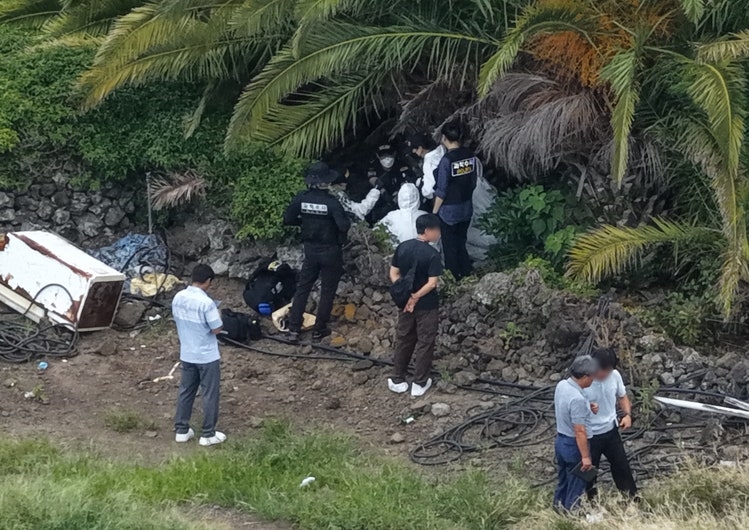
Jang was last seen on closed-circuit television near Hallim-eup in Jeju on May 12, after which she was reported missing. Her body was found at 10:46 a.m. Monday at a palm tree farm in Hallim-eup, Jeju, following an extensive police search.
Police said they found no signs of criminal activity based on the condition of the scene and autopsy results, and the National Forensic Service issued an opinion that hanging could be considered a possible cause of death.
Corporal Bu, who received the missing persons report concerning Jang in May, has been taken into detention on charges including dereliction of duty, forgery and use of electronic public records, and obstruction of official duties by deception.
yeonjoo7@heraldcorp.com