Floor area ratio and height limits eased, maximum development cap scrapped — paving the way for large-scale mixed-use projects
Tourism accommodation zone introduced to build a combined business, culture and tourism hub for southeast Seoul
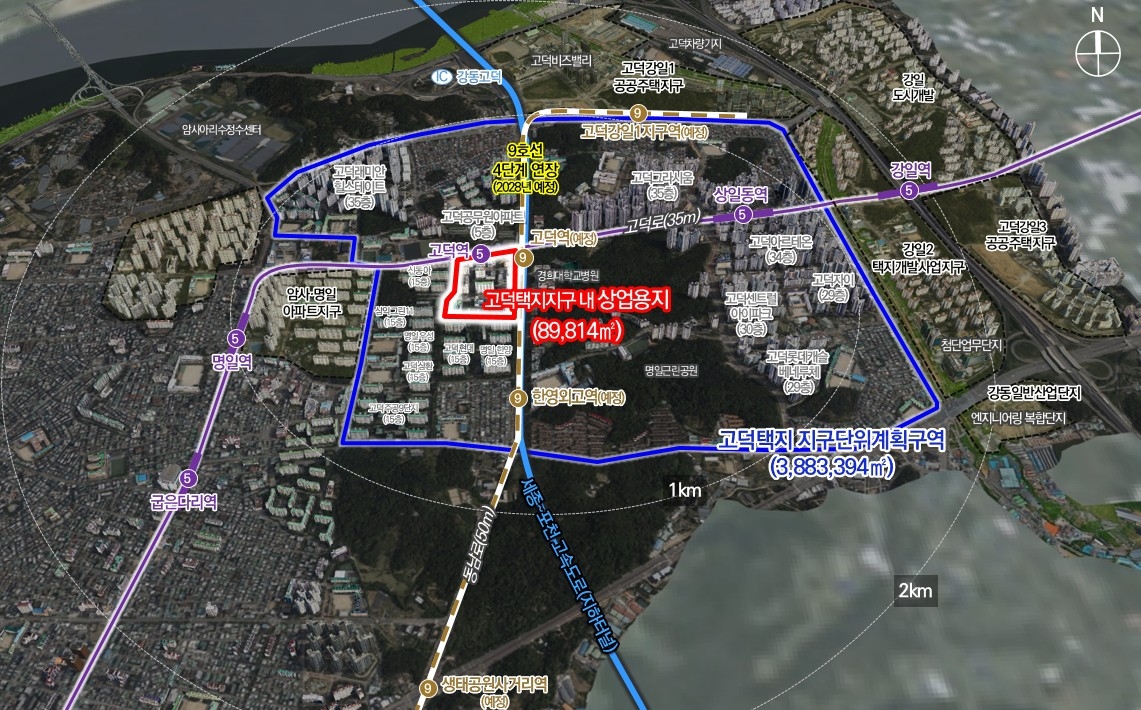
Gangdong-gu will ease floor area ratios and building height limits on commercial land in Myeongil-dong and introduce a tourism accommodation zone, dramatically improving development conditions to transform the area into a new lifestyle hub for southeast Seoul — one that blends business, culture and tourism.
Under the plan, the base floor area ratio for the roughly 89,000-square-meter commercial site around 47 Myeongil-dong will be raised to 800 percent, with an allowable ratio of up to 880 percent. Building heights will also be relaxed in consideration of the central district's skyline: up to 160 meters along arterial roads and up to 110 meters on interior streets.
In addition, the cap on maximum development scale will be abolished, enabling large-scale, mixed-use development across multiple lots.
A tourism accommodation zone will also be introduced to cultivate the area as a mixed-use hub encompassing not only business and commercial functions but also culture and tourism. The aim is to strengthen the central role of the Myeongil-dong commercial site — the only commercial zone within the Godeok housing district — and boost the self-sufficiency and urban competitiveness of southeast Seoul.
The revised district unit plan for the Godeok housing district (Myeongil-dong commercial site) was approved Wednesday at the 14th Joint Urban and Architecture Committee of the Seoul Metropolitan Government.
The site is the only commercial zone within the Godeok housing district and sits near Godeok Biz Valley and an advanced business complex, giving it strong potential to emerge as a new economic and commercial center for the area. Broader transportation access and residential and lifestyle infrastructure have continued to improve with the recent opening of the Anseong–Guri section of the Sejong–Pocheon Expressway and the progress of large-scale reconstruction projects.
The site's prospects are set to improve further when the planned Line 9 extension connects to Godeok Station on Line 5 in 2028, creating a transfer hub for both lines. The district plans to actively reflect these changing transportation conditions in its urban planning, developing the Myeongil-dong commercial site into a pedestrian-oriented, next-generation transit-oriented area.
Open public spaces will be expanded around subway entrances and major pedestrian routes, and an underground passage will link the Godeok-ro subway station with surrounding buildings to improve walkability. A three-dimensional pedestrian network connecting above- and below-ground levels will be built to enhance both accessibility and vitality in the commercial zone.
Through this revision to the district unit plan, the Myeongil-dong commercial site is expected to evolve beyond a conventional commercial zone into a mixed-use hub for southeast Seoul that combines business, culture, tourism and regional transit functions. Easing regulations on development scale and density is expected to spur private-sector development and accelerate the creation of new jobs and lifestyle and cultural spaces linked to surrounding hubs such as Godeok Biz Valley.
The district will proceed with a public re-notification reflecting the decisions made at this review. The Seoul Metropolitan Government is then expected to finalize and officially announce the revised Godeok housing district (Myeongil-dong commercial site) district unit plan between September and October.
Gangdong-gu District Mayor Lee Su-hee said the improvements to development conditions — including eased floor area ratios and height limits — along with strengthened business, culture and tourism functions had laid the groundwork for the Myeongil-dong commercial site to grow into a jobs hub representing southeast Seoul and a next-generation transit-oriented area. "Going forward, we will continue to develop systematic urban plans that reflect the district's unique character and the evolving urban environment, creating a 'Wannabe Gangdong' that southeast Seoul aspires to, and further enhancing Gangdong-gu's urban competitiveness," she said.
seouldream01@heraldcorp.com