Business establishments employed about 20.718 million workers in July, up 1.1% from a year earlier
Permanent-staff headcount rose by 78,000 while temporary and daily workers jumped by 147,000
Involuntary separations surged 24.3%, with temporary and daily workers accounting for 87.6%
Nominal wages rose 3.1% in June, but real wages slipped 0.1%
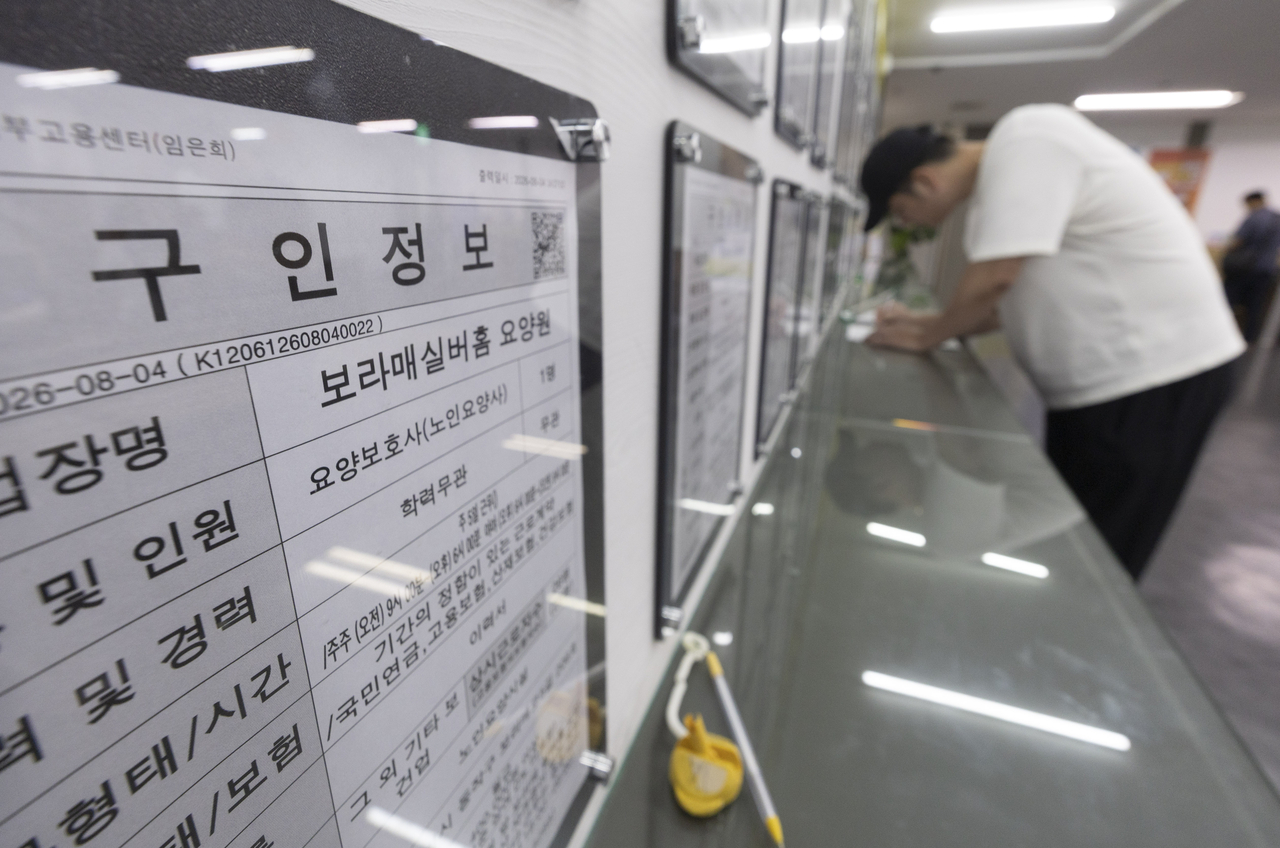
The number of workers at domestic business establishments rose by 226,000 from a year earlier, but 65 percent of that gain came from temporary and daily workers. Real wages, adjusted for inflation, fell for a third consecutive month, eroding workers' actual purchasing power.
According to the Ministry of Employment and Labor's "July 2026 Business Labor Force Survey" released Thursday, establishments with at least one employee had about 20.718 million workers as of the last business day of last month — an increase of 226,000, or 1.1 percent, from the same month a year ago.
By employment type, the number of permanent workers rose by 78,000, or 0.5 percent, while temporary and daily workers jumped by 147,000, or 7.6 percent — accounting for 65.0 percent of the total increase. Other workers grew by 1,000, or 0.1 percent.
By establishment size, workplaces with fewer than 300 permanent employees had about 17.025 million workers, up 164,000, or 1.0 percent. Those with 300 or more permanent employees had about 3.693 million workers, up 62,000, or 1.7 percent.
Health and welfare sector adds 119,000; wholesale and retail sheds 28,000
![[Provided by the Ministry of Employment and Labor]](https://wimg.heraldcorp.com/news/cms/2026/08/27/news-p.v1.20260827.ffba797e013d4db6a3a5635a7cb12763_P1.jpg)
By industry, the health and social welfare services sector posted the largest gain, adding 119,000 workers, or 4.6 percent. Finance and insurance grew by 27,000, or 3.1 percent, and professional, scientific and technology services added 25,000, or 1.8 percent.
Wholesale and retail trade shed 28,000 workers, a decline of 1.2 percent. Arts, sports and leisure-related services fell by 9,000, or 2.7 percent, and information and communications dropped by 2,000, or 0.3 percent.
Manufacturing, which accounts for roughly 18 percent of all business establishment workers, added 14,000 jobs. The sector's monthly gains have expanded steadily — from 3,000 in April to 7,000 in May, 12,000 in June and 14,000 in July.
Labor market turnover also rose sharply. New hires last month totaled about 1.143 million, up 177,000, or 18.3 percent, from a year earlier, while separations reached about 1.127 million, up 178,000, or 18.8 percent. Both the hiring rate and the separation rate stood at 5.9 percent and 5.8 percent, respectively, each up 0.9 percentage points from a year ago.
Among new hires, recruited workers numbered about 1.029 million, up 168,000, or 19.6 percent. Permanent-staff recruitment rose by 36,000, or 11.3 percent, to 357,000, while temporary and daily worker recruitment jumped by 132,000, or 24.5 percent, to 672,000.
Construction posted the largest sectoral gain in hiring, adding 61,000 workers from a year earlier, followed by accommodation and food services with 25,000. Education services and information and communications each saw hiring fall, by 2,000 and 1,000, respectively.
Among separations by reason, voluntary departures rose by 42,000, or 14.6 percent, to 327,000. Involuntary separations — including contract expirations, restructuring, mergers and dismissals — jumped by 131,000, or 24.3 percent, to 669,000.
Temporary and daily workers accounted for 586,000, or 87.6 percent, of all involuntary separations, up 117,000, or 24.9 percent, from a year earlier. By industry, construction and accommodation and food services recorded the largest increases in involuntary separations, adding 61,000 and 21,000, respectively.
Nominal wages up 3.1%, but inflation wipes out gains — real wages down 0.1%
![[Provided by the Ministry of Employment and Labor]](https://wimg.heraldcorp.com/news/cms/2026/08/27/news-p.v1.20260827.374ec00233dd4d01a742312df9d4a404_P1.png)
Nominal wages rose, but real wages adjusted for inflation remained in negative territory.
The average monthly wage per worker at establishments with at least one permanent employee came to 4.094 million won ($2,960) in June, up 123,000 won, or 3.1 percent, from the same month a year ago.
The real wage per worker, adjusted for June price levels, fell to 3.412 million won from 3.414 million won a year earlier — a decline of 2,000 won, or 0.1 percent. The nominal wage increase was effectively wiped out by inflation, reducing workers' real purchasing power.
Real wages have now fallen for three consecutive months since April. In May, nominal wages grew just 1.7 percent while real wages dropped 1.4 percent. The pace of decline narrowed in June, but the downward trend continued.
By employment type, the average monthly nominal wage for permanent workers was 4.375 million won, up 3.6 percent from a year earlier. Temporary and daily workers earned 1.773 million won, up 3.8 percent.
For permanent workers, regular pay rose 2.2 percent to 3.713 million won, while overtime pay climbed 6.2 percent to 283,000 won. Special allowances jumped 17.2 percent to 379,000 won, driven by retroactive pay raises and expanded performance bonuses in semiconductor-related industries.
By establishment size, the average monthly nominal wage at workplaces with fewer than 300 employees was 3.698 million won, up 2.3 percent. At establishments with 300 or more employees, it was 5.933 million won, up 4.4 percent. The wage gap between the two groups stood at 2.235 million won.
The average monthly working hours per worker in June came to 157.6 hours, up 10.4 hours, or 7.1 percent, from a year earlier, largely because the number of working days on the calendar rose by two — from 19 to 21 — compared with last year.
fact0514@heraldcorp.com