Ancient Mahan to the future: reestablishing the historical, cultural and ecological value of the Yeongsan River
60 participants to be recruited through Sept. 3; field trip to riverside pavilions set for Oct. 3
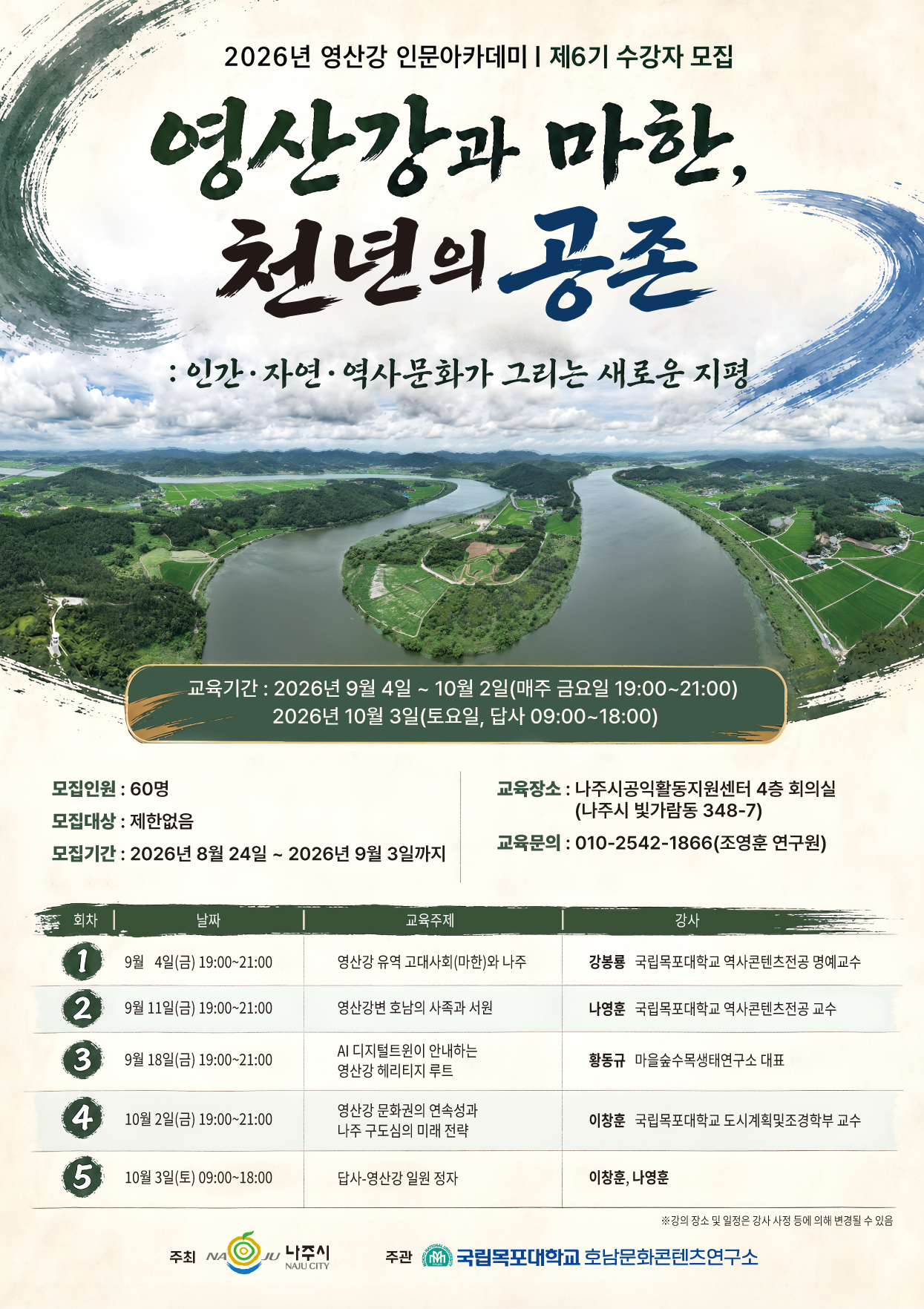
Naju is inviting residents to rediscover the historical, cultural and ecological value of the Yeongsan River — from the ancient Mahan kingdom to contemporary life and the city's future — through a new public lecture series.
The city announced Wednesday it is accepting applications through Sept. 3 for the sixth cohort of the Yeongsan River Humanities Academy 2026.
The program will admit 60 participants with no eligibility restrictions; anyone may attend by arriving at the venue before a session begins.
This year's academy runs under the theme "The Yeongsan River and Mahan: A Millennium of Coexistence — A New Horizon Drawn by People, Nature, History and Culture," with five sessions held from Sept. 4 through Oct. 3.
The program focuses on the historical, cultural and ecological legacy of the Yeongsan River since the Mahan era. It also seeks ways to preserve and make use of local heritage through digital technologies such as AI and spatial information, while pursuing integrated conservation and community development alongside citizens.
Sessions one through four will be held every Friday from 7 p.m. to 9 p.m. in the main conference room of the Naju Civic Activity Support Center in Bitgaram-dong.
The opening lecture on Sept. 4 will be delivered by Kang Bong-ryong, professor emeritus of the history content program at Mokpo National University. His talk, "Ancient Society (Mahan) in the Yeongsan River Basin and Naju," will examine the historical significance of the basin during the Mahan period and its connection to Naju.
On Sept. 11, Na Yeong-hun, a professor in the same program at Mokpo National University, will explore the history of local scholarly clans and seowon — traditional Confucian academies — that developed along the Yeongsan River, in a lecture titled "Honam's Sajok and Seowon Along the Yeongsan River."
On Sept. 18, Hwang Dong-gyu, head of a village forest and arboricultural ecology research institute, will present "Yeongsan River Heritage Routes Guided by AI Digital Twins," introducing new possibilities for preserving and utilizing the river's cultural heritage through advanced technologies including AI and digital twin systems.
On Oct. 2, Lee Chang-hun, a professor in the urban planning and landscape architecture department at Mokpo National University, will discuss future directions for Naju's old city center based on the historical continuity of the Yeongsan River cultural sphere, in a lecture titled "Continuity of the Yeongsan River Cultural Zone and Future Strategies for Naju's Old Downtown."
The fifth and final session on Oct. 3 will run from 9 a.m. to 6 p.m. as a field trip to traditional pavilions along the Yeongsan River, led by professors Lee and Na.
The academy treats the Yeongsan River not merely as a waterway but as a treasured asset of Naju in which the lives, history and culture of its people have accumulated since the Mahan era. The curriculum spans ancient history and seowon culture through cutting-edge digital technology and urban regeneration, bridging past, present and future.
The program also aims to extend classroom learning into the field, allowing citizens to see and experience the river's historical and cultural resources firsthand and discover the value of their region anew.
"The Yeongsan River Humanities Academy has continued for six years, combining academic depth with civic participation as one of Naju's signature humanities programs," a city official said. "This year's program covers a wide range from the Mahan cultural sphere to the preservation and use of cultural heritage through digital technology and the future of Naju's old downtown. We hope it will be a meaningful opportunity for participants to discover the value the Yeongsan River holds."
kkm9971@heraldcorp.com