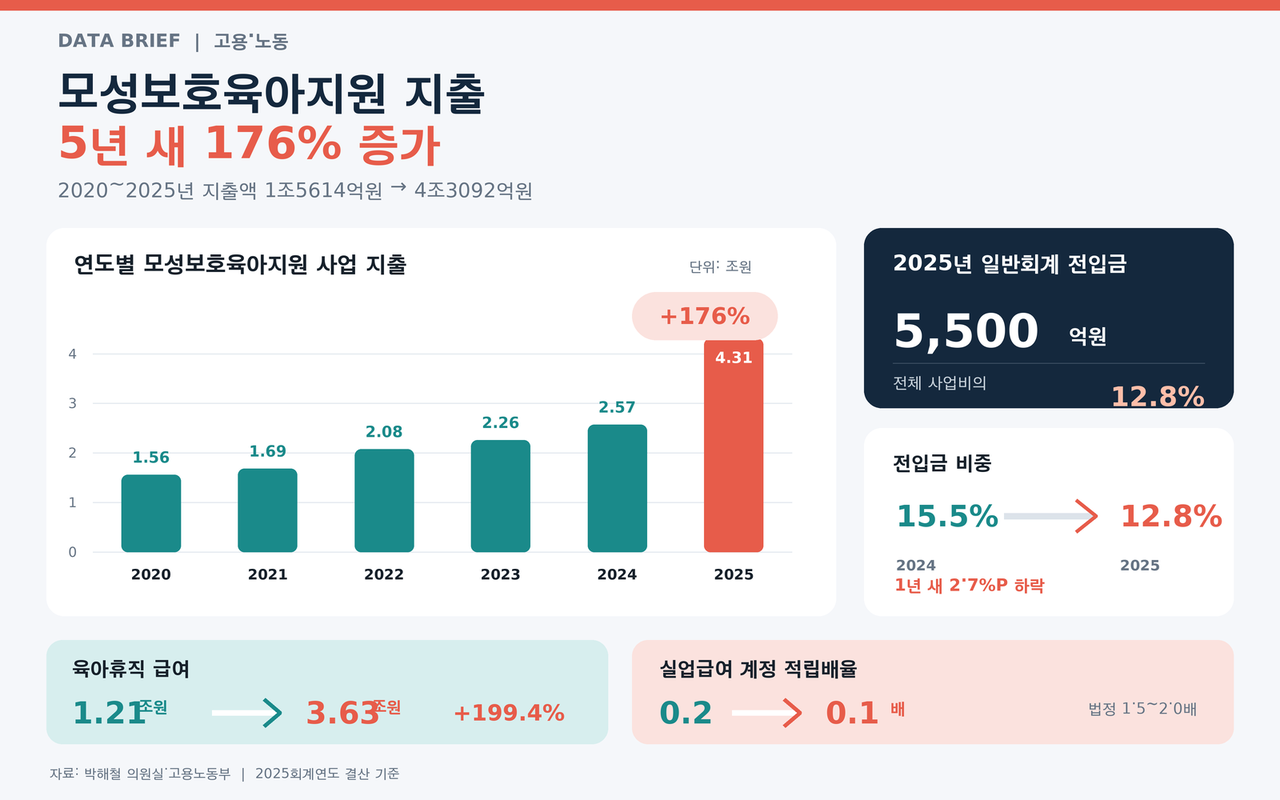
Spending on maternity and parental support programs — including parental leave benefits — surged 176 percent over five years, topping 4.3 trillion won ($3.11 billion) last year. Yet the share of program costs covered by the government's general account fell to just 12.8 percent.
Critics say the rising costs of work-family balance policies are being concentrated in the employment insurance fund, whose fiscal reserves are already stretched thin.
An analysis of the Ministry of Employment and Labor's fiscal year 2025 settlement review report by Democratic Party of Korea lawmaker Park Hae-cheol, a member of the National Assembly's Climate, Energy, Environment and Labor Committee, found that maternity and parental support spending reached 4.31 trillion won last year.
That marks an increase of 2.75 trillion won, or 176 percent, from 1.56 trillion won in 2020. Spending consistently rose year by year — 1.69 trillion won in 2021, 2.08 trillion won in 2022, 2.26 trillion won in 2023 and 2.57 trillion won in 2024. Last year's figure jumped 1.74 trillion won, or 67.4 percent, from the previous year.
The maternity and parental support program covers benefits for maternity leave, miscarriage and stillbirth leave, parental leave, reduced working hours for child-rearing, paternity leave and infertility treatment leave.
Parental leave benefits saw the sharpest increase. Payouts rose from 1.21 trillion won in 2020 to 3.63 trillion won last year — a jump of 2.42 trillion won, or 199.4 percent. The number of recipients also grew over the same period, from 112,038 to 184,329, an increase of 72,291, or 64.5 percent.
Benefits for reduced working hours during child-rearing more than quadrupled, climbing from 55 billion won in 2020 to 228.2 billion won last year. The number of recipients rose from 14,698 to 39,400, an increase of 24,702, or 168.1 percent.
Despite the rapid rise in program spending, general account transfers failed to keep pace. The general account transfer into the maternity and parental support program last year was limited to 550 billion won, covering just 12.8 percent of total outlays.
The transfer itself increased by 150 billion won from 400 billion won in 2024, but because overall program spending grew at a faster rate, the general account's share fell 2.7 percentage points, from 15.5 percent to 12.8 percent. The share had stood at 14.4 percent in 2022, 13.3 percent in 2023 and 15.5 percent in 2024.
As a result, the share of the employment insurance fund's unemployment benefit account consumed by maternity and parental support programs more than doubled, rising from 11.7 percent in 2021 to 24.6 percent last year. Roughly one-quarter of the unemployment benefit account's total outlays of 17.46 trillion won last year went to maternity and parental support programs.
The employment insurance fund's fiscal health has also deteriorated sharply. Year-end reserves in the unemployment benefit account fell by roughly half in a single year, dropping from 3.51 trillion won in 2024 to 1.73 trillion won last year. The reserve ratio — which measures reserves against total outlays — fell from 0.2x to 0.1x, far below the legally required range of 1.5x to less than 2x.
"Maternity and parental support is not a matter for individual workers to handle alone — it is a social responsibility the state must share," Park said. "We need to substantially increase general account transfers in line with program expansion and put in place measures to secure the fiscal soundness of the employment insurance fund."
fact0514@heraldcorp.com