Nine out of 10 Koreans aged 65 or older receive some form of pension, yet more than half of recipients take home less than 500,000 won ($362) a month, according to government data released Tuesday. Women's average pension benefit falls short of 60 percent of men's, and non-homeowners receive on average more than 330,000 won less per month than homeowners.
The Ministry of Statistics released its "2024 Pension Statistics" on Tuesday, showing that about 9.122 million people aged 65 or older received at least one type of pension — including the basic pension and the national pension — in 2024, up 486,000, or 5.6 percent, from the previous year.
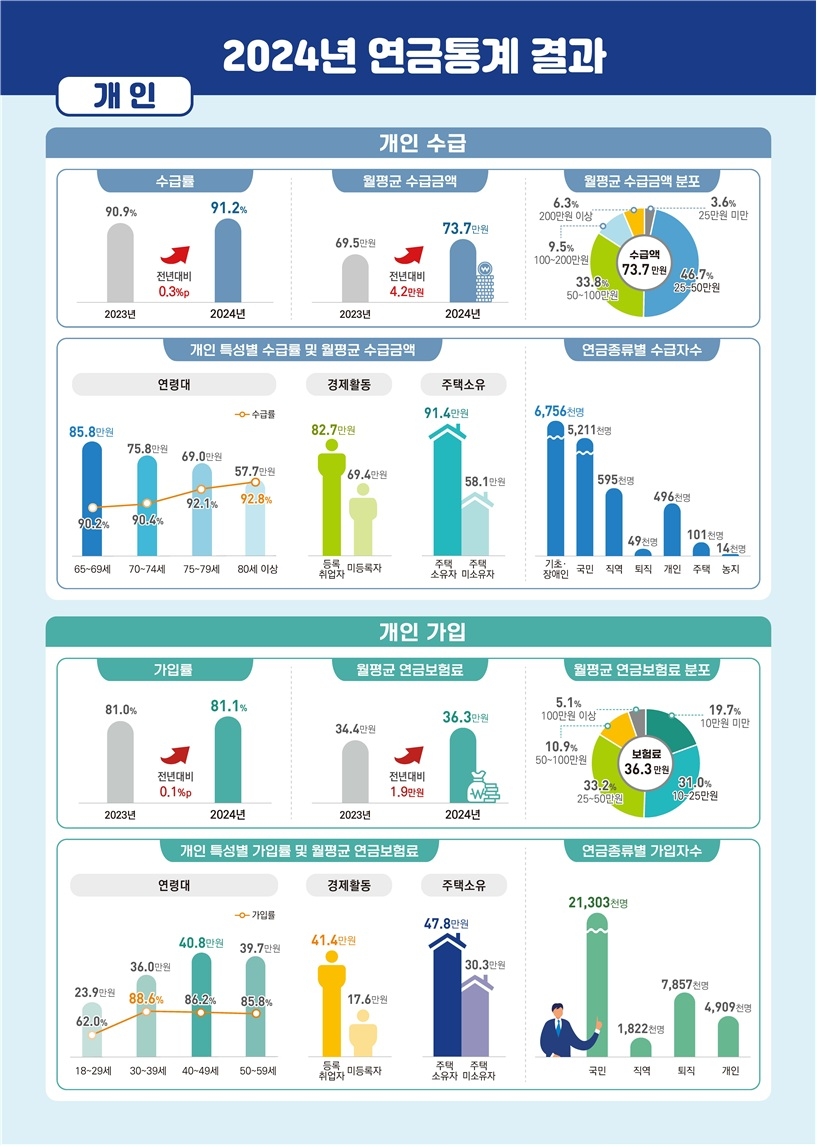
Among the roughly 10 million Koreans aged 65 or older, 91.2 percent received a pension, up 0.3 percentage points from the previous year. Still, about 878,000 people — 8.8 percent of the age group — received nothing at all.
Despite the higher coverage rate, actual benefit amounts fell well short of what is needed to support a comfortable retirement. The average monthly pension benefit was 737,000 won, up 42,000 won, or 6.0 percent, from the year before. The median benefit, however, was limited to 497,000 won.
Some 46.7 percent of recipients received between 250,000 and 500,000 won a month, while 3.6 percent received less than 250,000 won — meaning 50.3 percent of all recipients lived on less than 500,000 won a month. Another 33.8 percent received between 500,000 won and 1 million won, 9.5 percent received between 1 million and 2 million won, and 6.3 percent received 2 million won or more.
The gender gap in pension benefits was also stark. Men received an average of 957,000 won a month, while women received only 546,000 won — just 57 percent of the male average. The coverage rate also differed significantly: 95.5 percent for men versus 87.8 percent for women, a gap of 7.7 percentage points.
By age group, those between 65 and 69 received the highest average monthly benefit at 858,000 won, followed by 758,000 won for the 70–74 group, 690,000 won for the 75–79 group, and 577,000 won for those 80 and older — a clear decline with age. Analysts attribute this pattern to historically lower rates of economic participation among women and shorter national pension enrollment periods in older cohorts.
Asset ownership also produced a sharp divide. Homeowners received an average of 914,000 won a month, compared with 581,000 won for non-homeowners — a gap of 333,000 won. Recipients whose homes had a publicly assessed value exceeding 1.2 billion won averaged 1.77 million won a month, while those owning homes valued at 60 million won or less received an average of 641,000 won.
By pension type, about 6.756 million people — 74.1 percent of all recipients — received the basic pension or disability pension. National pension recipients numbered about 5.211 million, or 57.1 percent of the total. Average monthly benefits by type were: 300,000 won for the basic pension, 491,000 won for the national pension, 2.78 million won for occupational pensions, and 997,000 won for retirement pensions.
Among households that include at least one person aged 65 or older, about 6.831 million had at least one pension recipient — up 317,000 households, or 4.9 percent, from the previous year. The average monthly pension for recipient households was 959,000 won, though the median stood at 670,000 won. Single-person households received an average of 657,000 won a month, while single-generation couples received 1.32 million won.
The number of active pension enrollees — who will form the future base of retirement income — declined. The number of enrollees aged 18 to 59 fell by 258,000, or 1.1 percent, to about 23.484 million. The enrollment rate edged up 0.1 percentage points to 81.1 percent as the overall population in that age group shrank, but about 5.476 million people in the bracket still had no pension coverage.
Particularly notable was the drop among those aged 18 to 29: enrollment fell by 267,000, or 6.1 percent, to about 4.127 million, and the enrollment rate dropped 1.5 percentage points to 62.0 percent, down from 63.5 percent. By contrast, enrollment rates were 88.6 percent for those in their 30s, 86.2 percent for those in their 40s, and 85.8 percent for those in their 50s.
Among the roughly 4.105 million people aged 60 to 64 — the cohort straddling the national pension eligibility age — only about 1.824 million were receiving a pension, a coverage rate of 44.4 percent. More than half, about 2.281 million people, received no pension at all. The pension enrollment rate for this age group was also limited to 43.1 percent, pointing to a significant population caught in the gap between employment income and pension eligibility.
fact0514@heraldcorp.com