![A still from a video posted by a Chinese blogger exposing the alleged use of formaldehyde on cabbage [Yonhap]](https://wimg.heraldcorp.com/news/cms/2026/08/25/news-p.v1.20260825.ebf3be4358764e0baa2da3bef656f802_P1.jpg)
Consumer anxiety is mounting in South Korea after reports emerged that some cabbage growers in China had used formaldehyde — a Group 1 carcinogen — to keep the vegetable fresh. The alarm is amplified by the fact that imports of Chinese kimchi have reached record levels.
On Tuesday, posts warning about the formaldehyde-treated cabbage spread rapidly across social media platforms, including parenting community forums. "Almost all the kimchi served at restaurants is Chinese-made," read one widely shared message, while another cautioned that "most of the salted cabbage used for kimjang kimchi-making is also from China." Formaldehyde is classified as a Group 1 carcinogen by the International Agency for Research on Cancer, a body under the World Health Organization. It is commonly used in industrial applications, disinfection and the preservation of biological tissue.
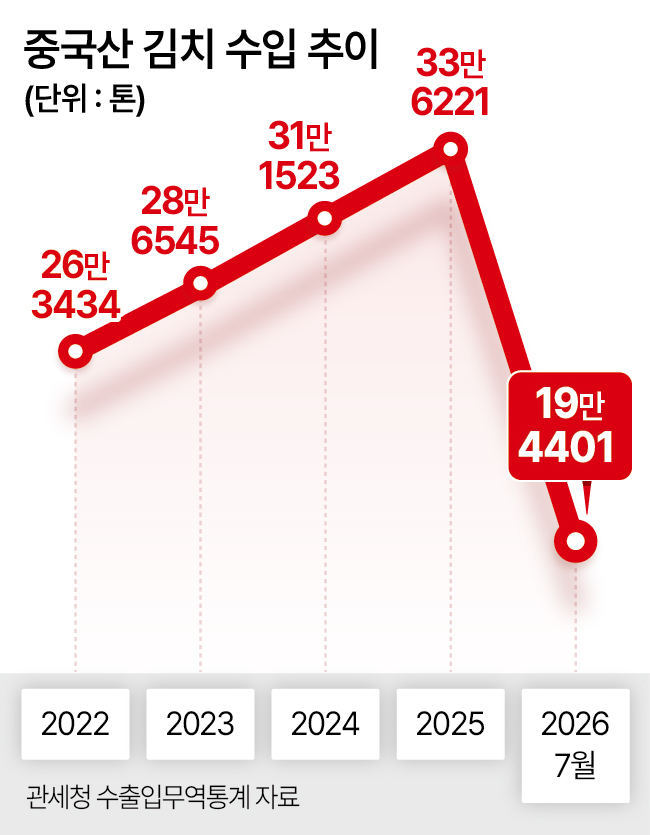
Surging import volumes have deepened the concern. Chinese kimchi, which accounts for 99 percent of all kimchi imported into South Korea, has grown steadily year after year. According to Korea Customs Service trade statistics, imports of Chinese kimchi reached a record 336,221 tons last year, a 39.7 percent increase over the past five years (2021–2025). This year, 194,401 tons had already arrived through July, putting the full-year total on track to set another record.
The restaurant industry is the largest consumer of Chinese kimchi. According to the Korea Rural Economic Institute's 2025 Kimchi Industry Survey Statistical Report, 44.1 percent of restaurant operators serve imported kimchi as banchan — up roughly 1.6 times from 28.1 percent in 2020. For kimchi used as a cooking ingredient, the import share exceeds half, at 51.0 percent.
The reason is straightforward: nearly half of businesses using imported kimchi (49.0 percent) cited lower prices, while 20.3 percent said they preferred it for price stability. A 10-kilogram commercial pack of Chinese cabbage kimchi sells online for around 15,000 won ($11), roughly half the 30,000–40,000 won range for the domestic equivalent.
Consumer advocacy groups are watching the situation closely. An official at the Korea Consumer Association said no consumer inquiries related to Chinese cabbage had come in yet, but added that the group was monitoring developments carefully.
The restaurant industry, meanwhile, is bracing for fallout. A franchise industry official noted that a similar controversy over a video showing Chinese salted cabbage had triggered a government investigation in 2021. "We use Chinese kimchi because of the cost — we have no choice," the official said. "What worries us is that this could lead to a drop in consumption or new regulations."
The controversy began with a video posted by a Chinese blogger alleging that farmers in some rural areas of China had applied formaldehyde to cabbage to extend its shelf life. The Chinese government has launched a special investigation to trace the distribution of the cabbage in question. South Korea's Ministry of Food and Drug Safety said Monday it was working through the Chinese embassy and other channels to determine whether any of the affected cabbage had been imported into the country. It said inspections of Chinese cabbage at customs had been tightened and that further action would be taken if additional information came to light.
spa@heraldcorp.com