
![A dense villa neighborhood in Seoul where a fast-track integrated planning redevelopment scheme has been drawn up. [Herald Business DB]](https://wimg.heraldcorp.com/news/cms/2026/08/25/news-p.v1.20250512.b6f8ea6c771e46729acf9b983333faef_P1.jpg)
A push by the government and the Democratic Party of Korea to transfer authority over designating redevelopment and reconstruction zones for projects of 500 units or fewer from the Seoul Metropolitan Government to individual district offices is raising fears of uncoordinated, piecemeal development. Critics warn that the 500-unit threshold could itself become a new regulatory boundary — one that incentivizes developers to carve up larger sites or pursue projects disconnected from surrounding neighborhoods.
According to political sources, the ruling party and government discussed the transfer of zone-designation authority at a senior party-government consultative meeting held Monday. Seoul city officials say the practical effect on timelines would be modest: seven of the nine key permits involved in redevelopment projects are already handled at the district level, and the city's own review processes — zone designation and integrated project implementation reviews — take only about four months in total.
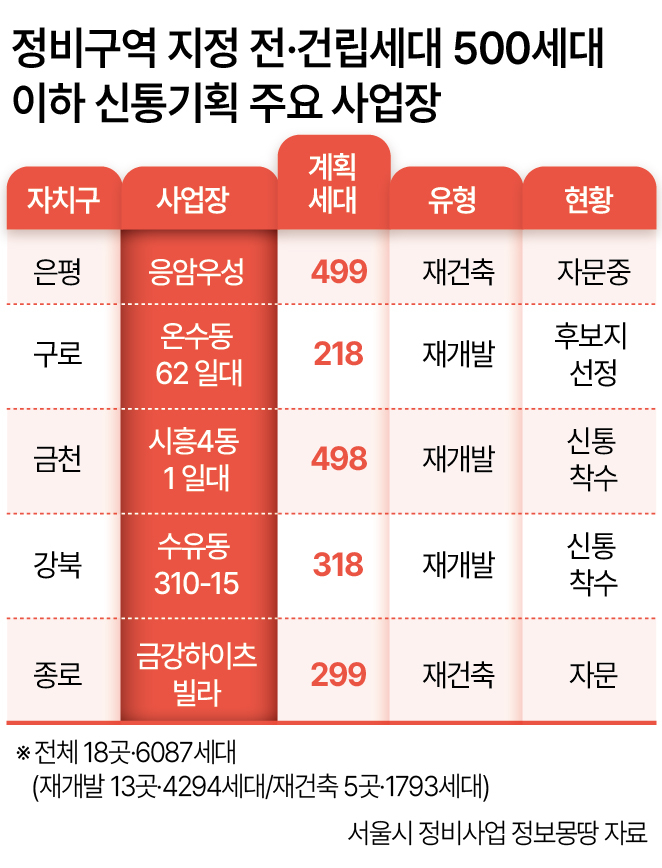
If the transfer goes ahead, the projects most immediately affected would be those that have not yet received zone designation. Data published Tuesday by the Seoul Metropolitan Government's redevelopment project information portal show that of 132 fast-track integrated planning redevelopment and reconstruction projects still awaiting zone designation — covering 160,555 units in total — 18 projects comprising 6,087 units fall at or below the 500-unit threshold. Of those, 13 are redevelopment projects (4,294 units) and five are reconstruction projects (1,793 units), with many located on small and mid-sized sites in Seoul's outer districts.
In Guro-gu's Onsu-dong 62 area, a redevelopment project covering roughly 10,927 square meters is planned for 218 units. When the site was selected, it was subject to conditions requiring a review of the appropriate zone boundary — including possible exclusions — in light of resident opposition. Guro-gu has since conducted a resident survey and is reviewing adjustments to the zone boundary. Experts say that if zone-designation authority shifts to district offices, the criteria applied could vary significantly from one district to another.
A redevelopment project in Geumcheon-gu's Siheung 4-dong 1 area is planned for 498 units — just below the 500-unit threshold. If the authority transfer goes ahead, sites near that boundary could face pressure to keep their unit counts under 500, potentially discouraging integrated development with adjacent areas in favor of standalone projects.
In Jongno-gu, a reconstruction plan is also under way for the Geumgang Heights Villa complex, which has 299 units and includes a proposal to rezone the site from a first-category general residential zone to a second-category general residential zone. Even if zone-designation authority is devolved to district offices, major urban planning decisions such as zoning changes would still require Seoul city review — raising the prospect of additional coordination between the two levels of government.
Kim Jun-yong, chairman of the Seoul Redevelopment Project Association, said consistency in policy is critical for redevelopment projects and warned that devolving zone-designation authority could lead to divergent decisions across districts. "Rather than fighting over who holds the authority, what matters is support that genuinely helps improve project viability and move things forward," he said. He added that the 500-unit threshold itself needs a clearer rationale, and that the possibility of a proliferation of small-scale projects leading to haphazard development deserves serious scrutiny.
Experts are particularly concerned that in outer areas, where project viability is already weaker than in larger developments, individual sites could end up proceeding on a small scale without being integrated with surrounding neighborhoods. When redevelopment zones are drawn broadly, roads, parks, and parking facilities can be upgraded as part of a coordinated plan. When sites are fragmented, development tends to focus on individual complexes, limiting the ability to secure public infrastructure and extract public contributions.
Seoul has seen this before. During a simultaneous apartment pre-sale round in 2000, 53 of 135 apartment complexes offered — 39.2 percent — were so-called "standalone apartments" of just one or two buildings. By 2001, the share had climbed to 47 percent, with 95 of 202 complexes falling into that category.
The surge was driven largely by a shrinkage of large-scale residential land in Seoul and a post-Asian financial crisis relaxation of regulations on small-scale row-house reconstruction, which led developers to favor smaller projects with simpler procedures. Such projects could be completed more quickly than large-scale ones, but the insertion of high-rise apartment buildings into low-rise residential neighborhoods triggered a wave of complaints about blocked sunlight and views, parking shortages, and inadequate roads and parks.
In response, Seoul in 2000 introduced a rule requiring that any residential area within 200 meters of a planned apartment site — where 70 percent or more of buildings were four stories or shorter — be designated as a district unit planning zone. The measure was designed to curb high-rise construction that ignored the surrounding low-rise fabric and to bring floor-area ratios and building heights under urban planning oversight.
Experts say that if zone-designation authority is transferred to district offices, metropolitan-level coordination mechanisms must be put in place to prevent a repeat of that era.
Seo Jin-hyung, a professor in the real estate law department at Kwangwoon University, said devolving authority to basic local governments makes it harder to rule out entanglement with local vested interests and stakeholders. "Part of the reason zone-designation authority has been exercised at the metropolitan level is precisely to guard against those kinds of conflicts of interest," he said.
Seo added that project developers might deliberately split large redevelopment zones into parcels of 500 units or fewer to take advantage of district mayors' designation authority. "If project scale shrinks, viability falls and redevelopment can stall," he said. "There are also limits to how systematically you can secure public contributions and infrastructure like roads and parks when projects are fragmented."
quq@heraldcorp.com




