
As daytime temperatures across Seoul climbed past 39 degrees Celsius in early August, Seodaemun-gu recorded the lowest daytime high among the capital's 25 autonomous districts for three consecutive days.
According to Korea Meteorological Administration data, the district's daytime highs from Aug. 3 to Aug. 5 were 34.2°C, 35.1°C and 35.2°C, respectively.
The gap with the city's hottest areas was striking. On Aug. 3, Guro reached 39.0°C while Seodaemun stood at 34.2°C — a difference of 4.8°C. On Aug. 4, Gangnam hit 39.2°C against Seodaemun's 35.1°C, a gap of 4.1°C. On Aug. 5, Nowon reached 39.2°C while Seodaemun recorded 35.2°C, a difference of 4.0°C.
What makes the figures notable is that Seodaemun did not simply have one cooler day by chance — it held the lowest peak temperature in the city across all three days of a sustained citywide heat wave.
The district encompasses five mountains — Ansan, Inwangsan, Baengnyeonsan, Gungdongsan and Bukhansan — along with two streams, Hongje Stream and Bulgwang Stream. Its urban layout is defined by forests, waterways and residential green spaces that extend into neighborhoods throughout the district.
The district has been shaping its urban environment around this natural geography, designing green corridors and wind channels so that cool air generated by the mountains and streams can flow into residential areas. It also invests in annual upkeep of forest and neighborhood green spaces and in expanding roadside greenbelts and street trees to strengthen connectivity across the green network.
Local temperatures are influenced by a range of meteorological factors — including the location and elevation of observation points, surrounding conditions and wind direction on any given day — so the district stops short of attributing the temperature gap directly to any single project. Instead, it treats the district's rich natural environment as an asset for building a city resilient to heat waves.
The district is working to connect water, greenery and shade throughout residential areas so that residents can feel the cooling effect of nature in their daily lives.
Five water playgrounds are currently in operation. Three more are being built this year — at Hongeun 13-zone Children's Park, Gungdeul Children's Park and Bokjusan Neighborhood Park — and are set to open to residents next summer.
An air-conditioned air dome has been installed at the "Singihan Noliteo" playground in Hongje-dong, giving children a space to play freely regardless of season or weather even as heat waves become a regular feature of the changing climate.
The district is also expanding cool spaces along pedestrian routes. Cooling fog systems and water features operate at several locations, including a water facility beneath the Hongeun intersection overpass, Independence Park, Changcheon Culture Park and the rose tunnel in Hongje-dong. Along major walkways, roadside greenbelts and street trees are maintained to increase shade and reduce radiant heat rising from the ground.
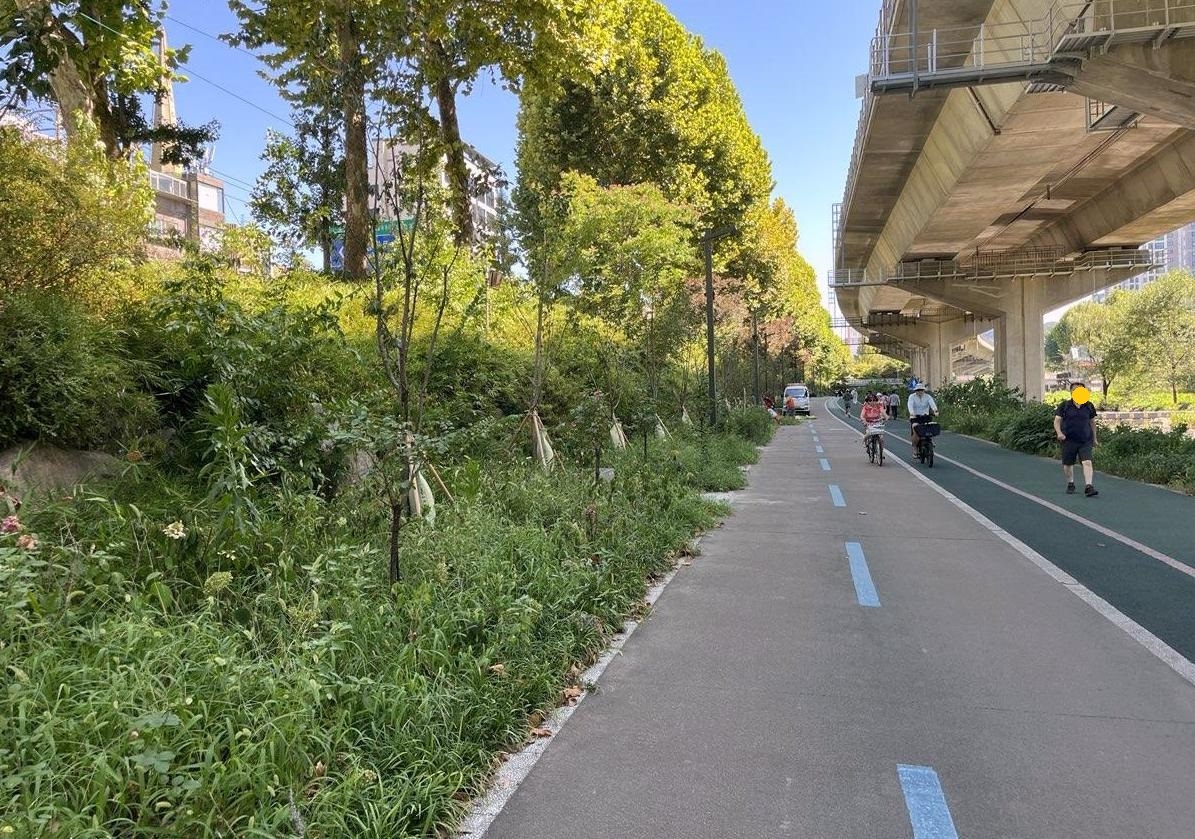
The district's streams serve as both green corridors within the city and summer retreats for residents. Along Hongje Stream, 221 cherry trees — including both single and double-flowering varieties — along with about 5,000 hydrangea and rose plants have been added to expand riverside greenery. Along Bulgwang Stream, about 90 broad-canopied shade trees — including weeping willows, Korean ash, white willows and goldenrain trees — have been planted to provide natural shade for residents walking along the waterway.
Seodaemun-gu plans to continue building an urban environment where green spaces, waterways and residential shade are connected, centered on its five mountains and two streams.
"Seodaemun's mountains and streams are an even more precious asset in an era of climate crisis," district chief Park Wun-ki said. "We will connect forests and waterways to residents' daily lives and build a city that can withstand heat waves."
seouldream01@heraldcorp.com




