Corporate net selling hits $186.9 billion in first half
Government urged exporters to convert proceeds, repatriate overseas reserves
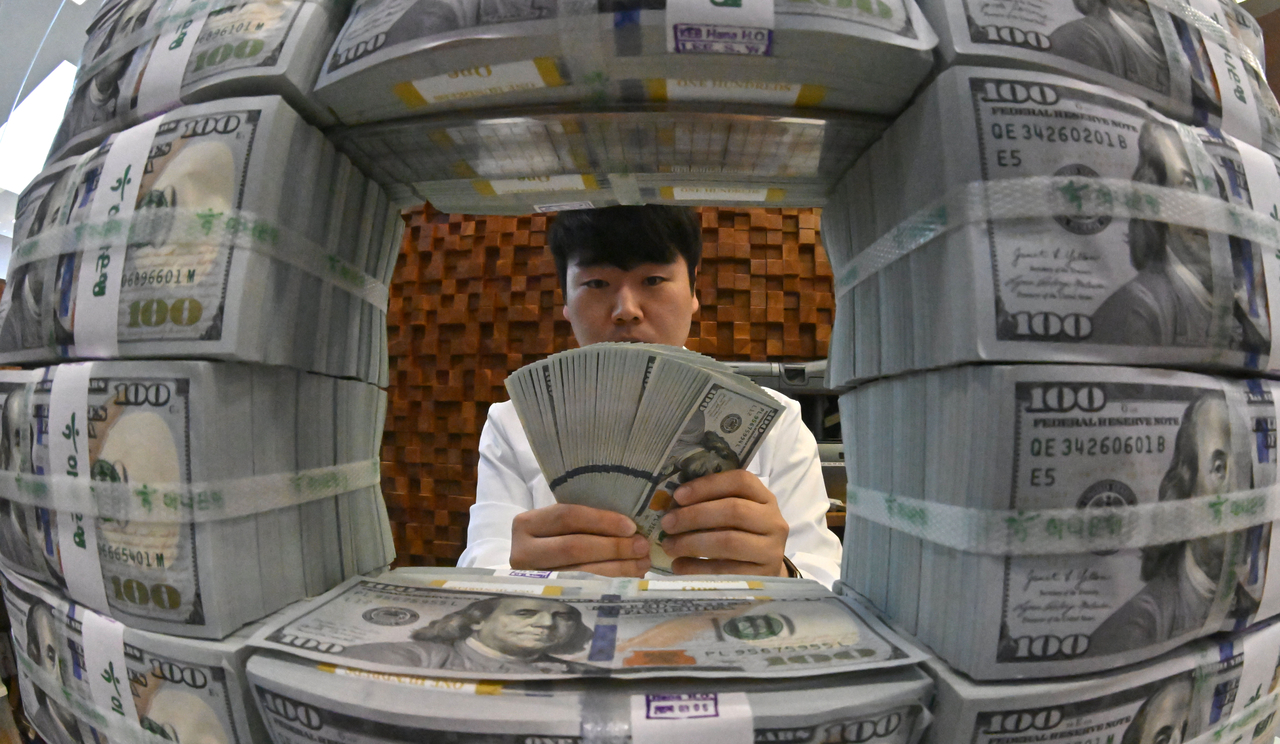
South Korean exporters sharply increased their dollar selling this year compared with last year, data show. Analysts say the surge in corporate dollar supply — driven by a government push for exporters to convert their proceeds and repatriate overseas reserves — contributed to the recent sharp fall in the won-dollar exchange rate.
According to foreign exchange transaction data from the Bank of Korea submitted to Democratic Party of Korea lawmaker Kim Nam-jun of the National Assembly's Finance and Economy Planning Committee, non-financial private companies' spot and forward dollar sales totaled $263.59 billion in the second quarter of this year — a 71.5 percent increase from $153.67 billion in the same period last year.
Corporate dollar purchases also rose over the same period, climbing 23.9 percent from $124.2 billion to $153.94 billion, but the increase in selling was far larger. As a result, net selling — the difference between sales and purchases — nearly quadrupled, from $29.47 billion in the second quarter of last year to $109.65 billion in the second quarter of this year.
In the first quarter of this year, companies sold $201.52 billion and bought $124.27 billion. That brought cumulative first-half sales to $465.11 billion and purchases to $278.21 billion, putting net selling at $186.9 billion — more than three times the $58.49 billion recorded in the first half of last year.
In Bank of Korea statistics, non-financial private companies refers to businesses excluding financial institutions and public enterprises; the transaction figures include both spot and forward foreign exchange deals.
The surge in corporate dollar selling came into focus as the won-dollar rate soared into the 1,500-won range this year, stoking concerns about supply-demand imbalances in the foreign exchange market. In response, the government held a meeting with major exporters in June, asking them to convert export proceeds quickly and increase the repatriation of funds held overseas. The request reflected an assessment that dollars earned by exporters were not reaching the domestic foreign exchange market in sufficient quantities.
Since then, increased dollar selling by exporters and forward dollar sales by shipbuilders, along with inflows from SK Hynix's American depositary receipt issuance, have boosted dollar supply in the foreign exchange market. Corporate dollar selling is understood to have continued at a substantial level into the third quarter.
The won-dollar rate has fallen sharply in recent weeks. After dropping below 1,500 won for the first time in about a month on July 8, it fell below the 1,400-won level on Wednesday. As of around 9:40 a.m. Monday, the rate stood at 1,382.75 won.
"The recent stabilization of the won-dollar rate owes much not only to the efforts of foreign exchange authorities but also to the expanded dollar supply from exporters in sectors such as semiconductors," Kim said. "We must focus on institutional support to sustain a virtuous economic cycle in which AI and semiconductor export earnings stabilize the exchange rate through dollar inflows, which in turn feed back into domestic investment in AI and semiconductor mega-projects."
forest@heraldcorp.com