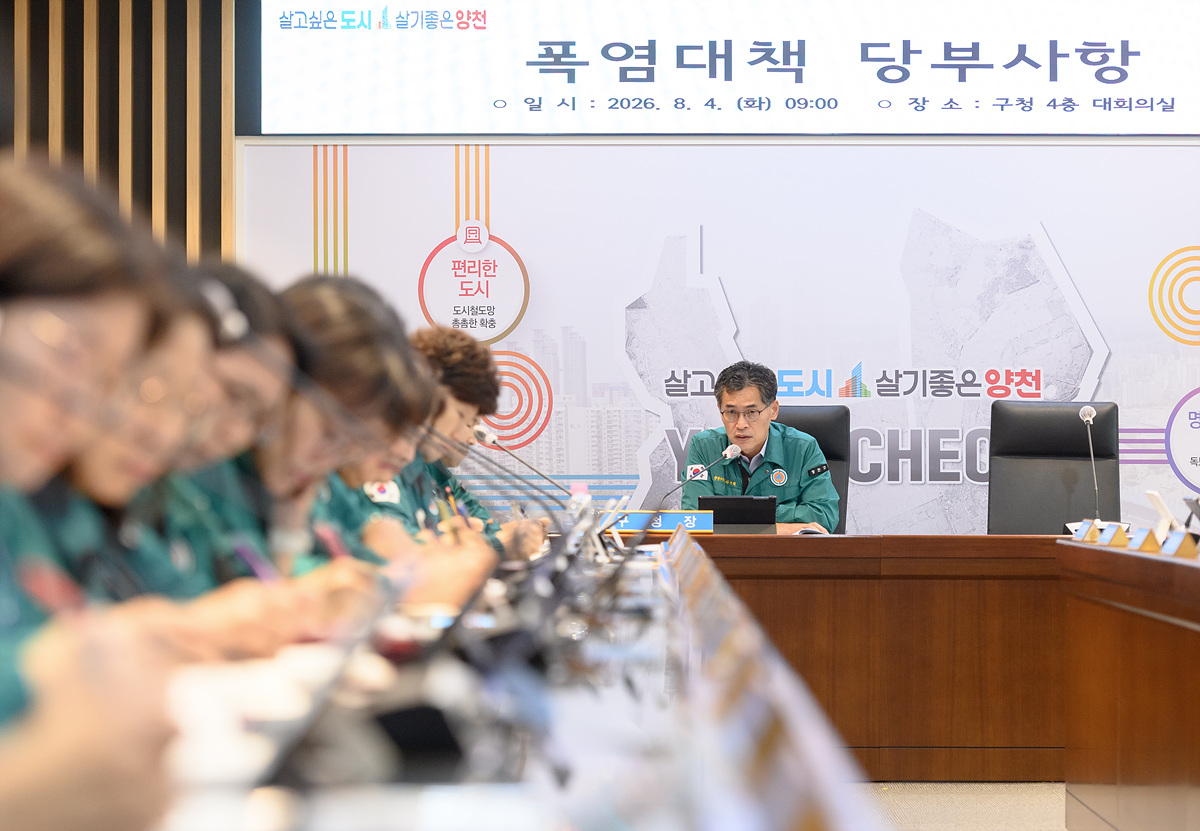
Yangcheon-gu announced Sunday that it will provide special cooling subsidies to low-income and vulnerable residents facing mounting living costs amid a prolonged heat wave and high inflation. The district is led by District Mayor Lee Gi-jae.
As the heat wave drags on, the summer financial burden on low-income and vulnerable groups has grown sharper. According to the Korean Statistical Information Service's "Vulnerability Level by Natural Disaster Type" data, vulnerable populations face a heat-wave vulnerability rate of 19 percent — roughly double the 10.7 percent recorded for non-vulnerable groups — making heat waves the disaster type for which they are most at risk.
In response, the district will extend cooling subsidies to households registered in Yangcheon-gu as of Aug. 7 that qualify as basic livelihood recipients, near-poverty households, single-parent families, or recipients under the Seoul-type basic security program.
A total of 16,772 households are eligible, each receiving a flat payment of 50,000 won ($36), bringing the total outlay to 838.6 million won in city funds. The district has completed preliminary steps — including verifying eligible recipients and checking account details — to ensure swift and complete disbursement. This year, ahead of finalizing the recipient list, the district sent advance text notifications through each neighborhood office to confirm eligibility and minimize the risk of anyone being missed.
The subsidy will be deposited directly into the account of each household head on Thursday with no separate application required. After disbursement, the district plans to work with neighborhood community centers to verify that all payments have been made and to respond promptly to any related inquiries.
Residents seeking details on eligibility or the payment process may contact their local neighborhood community center or the Yangcheon-gu Office's Livelihood Security Division.
Alongside the cooling subsidy, the district has activated a protection system for vulnerable residents to prevent heat-wave harm. When a heat-wave alert is issued, local care networks — including neighborhood care teams and lifestyle support workers — conduct welfare checks on vulnerable households and provide guidance on heat-wave safety measures.
When a major heat-wave alert is declared, welfare checks are stepped up to at least once every two days, with information on nearby cooling centers and health guidelines provided at the same time.
This year the district has also broadened its support by distributing household cooling items — such as electric fans and cooling mats — to safety-vulnerable households, including basic livelihood recipients and near-poverty households, during scheduled electrical, gas and fire department facility inspections, further easing the heat-wave burden on vulnerable residents.
"The longer the heat wave lasts, the heavier the cooling costs weigh on vulnerable residents, and I hope this support makes a real difference in helping them get through the summer safely," District Mayor Lee said. "We will continue to look after our neighbors with care so that no one is left behind in the heat, and we will keep our safety net strong."
seouldream01@heraldcorp.com