![What stories do the derelict boats that came ashore on the hillside of a fishing village in Boao, Chonghai, Hainan, carry with them? [Ham Young-hoon]](https://wimg.heraldcorp.com/news/cms/2026/08/22/news-p.v1.20260821.7f4afd919b54405a812c0d666332f069_P1.jpg)
![A melancholy scene: a derelict vessel rests on the white sand beach in front of the Daoji Hotel in Boao. [Ham Young-hoon]](https://wimg.heraldcorp.com/news/cms/2026/08/22/news-p.v1.20260821.c0dd8e6a25a54f7bb2b1091c8976763e_P1.jpg)
Hainan Province is a well-rounded destination that checks every box a traveler could want — golf, surfing, fine dining, stunning natural scenery, traditional culture, distinctive urban architecture, luxury hotels and shopping. Yet the island also holds a number of spots with a more mysterious kind of charm.
Among the most intriguing are the derelict wooden boats scattered along the shoreline of Boao town in Chonghai.
On the long white beach in front of the Daoji Hotel, a single vessel sits slightly tilted, as if it owns the shore. In the village of Fanghai, several smaller boats — each roughly 2 meters wide and 4 to 5 meters long — have been hauled up onto a hillside overlooking the sea. These vessels are known collectively as "The Story of the Sea" (Haidi Gushi).
It is difficult to say exactly when these boats were built or who sailed them. Wooden boats are fitted together with interlocking planks, and even in their weathered state, the heavy structural frames appear sturdy enough to hold the hulls together.
The boat in front of the Daoji Hotel is too large to have been a simple inshore fishing vessel. Visitors are left to wonder: did it once carry treasure from distant shores and wash up here, or did it simply serve out its full working life as a deep-sea fishing boat?

The shallow waves off Daoji trace abstract patterns across the undulating sand, seeping far inland toward the village. When a wave washes in, walkers on the beach appear to be gliding across the surface of the water.
Because each wave spreads thin and wide before retreating, the derelict boat on this shore seems perpetually on the verge of being touched by the sea again — as if it might reclaim its vitality at any moment. That single vessel casts a melancholy spell over the whole scene.
The smaller boats that made their way up to the Fanghai fishing village are clearly former fishing craft. They have since been transformed into a restaurant, bar and cafe collectively called "The Story of the Sea" (Haidi Gushi).
A drink enjoyed on board one of the old hulls, or beside it, cuts a little deeper into a traveler's heart.
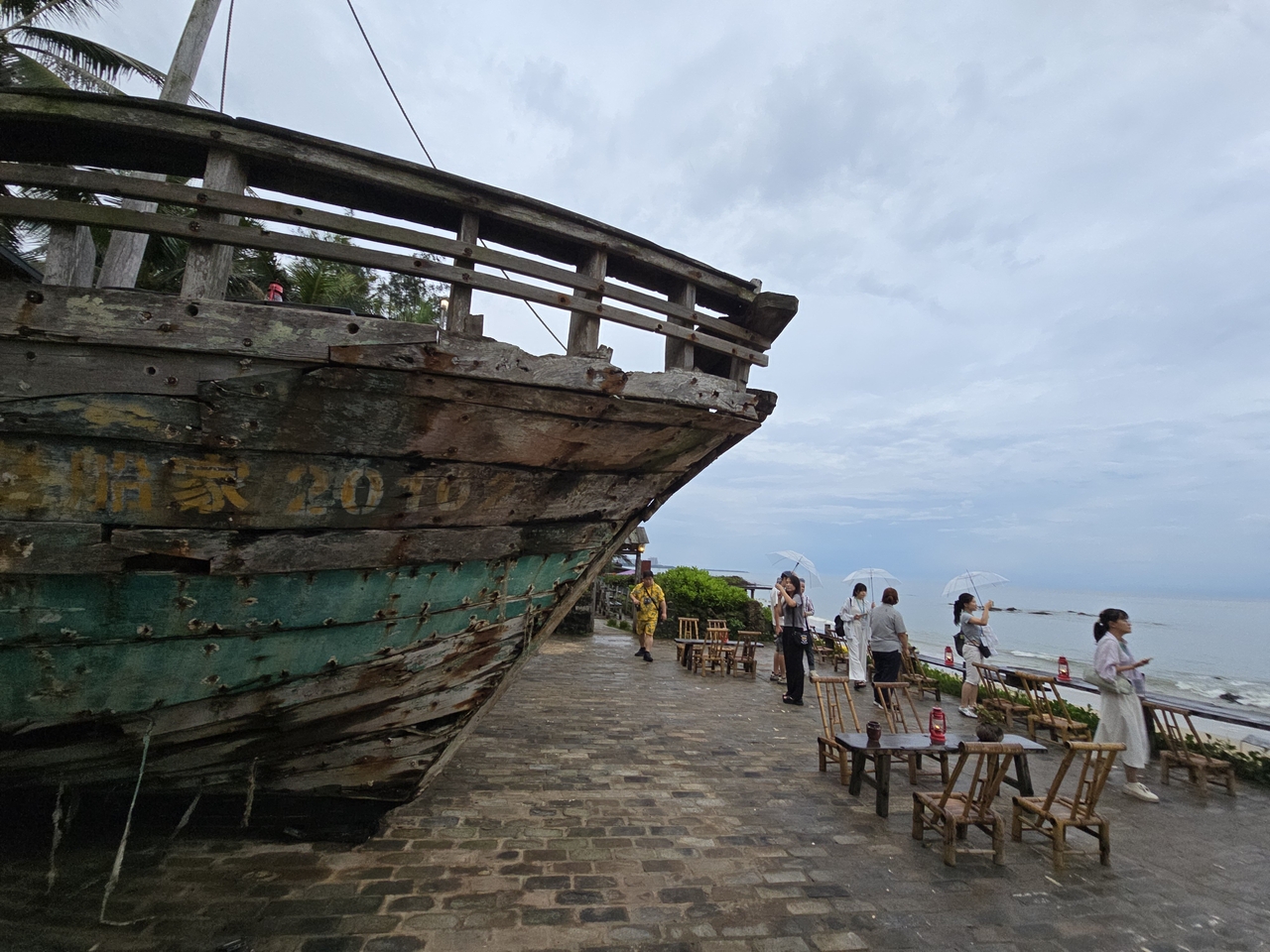
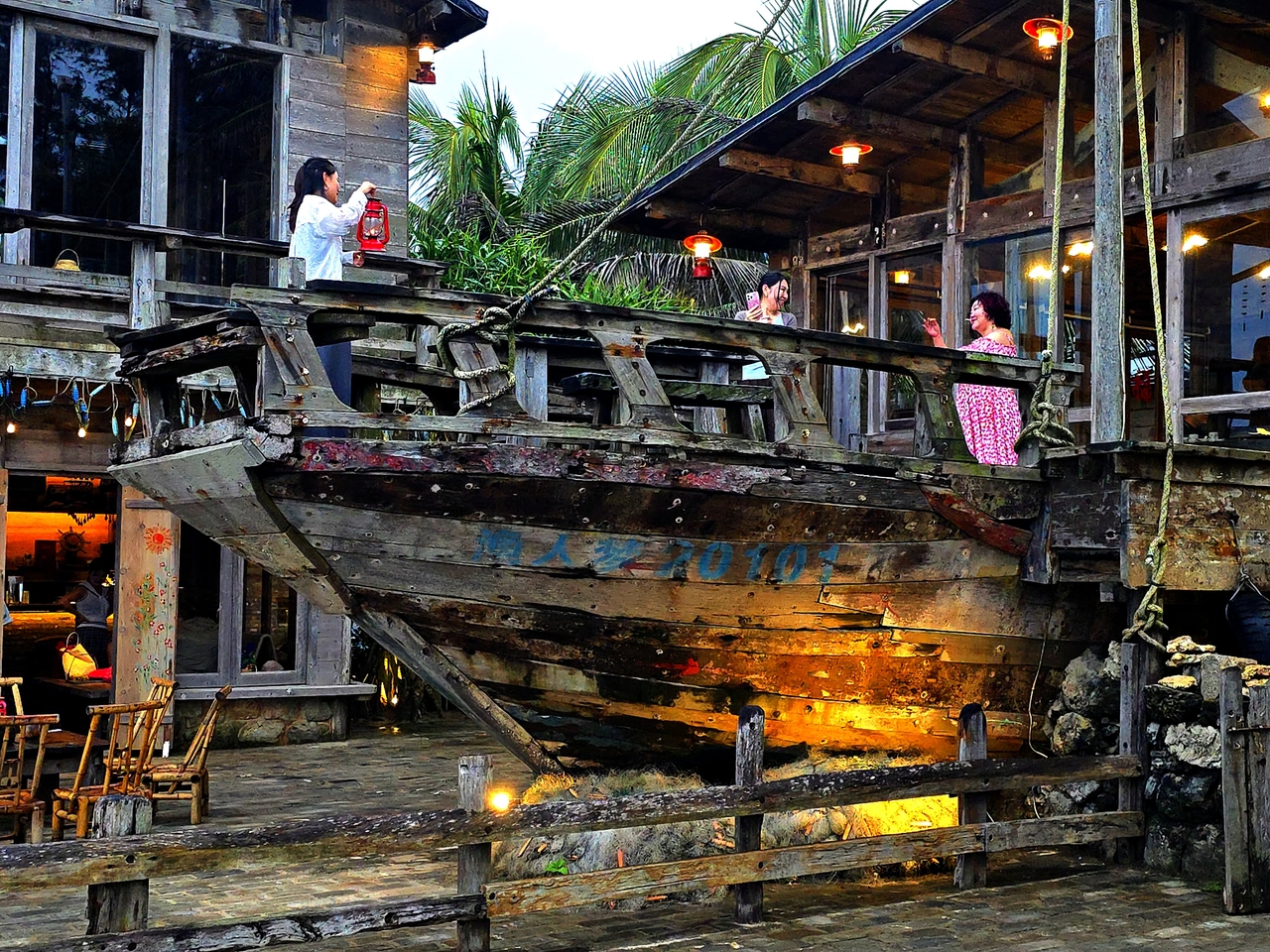
The more a visitor lets their imagination run — wondering how and why this boat ended up as a bar — the better the drinks taste, and the deeper the pleasant haze settles in. Everyone blames the boats.
The Story of the Sea was founded in 2010 by Jiang Xiang, a cultural arts organizer from the fishing community. He built the venue at the estuary where the Wanquan River, flowing from the interior of Hainan Island, meets the Shamei inner sea — an inlet pushed inland by the East China Sea — creating a brackish confluence where fresh water and salt water blur together.
The wooden hulls were preserved largely as found. Timber salvaged from the derelict boats, along with coral stone, was used to complete the bar's structure.
Fishing nets once used by the village's fishermen, lanterns they lit before heading out for night catches while their children slept, and shells and husks left over from the day's haul now serve as decorative elements inside and out.
![A nighttime view of the fishing village in Boao town. [Ham Young-hoon]](https://wimg.heraldcorp.com/news/cms/2026/08/22/news-p.v1.20260822.6a30f5c9431249d0aa01a8a8b4e871d6_P1.jpg)
"The Story of the Sea is a dream that lives inside everyone," Jiang said. "From childhood I carried a deep affection for fishing villages and the sea. I wanted to create a place of rest centered on maritime culture — something the people of Hainan and Hainan's international tourism island could be proud of. Beyond serving food, I wanted to add a cultural dimension and share an emotional connection with visitors from many countries."
That vision is what led Jiang to build The Story of the Sea around the old hulls.
Judging by the degree of wear and decay, and given that wooden fishing boats typically last 40 to 50 years at most, the Boao vessels appear to have been in their prime sometime in the mid- to late 20th century.
Having fulfilled their purpose of sustaining the lives of fishermen, the boats came ashore to rest, and timber from broken hulls was reborn as tables and chairs. That is how a retired fishing boat finds new life.
The venue first gained wider recognition after economic and cultural leaders attending the Boao Asia Forum in 2010 praised it warmly.

Marketing around derelict boats is a strategy many destinations have tried — including Taean in South Korea (where a "treasure ship" installation was later removed after causing widespread confusion), as well as sites across the South Pacific and Australia.
As word of mouth spread about shipwrecked treasure vessels and warships sunk in battle, tourism authorities in Brisbane, Australia, went a step further and deliberately scuttled 15 ships in shallow coastal waters. Those 15 vessels became celebrated photo spots.
The derelict boats on the beach in front of Daoji and in the Fanghai fishing village in Boao are different from those sad stories elsewhere, or from ships deliberately sunk for tourism purposes.
What comes through here is something genuine — the passion of fishermen striving for a better life, the pride and hope they carried, and a deep respect for the boats that served them.
These were the boats the villagers actually used. Having completed their missions, they remain in the village like symbols of success and achievement, standing watch. Now they serve a new, sustainable purpose — as icons that deepen the romance of traveling to Hainan.
abc@heraldcorp.com