![A medical school in Seoul. This image is not directly related to the article. [Yonhap]](https://wimg.heraldcorp.com/news/cms/2026/08/21/news-p.v1.20260727.3fd6af62c4f1421b9849863f6f5dc7a0_P1.jpg)
Even with the introduction of a regional doctor admissions track in the 2027 academic year's early admissions cycle, students with low grades are unlikely to gain entry to medical school, according to a new analysis. Applicants to the new track are also more likely than those in the existing regional talent track to apply simultaneously to pharmacy schools and other medical-field programs.
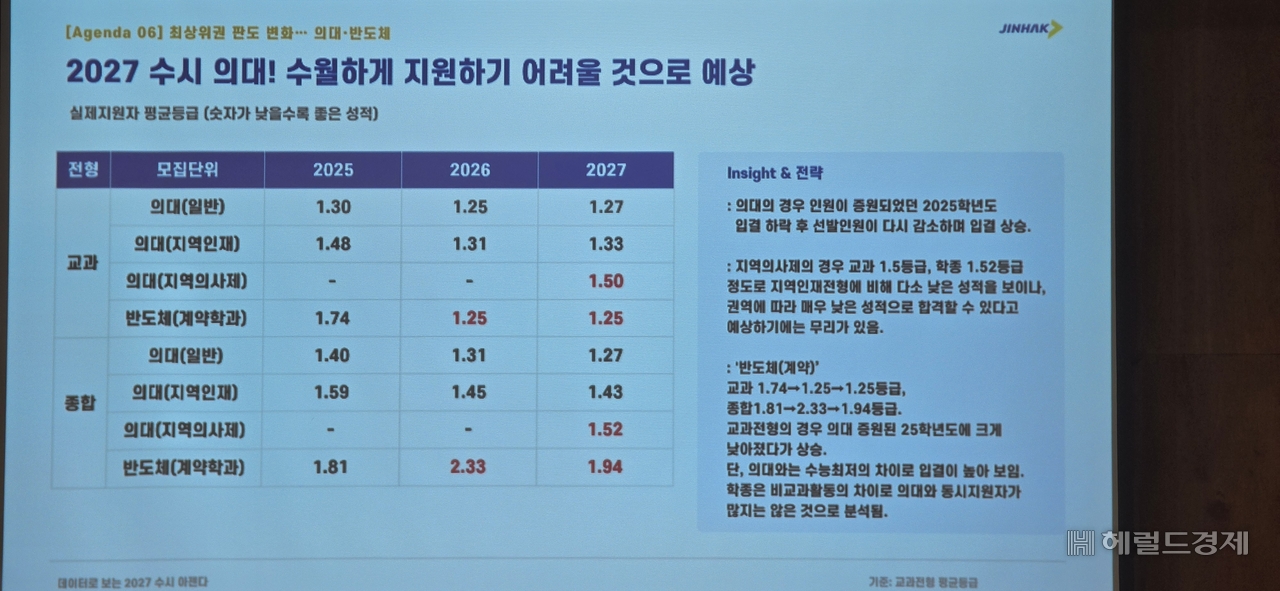
Jinhaksa, a college admissions consulting firm, analyzed data from users of its mock application and admission-prediction service and found that the average grade among applicants to the 2027 regional doctor track stood at about 1.50 in the grade-based admissions category and about 1.52 in the comprehensive admissions category.
Woo Yeon-cheol, head of the admissions strategy research institute at Jinhaksa, said at a press briefing held Friday at the company's office in Jongno-gu, Seoul, that "because the regional doctor track selects a small number of students, there is some possibility of unexpected admission outcomes in certain cases, but it would be unreasonable to expect admission with very low grades."
The overall grade level of early medical school applicants is also trending upward again. Average applicant grades dipped somewhat in the 2025 academic year when the number of seats expanded due to the medical school enrollment increase, but competition among top students has intensified as enrollment numbers have since been reduced.
Based on Jinhaksa's mock application data, the average grade among applicants to the general grade-based medical school track is projected to edge up from 1.25 in the 2026 academic year to about 1.27 in 2027.
The regional doctor track also differs from the existing regional talent track in its applicant composition. Among regional talent track applicants, 70 percent also applied to other medical schools, while 21 percent applied simultaneously to dental schools, traditional Korean medicine schools, pharmacy schools or other medical-field programs outside medical school. About 6 percent applied concurrently to Seoul National University, Yonsei University, Korea University or semiconductor contract programs.
Regional doctor track applicants, by contrast, showed a lower rate of concurrent medical school applications at 58 percent, while the share applying simultaneously to other medical-field programs rose to 30 percent. Jinhaksa noted a particular tendency among pharmacy school applicants to consider the regional doctor track as an additional application option.
"It appears that students who had been considering pharmacy school and similar programs are looking to submit one or two applications to the regional doctor track now that it exists," Woo said. "There is a real possibility that a significant number of top students from medical-field programs, not just existing medical school applicants, will flow into the regional doctor track."
Jinhaksa cautioned that the creation of the regional doctor track alone should not be taken as a sign that the bar for entering medical school has dropped significantly. The number of students selected is not large, and the College Scholastic Ability Test minimum score requirements are similar to those of the existing regional talent track, meaning applicants need to be competitive in both school grades and the college entrance exam.
brunch@heraldcorp.com