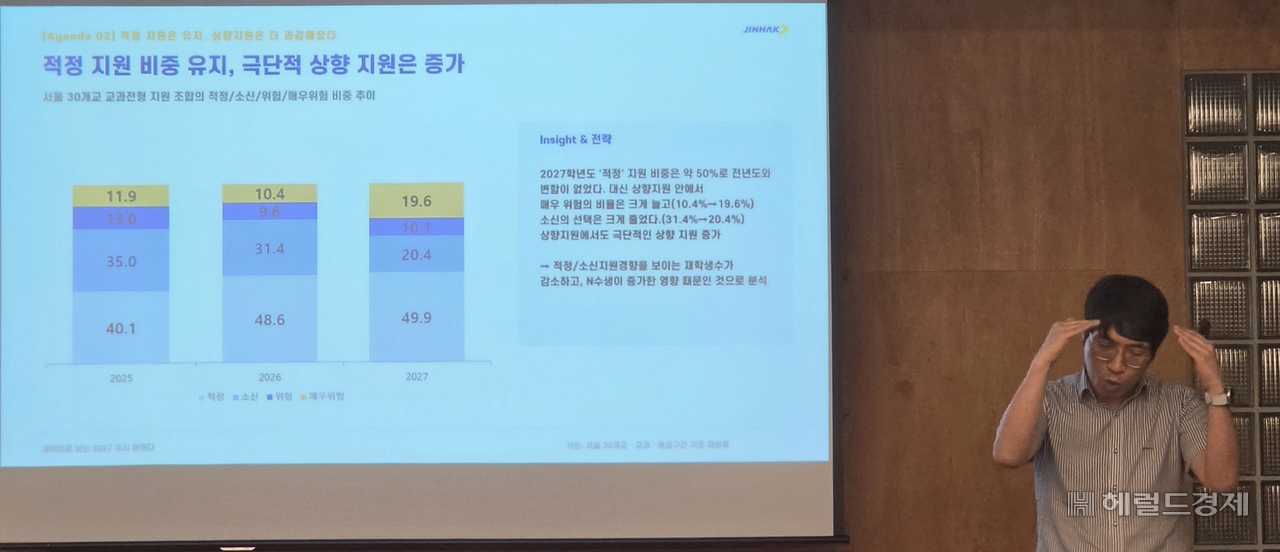
Contrary to expectations that students would play it safe in the final year of the current college admissions system, the share of applicants targeting schools far beyond their realistic reach has nearly doubled in the early-decision round for the 2027 admissions cycle. While the proportion of applications deemed appropriate held roughly steady, so-called "conviction" applications — targeting schools one or two tiers above a student's level — declined sharply, while extreme long-shot applications surged, pointing to a growing polarization in application strategy.
An analysis by admissions consulting firm Jinhaksa of users of its mock-application and admission-prediction service found that 49.9 percent of simulated applications to the school record-based early-decision track at 30 Seoul universities for the 2027 cycle were rated "appropriate" — little changed from 48.6 percent last year. By contrast, the share rated "very risky," meaning the applicant has very little chance of admission, stood at 11.9 percent in the 2025 cycle and 10.4 percent in 2026, then jumped to 19.6 percent in 2027. In effect, the share of students applying to schools well beyond their reach nearly doubled in a single year.
Over the same period, the share of "conviction" applications — targeting schools slightly above a student's level — fell from 35.0 percent in the 2025 cycle to 31.4 percent in 2026 and then to 20.4 percent in 2027. Students are splitting into two camps: those who apply within their realistic range and those who aim for the very top schools with little expectation of admission, bypassing the middle ground.
"Many expected students to apply conservatively this year, given that it is the last admissions cycle under the current system," said Woo Yeon-cheol, head of the admissions strategy research institute at Jinhaksa. "But when we looked at the actual data, appropriate-range applications were similar to last year while very risky reach applications increased significantly — a pattern quite different from what was anticipated."

Jinhaksa cited the decline in current 12th-graders and the rise in repeat test-takers as one factor behind the shift. Among Jinhaksa users, the number of 12th-grade users for the 2027 cycle fell 28.5 percent from the previous year, while repeat test-takers rose 6.4 percent. The share of repeat test-takers among all users climbed from 20.8 percent to 28.1 percent.
As more repeat test-takers — who tend to focus more heavily on the regular admissions round — enter the pool, some are increasingly inclined to apply boldly to reach schools in the early-decision round, reasoning that the regular round remains a fallback if they fall short. Jinhaksa cautioned that it would therefore be premature to conclude that early-decision competition will ease this year simply because the number of 12th-grade applicants has declined.
A separate trend also continues: students are increasingly treating the College Scholastic Ability Test minimum score requirement not as a safety net but as an opportunity to leapfrog rivals. The share of mock applications to tracks carrying a CSAT minimum requirement exceeded 70 percent for three consecutive years — 71.8 percent in the 2025 cycle, 74.9 percent in 2026 and 74.2 percent in 2027.
Tracks without a CSAT minimum are decided solely by school grades, whereas tracks with a minimum create the possibility of admission if other applicants fail to meet the threshold — an expectation that continues to draw students toward those tracks.
However, the so-called "social studies switch" trend adds another variable this year. The influx of top-tier science-track students into the social studies subject area could make it harder for humanities-track students to secure high grades, while science-track students who have moved to social studies should not overestimate their chances of meeting the CSAT minimum based solely on an improvement in their elective subject scores.
"Applying too aggressively on the sole assumption that you can meet the CSAT minimum is risky," Woo said. "This year, the competitive score range is also likely to rise somewhat across the board, so students should build their strategy conservatively rather than relying only on last year's admissions results."
Meanwhile, Jinhaksa noted that because the data are drawn from users of its mock-application service rather than from actual university application records, final competition ratios and cutoff scores may differ from what the simulations suggest.
brunch@heraldcorp.com