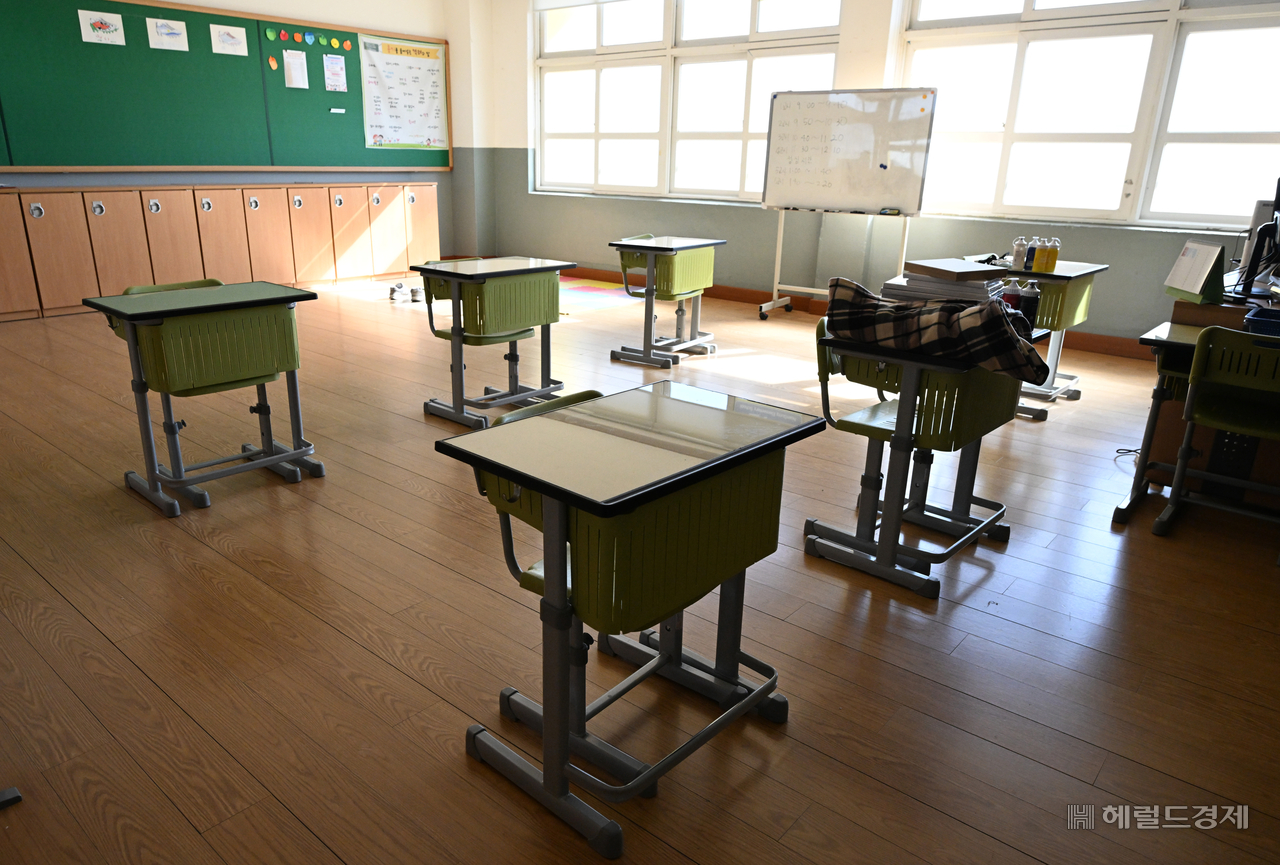
The government plans to overhaul the local education finance grant system in line with a shrinking school-age population and create a new "Education and Human Capital Account" to channel the resulting funds into early childhood, higher and lifelong education. The move is designed to broaden the scope of education spending — long concentrated on elementary and secondary schooling — to cover all stages of life, from early childhood through adulthood.
Under the government's reform plan released Friday, a dedicated education fund called the Education and Human Capital Account will be established within the Future Response Fund. Legislation will guarantee that revenue generated by the grant overhaul flows exclusively into this account and cannot be transferred to other accounts.
The government will scrap the current system, under which 20.79 percent of domestic tax revenue is automatically allocated to education grants, and instead set the size of elementary and secondary grants based on the nominal growth rate over the preceding three years and changes in the school-age population. The decline in the school-age population will be reflected at only 35 percent to account for fixed education costs — such as teacher salaries — that do not fall proportionally as student numbers decrease.
After paying out elementary and secondary grants under the new formula, the difference between that amount and what would have been disbursed under the old system will flow into the Education and Human Capital Account. Specifically, the account will receive the gap between 20.79 percent of domestic tax revenue — excluding transfers to the Future Response Fund — and the grant amount calculated under the new formula.
The Education and Human Capital Account will be directed primarily toward early childhood, higher and lifelong education, areas long criticized as underfunded. Funds may also be used to cultivate top talent in science, engineering and technology; attract skilled workers from abroad; and prevent the emigration of domestic talent. The account can additionally support education projects deemed urgent under national policy or requiring large-scale public investment.
"The purpose of reforming the grant system is to achieve balanced investment from early childhood through lifelong education," a Ministry of Education official said. "It is right that the fund's resources be focused primarily on early childhood and higher and lifelong education."
Elementary and secondary education will continue to be supported through local education finance grants distributed to regional education offices nationwide, while the Education and Human Capital Account may be tapped for national education initiatives that exceed the capacity of individual education offices.
![Minister of Planning and Budget Park Hong-keun (left) and Minister of Education Choi Kyo-jin attend a public forum on reforming the local education finance grant system held at Government Complex Seoul in Jongno-gu, Seoul, on Aug. 8. [Yonhap]](https://wimg.heraldcorp.com/news/cms/2026/08/21/rcv.YNA.20260708.PYH2026070807290001300_P1.jpg)
Funds generated by the grant overhaul will begin accumulating in the Education and Human Capital Account in earnest from 2028. In 2027, virtually no revenue will flow directly into the account from the formula change, so the government plans to transfer funds from the Future Response Fund's general account to advance related projects in the interim.
From 2028, revenue from the reform will flow in directly. A government official said the annual inflow would be "considerably more than 1 trillion won ($718 million)," though the government declined to disclose specific figures by year.
The government will also put in place safeguards to prevent a reduction in elementary and secondary education funding. Legislation will require that any shortfall be made up when the grant amount calculated under the new formula falls below the previous year's level, ensuring the total grant does not decrease.
The Ministry of Education said that while the automatic link to 20.79 percent of domestic tax revenue will be removed, the underlying principle of securing stable funding for elementary and secondary education will be preserved, and the reform largely aligns with proposals the ministry had been developing internally. "We had been considering setting a kind of ceiling on the grant and redirecting the excess — the amount that would have grown too large under the 20.79 percent link — toward early childhood education and other areas, thereby expanding the overall education funding pie," a ministry official said.
Within the education sector, however, concerns persist that incorporating the school-age population decline into the formula will make it difficult to cover fixed costs such as teacher salaries. The Ministry of Education acknowledges that personnel costs for teachers and staff rise naturally by more than 1 trillion won each year. "We are aware of the education sector's concerns about the annual increase in personnel costs," a ministry official said. "Applying only 35 percent of the school-age population decline — rather than the full rate — was precisely a measure to account for fixed costs like salaries that arise regardless of falling student numbers."
![Park Young-hwan, chairman of the Korean Teachers and Education Workers Union, speaks at a joint press conference held outside Government Complex Seoul in Jongno-gu on Aug. 8 by three teacher organizations — the Korean Teachers and Education Workers Union, the Teachers' Labor Union Federation and the Korean Federation of Teachers' Associations. [Yonhap]](https://wimg.heraldcorp.com/news/cms/2026/08/21/rcv.YNA.20260708.PYH2026070807280001300_P1.jpg)
The education sector has pushed back collectively against the government's grant overhaul. The Korea Council of Superintendents of Education released a joint statement Friday signed by 16 city and provincial education superintendents, calling for the current 20.79 percent link to domestic tax revenue to be maintained and for the establishment of an official consultative body that includes the superintendents.
The council particularly called for early childhood, elementary and secondary education to be explicitly designated as investment priorities within the Education and Human Capital Account, and said legislation should guarantee the scale, purpose and operating principles governing how funds generated by the overhaul are used, with priority given to those education levels.
A coalition of 354 organizations representing teachers, parents and civil society groups, formed to respond to the 2026 local education finance grant overhaul, held a press conference outside Government Complex Seoul on Friday, demanding that "the unilateral reform of education finances without the consent of education stakeholders be halted."
The groups argued that a decline in the school-age population does not automatically translate into lower demand for education funding, pointing to ongoing needs such as expanding special education and upgrading aging school facilities and practical learning environments. The coalition called for maintaining the statutory 20.79 percent link to domestic tax revenue, strengthening the state's fiscal responsibility for early childhood through secondary education, and forming an official public deliberation body that includes education superintendents, teachers and parents.
brunch@heraldcorp.com