![Photo is unrelated to the article. [Getty Images Bank]](https://wimg.heraldcorp.com/news/cms/2026/08/20/news-p.v1.20260820.140da2a7593f4eaebcd110f232d409c0_P1.png)
With the Kospi trading below the 7,000 mark and investor sentiment frozen, analysts warn that even a rebound is unlikely to translate quickly into a sustained uptrend. Retail investors who bought during the downturn are expected to sell into any recovery, weighing on the pace of gains.
According to Korea Exchange, the Kospi opened Thursday up 209.17 points, or 3.23 percent, at 6,680.34. After being pushed down to the 5,500 level on July 30, the index rebounded to the 6,000 range but has yet to establish a foothold above 7,000.
The index has repeatedly attempted to reclaim the 7,000 level this month, only to be turned back each time. It closed in the 6,900 range on Friday and briefly surpassed 7,100 during trading on Tuesday before surrendering its gains to finish in the 6,800 range.
Market analysts say the large volume of net retail purchases accumulated near the top of the index's recent range could cap the Kospi's upside. As the index rises, selling pressure from retail investors looking to recoup losses is expected to intensify, limiting further gains.
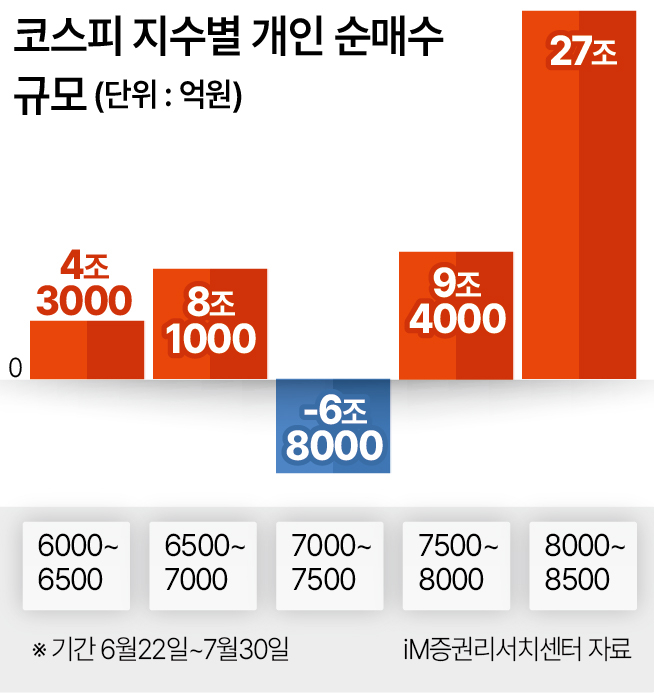
According to research by iM Securities, retail investors net purchased 9.4 trillion won ($6.7 billion) in the Kospi between the 7,500 and 8,000 levels, and 27 trillion won between 8,000 and 8,500, from June 22 through July 30 — a period during which the index fell more than 38 percent, from 9,114.55 to 5,593.56.
Broadening the scope to since last October, retail buying remains heavily concentrated in the 7,000-to-8,500 range. Cumulative net retail purchases stand at 37.8 trillion won in the 7,000-to-7,500 band, 60.4 trillion won in the 7,500-to-8,000 band and 56.6 trillion won in the 8,000-to-8,500 band.
"Once the index climbs above 7,000, retail resistance could be fierce," said Kim Jun-young, a researcher at iM Securities. "Retail investors learned during last month's correction that buying does not always mean profit, and they are more likely to gradually reduce their positions than to switch back to buying."
As the Kospi pushes above 7,000, loss-recovery selling from retail investors who accumulated shares during the downturn is expected to grow, potentially stalling any further advance.
Lee Jae-man, a researcher at Hana Securities, said cumulative net retail purchases in the 8,000-to-8,500 range — where the index has corrected more than 15 percent from its peak — total 27 trillion won, the largest of any band. "In the 7,500-to-8,500 range, retail-driven selling pressure is likely to be high, which could slow the pace of any rebound and expand volatility," he said.
A sustained recovery above 7,000 will also require a rebound in trading volume. Without a meaningful increase in funds flowing into the market, the index's upward momentum could remain limited.
According to Korea Exchange, the Kospi's average daily trading value plunged from 50.35 trillion won in May to 24.27 trillion won as of Wednesday. Over the same period, the Kosdaq market's average daily trading value fell more than 60 percent, from 15.57 trillion won to 6.11 trillion won.
Average daily trading value on both the Kospi and Kosdaq has dropped to its lowest level of the year this month, reflecting dampened investor sentiment as the Kospi has struggled to mount a meaningful recovery since the correction.
Investor deposits held in brokerage accounts — a gauge of funds waiting to enter the market — have also been shrinking. According to the Korea Financial Investment Association, such deposits fell from 132 trillion won at the end of May to 105 trillion won as of Tuesday.
Foreign investor flows, which heavily influence the direction of domestic markets, remain another key variable. Foreign investors have net sold 3.05 trillion won on the Kospi so far this month, after offloading more than 8 trillion won last month.
moon@heraldcorp.com