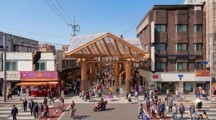
![A property listing board at a real estate agency in Eunpyeong-gu, Seoul. The government is set to launch a "jeonse and monthly rent safe trust" program designed to lower housing costs for tenants while eliminating the risk of rent arrears for landlords. [Yonhap]](https://wimg.heraldcorp.com/news/cms/2026/08/20/news-p.v1.20260816.bc19a0629a194891844a0a329289a73b_P1.jpg)
South Korea is set to formally launch a "jeonse and monthly rent safe trust" program that aims to reduce housing costs for tenants while shielding landlords from the risk of unpaid rent. Under the scheme, a dedicated stabilization body will receive jeonse deposits, invest them and pay landlords a monthly return — allowing tenants to live under a jeonse arrangement at lower cost than monthly rent while keeping their deposits safe from fraud.
The Korea Housing and Urban Guarantee Corporation (HUG) will begin recruiting participants in September, with contracts to be signed before the end of the year.
The Ministry of Land, Infrastructure and Transport announced Thursday that it would push ahead with the safe trust program as a follow-up measure to its Aug. 13 rapid housing supply plan.
The program works through a three-way lease agreement among the stabilization body, the landlord and the tenant. Once the tenant deposits the jeonse sum with the body, the body invests it — including in project financing loans backed by guarantees — to generate an annual return of around 4%, which is then paid to the landlord monthly. HUG will handle deposit custody, investment management, refunds, and the recruitment of landlords and tenants. Participation is voluntary and applies only when all three parties enter into a contract together.
The ministry said both landlords and tenants stand to benefit from enrolling in the safe trust program.
Landlords will receive a stable monthly income from the investment return on the jeonse deposit, eliminating concerns about rent arrears. The planned return rate of 4.35% is slightly below the 4.7% jeonse-to-monthly-rent conversion rate for row houses and multi-family homes in Seoul as of May. If a tenant vacates unexpectedly before the contract ends, the landlord's vacancy risk is also minimized — the stabilization body will continue paying the monthly return through the end of the contract period even after refunding the deposit.
Registered rental business operators will be exempt from the mandatory rental deposit return guarantee, reducing their guarantee fee burden of 0.23 to 0.27 percent.
The ministry is also pursuing tax support for landlord income from the program, a matter on which consultations with the Ministry of Economy and Finance have been completed.
In addition, landlords who participate and relocate from Seoul or other regulated areas to regional cities will be able to receive a housing pension. On top of the roughly 4% annual return from the safe trust program, they could collect an additional 1 to 3 percent per year through the pension. The arrangement is designed to encourage baby boomers to convert their owner-occupied homes into jeonse supply, promote their relocation to the regions and secure retirement income all at once.
For tenants, the program offers the chance to live under a jeonse arrangement — cheaper than monthly rent — while having their deposit safely managed by the stabilization body. This removes the need to separately purchase a jeonse deposit return guarantee or a jeonse loan guarantee, cutting guarantee fee costs.
Tenants who meet income and other eligibility requirements can use the government's Buttimok housing fund jeonse loan or a commercial bank loan to cover the lump-sum deposit. Jeonse loan interest rates of 3 to 4 percent are also lower than the prevailing jeonse-to-monthly-rent conversion rate of 5 to 6 percent.
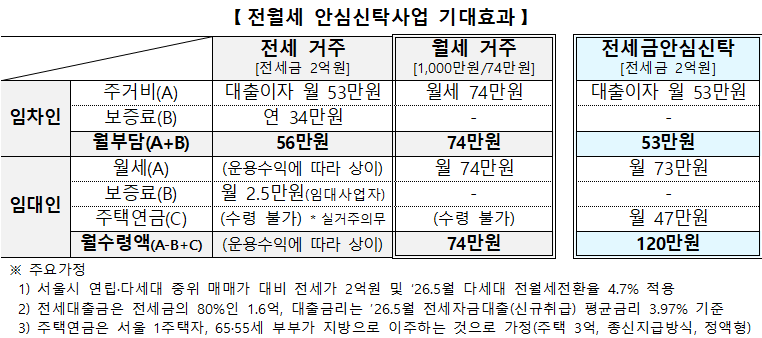
To illustrate the savings, the ministry offered a hypothetical case involving a row house or multi-family home with a market value of 300 million won ($214,000): a jeonse deposit of 200 million won, or alternatively a monthly rent arrangement with a 10 million won deposit and 740,000 won per month. Under the safe trust program, a tenant could save roughly 200,000 won a month. Instead of paying 740,000 won in monthly rent, the tenant would live under a jeonse arrangement and borrow up to 80 percent of the deposit — 160 million won — at an average new jeonse loan rate of 3.97 percent as of May, resulting in monthly interest of 530,000 won. The tenant could also save an additional 340,000 won a year by forgoing separate jeonse deposit return and loan guarantee fees.
A landlord who joins the program would receive a guaranteed monthly return of 730,000 won — based on a 4.35 percent yield — without having to worry about arrears or vacancies. Registered rental operators would also avoid paying 300,000 won a year in rental deposit guarantee fees. Landlords who relocate to the regions could receive an additional 470,000 won per month through the housing pension.
The ministry plans to open separate public recruitment drives for general landlords and tenants, with no restrictions on housing type. Two application tracks will run in parallel: one in which a landlord applies first and the stabilization body then helps recruit a tenant, and another in which a landlord and tenant agree on a deposit level in advance before jointly applying. A pilot supply of 500 units from Korea Land and Housing Corp. purchase-rental housing will also be included.
The program will initially target homes with a market price of 2 billion won or less. Applicants will be screened to ensure the deposit is not disproportionately large relative to the market price and that the property has no building code violations.
Going forward, the stabilization body plans to use pooled jeonse deposits to establish a housing supply activation fund. An asset manager will be selected by October, investors recruited and the fund registered between November and December, and operations launched from the time tenants begin moving in.
Detailed procedures, contract terms and the monthly return rate will be disclosed when the formal program announcement is made at the end of September.
The ministry said the rapid shift from jeonse to monthly rent — driven by widespread jeonse fraud, a landlord preference for monthly rent during the low-interest-rate era and other factors — has increased the housing cost burden on vulnerable groups such as young people. It described the safe trust program as a new form of lease contract that combines the advantages of both jeonse and monthly rent while eliminating the risks of each.
Kim I-tak, first vice minister of land, infrastructure and transport, said the program would allow tenants to enter lease agreements without fear of losing their deposits and landlords to do so without worrying about unpaid rent. "We plan to review not only the model we have designed but also various other contract structures to promote a healthier rental market," he said.
smh@heraldcorp.com