Parental leave benefit payouts more than doubled in two years as the government sharply expanded work-family balance support, while the employment insurance fund's unemployment benefit account reserves were cut nearly in half over the same period.
Experts say the government must increase direct fiscal support so that the cost of national low birth rate policies does not fall disproportionately on the employment insurance system, which is funded by premiums paid by workers and employers.
According to a fiscal audit review report on the Ministry of Employment and Labor, provided Wednesday by the office of People Power Party lawmaker Na Kyung-won of the National Assembly's Climate, Energy, Environment and Labor Committee, total spending on the maternity and parental support project last year reached 4.31 trillion won ($3.05 billion). That marks a 176.0% increase from 1.56 trillion won in 2020.
The maternity and parental support project covers a range of benefits, including maternity leave pay, parental leave pay, reduced working-hours pay for parents of young children, paternity leave pay, and leave pay for fertility treatment.
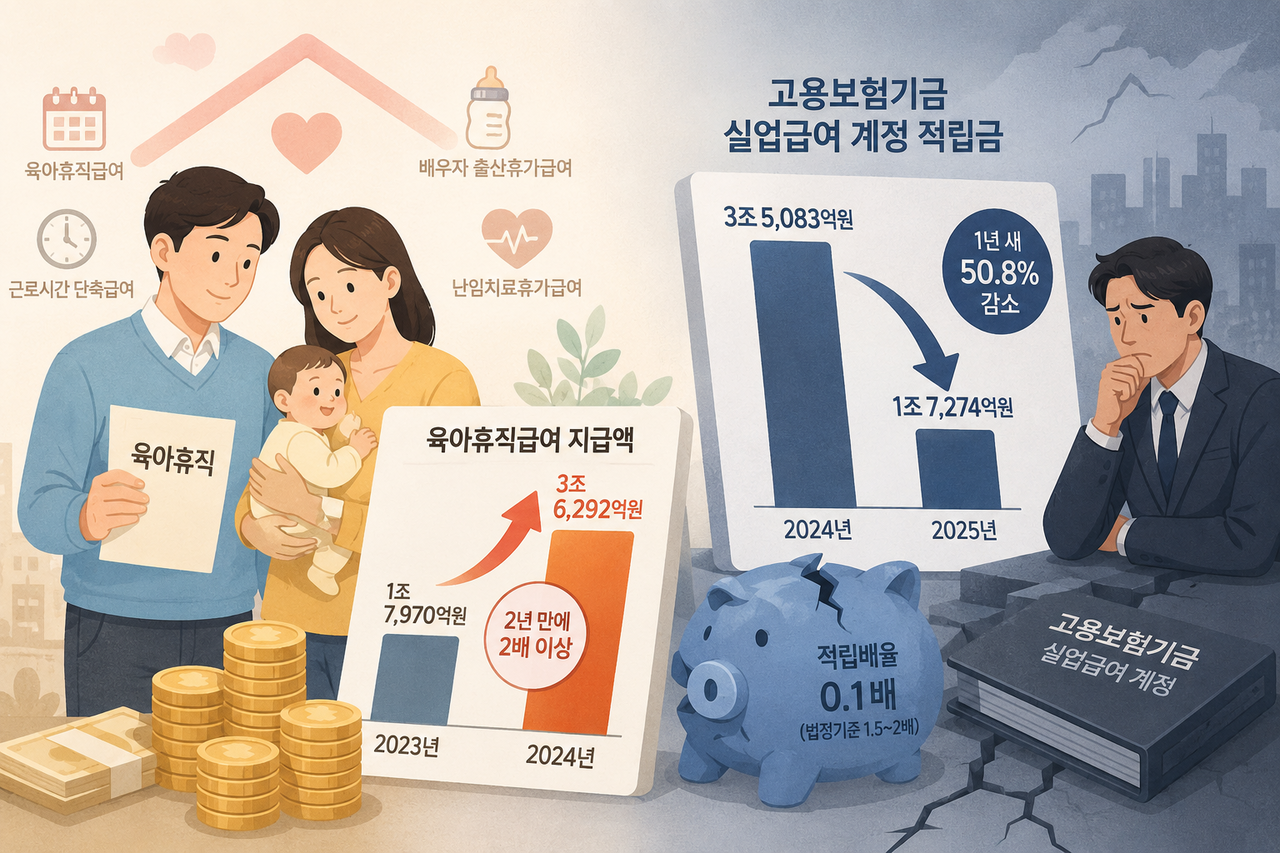
Parental leave benefits drove the spending surge. Payouts rose from 1.8 trillion won in 2023 to 3.63 trillion won last year — a 102.0% increase in two years. Compared with 1.21 trillion won in 2020, the figure has nearly tripled, up 199.4% over five years.
The number of recipients also grew rapidly. Those receiving parental leave benefits rose from 132,535 in 2024 to 184,329 last year, an increase of 51,794, or 39.1%. Recipients of reduced working-hours pay for parents climbed from 26,627 to 39,400 over the same period, while paternity leave benefit recipients increased from 18,241 to 24,412.
Analysts attribute the growth to rising public interest in work-life balance and a series of government policy enhancements. The government introduced the "3+3 parental leave" system in 2022 and expanded it to the "6+6 parental leave" system starting in 2024.
Under the 6+6 parental leave system, when both parents of a child under 18 months old take parental leave simultaneously, each receives 100% of their regular wage for the first six months. Monthly payment caps start at 2.5 million won for the first and second months, rising to 3 million won in the third month, 3.5 million won in the fourth, 4 million won in the fifth, and 4.5 million won in the sixth.
Standard parental leave benefits were also raised last year. The previous monthly cap of 1.5 million won was replaced by a tiered system: 2.5 million won for months one through three, 2 million won for months four through six, and 1.6 million won from the seventh month onward.
The concern is that the employment insurance fund is absorbing a growing share of the rapidly expanding parental support spending.
The maternity and parental support project draws from the unemployment benefit account of the employment insurance fund, which is financed primarily by insurance premiums paid by workers and employers.
Total spending from the unemployment benefit account last year reached 17.46 trillion won, up 2.31 trillion won from 15.15 trillion won the previous year. Within that total, the share attributable to maternity and parental support rose from 17.0% in 2024 to 24.6% last year, a gain of 7.6 percentage points — meaning roughly one in every four won paid out of the unemployment benefit account went toward parental support.
The fund's fiscal buffer is eroding quickly as a result. Year-end reserves in the unemployment benefit account plunged 50.8% from 3.51 trillion won in 2024 to 1.73 trillion won last year. The reserve ratio fell from 0.2 times to 0.1 times annual spending.
Under current employment insurance law, the unemployment benefit account must maintain reserves of at least 1.5 times but less than twice the year's total spending, as a buffer against mass unemployment or labor market instability. Last year's reserve ratio was limited to 0.1 times. The ratio has declined steadily — from 0.9 times in 2017 to 0.3 times in 2020 and now to 0.1 times last year — and has not met the legally required level at any point in the past decade.
Although the government has been increasing direct budget transfers to the maternity and parental support project, critics say the pace has failed to keep up with rising expenditures.
General account transfers to the project increased by 150 billion won, from 400 billion won in 2024 to 550 billion won last year. Even so, the share of general account transfers in total project spending actually fell, from 15.5% to 12.8%.
This year's general account transfer stands at 600 billion won, an increase of only 50 billion won from last year. According to the National Assembly Budget Office, the Ministry of Employment and Labor requested around 1.5 trillion won in general account transfers during this year's fund management planning process, citing employment insurance fund fiscal soundness, but the amount reflected was about 40% of what was requested.
Given that expanding parental support to address the low birth rate is unavoidable, experts argue that the state must take on a greater fiscal role rather than relying solely on insurance premiums paid by workers and employers.
A senior researcher at the Climate and Labor Committee said the shortfall in general account transfers "appears to be worsening the fiscal balance of the employment insurance unemployment benefit account" and called on the government to "establish a plan to expand general account transfers in line with projected increases in spending on the maternity and parental support project, which constitutes a mandatory national expenditure."
fact0514@heraldcorp.com