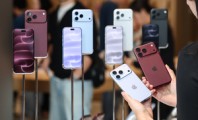
![Samsung Display's "wide-view display" and "wide stretchable," unveiled for the first time at IMID 2026, the country's largest display academic conference, held at Bexco in Busan. [Samsung Display]](https://wimg.heraldcorp.com/news/cms/2026/08/19/news-p.v1.20260819.d177d8b5719c44f0ba3fa6d5f98a5a24_P1.jpg)
Samsung Display on Wednesday unveiled a wide-view display featuring its latest wide-viewing-angle technology and the world's largest 20-inch wide stretchable display at IMID 2026, the country's largest display academic conference, held at Bexco in Busan.
Current foldable displays have a structural limitation: the curved surfaces on either side of the central fold reach only about 40 percent of the brightness seen from directly in front. Samsung Display said it has been developing a range of wide-viewing-angle OLED panels to address the problem.
Wide-viewing-angle technology keeps a display's color, brightness and contrast largely stable whether viewed from the front, the sides or above and below.
The newly unveiled 7.6-inch wide-view display delivers a bright, uniform image with no brightness drop even at the curved portions of the screen when viewed head-on.
"We completely redesigned the materials and structure of the new organic light-emitting layer," Samsung Display said, describing the panel as "the latest wide-viewing-angle technology capable of resolving the lateral brightness drop at the fold of a foldable phone and at the curved edges of edge displays."
The company said the technology is expected to enable uniform image quality regardless of viewing angle in next-generation form-factor products such as foldables, slidables and rollables.
The 20-inch wide stretchable applies tiling technology that connects two existing stretchable panels into a single seamless screen, more than doubling the display area compared with the previous product.
Samsung Display used ultra-precision panel design and module lamination technology to minimize the boundary between the two panels, making them appear as one continuous display.
The company expects large stretchable displays to find use across a range of curved-surface applications, including automotive digital cockpits, humanoid robots and digital signage.
Meanwhile, Samsung Display presented 57 technical papers at IMID 2026 — the most of any participating company, a distinction it also held last year. The OLED panel used in the Galaxy S26 Ultra won the IMID Display of the Year award.
In his keynote address at the opening of the conference, Jo Seong-chan, executive vice president and head of Samsung Display's Display Research Institute, said generative AI is "driving innovation across research, development and manufacturing, including materials and structural optimization and automated inspection," adding that "going forward, generative AI-based innovation will determine the competitiveness of the next-generation display industry."
joze@heraldcorp.com