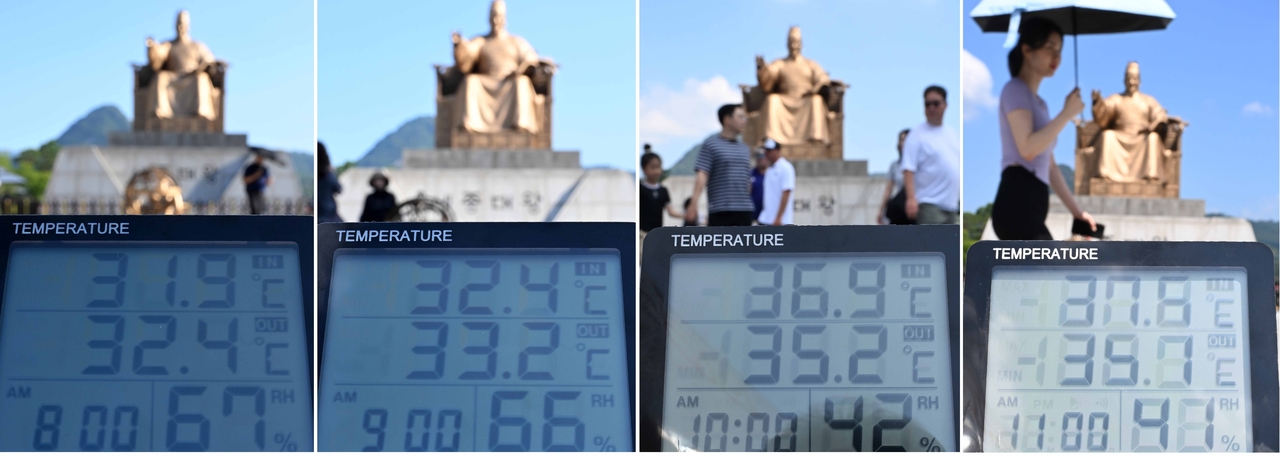
The Seoul Metropolitan Government announced Wednesday that it will adopt the "right to shaded walking" as a foundational principle of urban policy.
The concept calls for planning and managing city spaces so that residents can enjoy uninterrupted shade along their everyday walking routes. Seoul will incorporate the principle into its master urban plan and neighborhood-level plans, then apply it in stages to projects that physically reshape the city — district unit plans, redevelopment projects and public construction works. Street trees, gardens, building shade, canopies, awnings, open public spaces and public pedestrian corridors will be integrated into a single connected system, with the goal of allowing people to walk safely and comfortably from the moment they leave home until they reach destinations such as subway stations, schools, markets, hospitals and parks.
Seoul plans to build shaded neighborhood walking routes through a three-step strategy: identifying where shade is needed, creating shade suited to each location's conditions, and connecting individual shade elements into an unbroken network along residents' daily routes.
The first step is identifying where shade is most urgently needed — routes to subway stations, schools, markets, hospitals and welfare facilities, as well as spots where people must wait outdoors, such as crosswalks and bus stops. The second step is creating shade appropriate to each site: natural shade through tree planting where possible, and seasonal awnings, canopies and small rest shelters where trees cannot be planted. The third step is connecting individual installations to key living spaces — linking residential areas to subway stations, schools, markets, hospitals and parks into continuous shaded corridors.
Seoul will establish a planning, project and evaluation framework to ensure shade access is secured throughout every stage of urban development. The shade-walking principle will be embedded in the Seoul Master Urban Plan and neighborhood plans, and shaded routes will be incorporated into 350 designated "everyday pedestrian centers" — streets classified as everyday, leisure or vitality corridors. Shade standards will be applied in phases to district unit plans, redevelopment projects and public construction works. When new buildings and roads are designed, building height, placement, sidewalk width and planting space will be planned together. Open public spaces and pedestrian corridors will be encouraged to include large trees, awnings and benches as a package.
The city is also reviewing a plan to offer incentives to private building owners who install shade-creating structures such as pilotis, canopies, awnings and smart rest shelters along public walking routes.
Over the next two years through next year, Seoul will run pilot projects on 10 living-street corridors that are heavily used by residents and tourists or are particularly short on shade. Sites will be selected based on a composite assessment of sun exposure time, pedestrian volume, elderly population share, shade gaps and feasibility of installation. The program will expand citywide from 2028.
A city analysis of 67,029 sidewalk segments totaling 4,031 kilometers found that Seoul sidewalks are exposed to direct sunlight for an average of four hours and 21 minutes a day. Some 27.6 percent of all segments receive more than six hours of direct sunlight, indicating widespread shade gaps and breaks in walkable shaded routes. The average shade coverage across Seoul sidewalks was 44.4 percent — building shade accounted for 29.2 percentage points and street-tree shade for 15.2 percentage points. The analysis tracked sunlight exposure in one-meter increments from 10 a.m. to 5:30 p.m. on July 28 last year.
The need for shade while in transit is underscored by heat illness data. According to the KDCA's heat illness emergency room surveillance system, 31.4 percent of the 815 heat illness cases recorded in Seoul over the past three years (2023–2025) occurred on streets — the highest share of any setting. From May 15 through Monday this year, when the KDCA's heat patient monitoring system was active, Seoul recorded 445 heat illness cases, with five deaths estimated. The prolonged heat wave has also driven demand for shade-navigation apps. A map application called "Geuneulro: Ttubeogiui Yeoreum-gil," which guides users to destinations via the shadiest available routes, topped the Apple App Store free app download chart as of Aug. 6.
Seoul Mayor Oh Se-hoon said the initiative builds on the city's "garden city" efforts to expand green space in residential areas. "If the garden city vision has been about adding greenery to neighborhoods, the right to shaded walking is the next step — connecting that greenery from home all the way to your destination," he said. "We want shade to be not just an amenity enjoyed in select spots, but a basic urban service that protects the health and daily lives of all citizens."
cook@heraldcorp.com