![SK Telecom's Euljiro headquarters. [SK Telecom]](https://wimg.heraldcorp.com/news/cms/2026/08/19/news-p.v1.20260819.69bc043109e540ceaa79052b919502db_P1.jpg)
Following the race to develop independent AI foundation models, competition has begun for the government's "AI for All" project — an initiative to provide free artificial intelligence services to all citizens.
Six consortiums, led respectively by SK Telecom, KT, Kakao and three other firms, have entered the bidding process, setting the stage for what industry observers expect to be a second round of AI competition among information and communications technology companies.
According to industry sources, the Ministry of Science and ICT closed applications for the AI for All project on Tuesday. The six lead organizations — SK Telecom, KT, Kakao, MKD, ESTsoft and Xenon — are heading consortiums that together include 56 companies and institutions.
AI for All is a project to build a domestically developed generative AI service that any citizen can use free of charge, with no usage limits. The initiative is designed to prevent a widening gap in AI access from deepening social and economic inequality. The government aims to launch the service by the end of this year.
The Ministry of Science and ICT will evaluate applicants through written and presentation assessments and a suitability review. Selected companies will receive a total of 512 B200 GPUs.
SK Telecom, which passed the second evaluation round for the independent AI foundation model project, has assembled a consortium spanning finance, healthcare, education and the public sector, drawing on what the company describes as full-stack AI capabilities.
The company has positioned itself as a full-stack AI player — having recently unveiled its A.X K2 model through the foundation model project and established SK Hyper, a dedicated unit tasked with building out 5 GW of AI data center capacity by 2029.
SK Telecom plans to apply the A.X K2 model across AI chatbot services — covering conversation, search and summarization, document and image analysis, and scheduling — as well as AI agent services that handle reservations, applications and payments across healthcare, transportation, finance and education.
The consortium also brings in Liner for specialized search; Shinhan Bank and Hana Card for finance and payments; T Map Mobility for mobility services; SK Broadband for content; Persona AI for public data; Elrigg Group for education; GoodDoc and Soundable Health for healthcare; Nota and SelectStar for AI models and infrastructure; and AIM Intelligence for AI security.
Through these partnerships, SK Telecom aims to integrate AI with services across each sector and develop capabilities that can execute and resolve user requests end to end.
ESTsoft, a first-generation domestic software company known for its Alzip and Alyac products, has also entered the competition.
Its consortium includes Megazone for cloud managed services, Bidraft as a large language model startup, Suresofttech for software safety verification, WISEnut for chatbot and search software, ESTaid for the Zum search portal, Polaris Office for office software, and the Korea Productivity Center for corporate and public consulting.
![KT's Gwanghwamun West building. [KT]](https://wimg.heraldcorp.com/news/cms/2026/08/19/news-p.v1.20260819.9490448d427d4d73908592b61e1ce649_P1.jpg)
![LG Uplus's Yongsan headquarters. [LG Uplus]](https://wimg.heraldcorp.com/news/cms/2026/08/19/news-p.v1.20260819.cce0bebf6dbc419f8cc322699db2db15_P1.jpg)
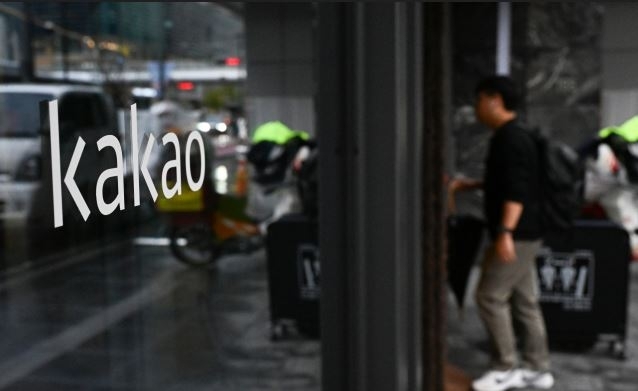
KT and Kakao, both of which fell short in the independent AI foundation model competition, are now making a fresh push through the AI for All project.
KT plans to pursue sovereign AI implementation and strengthen the domestic AI ecosystem by leveraging domestically produced neural processing units.
To that end, KT has partnered with Daum for portal services; DeepSearch for financial data technology; Lablup as an AI infrastructure startup; Rebellions for AI semiconductor fabless design; Mathpresso for education technology; Motif Technologies as an AI startup; Musinsa for fashion; Vessel AI Korea as an AI infrastructure startup; BC Card for finance and payments; Saltlux for AI services; ActionPower for AI-based voice recognition; Upstage for AI models; NC AI for AI models; Zigbang for real estate; Connectwave for e-commerce; and the Korea Educational Broadcasting System.
Kakao has formed a consortium with LG AI Research, LG Uplus, LG CNS and LG Electronics, with plans to collaborate across the full spectrum — from its own AI models and consumer-facing platforms to telecom-based service verification, devices, public system integration and AI infrastructure.
LG affiliates are expected to play a central role, covering AI models, real-world testing and devices. LG Uplus will handle usage environment verification and quality assurance, drawing on its telecom-based customer touchpoint capabilities. LG AI Research will provide and further develop the K-Exaone AI model and oversee safety verification.
LG Electronics will contribute device integration across living spaces, while LG CNS will support public system and data integration along with systems integration capabilities.
The consortium also includes Seoul National University Hospital and Lunit for validating health-specialized AI models; Wonderful Platform for senior care; Shinhan Bank, Jarvis & Villains and Worksphere for AI services covering finance, tax and employment; Day1 for expanding AI literacy; CrowdWorks for data quality; and Furiosa AI for AI infrastructure.
Meanwhile, MKD and Xenon entered the AI for All competition without forming separate consortiums.
ko@heraldcorp.com