Wonju's industrial complexes are reinventing themselves through culture.
City officials and private-sector partners in Wonju have agreed to expand youth content and strengthen K-food experiences at the city's designated "culture-leading industrial complex," befitting its status as the birthplace of the Buldak brand from Samyang Foods.
Wonju city announced Wednesday that it recently held a working-level meeting of the "Culture-Leading Industrial Complex Cultural Convergence Council" together with the Korea Industrial Complex Corporation's Gangwon Province branch, the Gangwon Design Promotion Agency, the Wonju Culture Foundation, and complex tenants Samyang Round Square, Samyang Foods and Onsecasero. The meeting reviewed ways to refine the project plan for the "Wonju Culture-Leading Industrial Complex Development Project," selected in July, and discussed next steps.
The Usan General Industrial Complex, completed in 1970, is one of the city's oldest industrial sites and serves as a hub for food manufacturing. The Taejang Agricultural and Industrial Complex, completed in 1991, has grown into a regional industrial base with a diverse mix of medical device, electronics, electrical and food companies.
The culture-leading complex project aims to layer cultural and youth content onto this industrial foundation, transforming the complexes from purely production-oriented spaces into places where people can work, enjoy themselves and linger.
The initiative's core brand is "Wonju, Wonder Plate" — a concept that evokes placing Wonju's industry and culture together on a single plate.
Plans call for developing K-food experiences and industrial tourism content by drawing on Samyang Foods and other K-food companies alongside local food industry resources. A youth design living lab, brand development programs and a regional content balanced-development support project are also planned to build a cultural ecosystem in which young people and local communities participate directly.
The project will also pursue the creation of a mixed-use cultural space and a parking tower, a streetscape improvement program for the Taejang Agricultural and Industrial Complex, upgrades to aging factories to make them more youth-friendly, and a regular "Culture Day" series — all aimed at improving both the physical environment and cultural conditions of the complexes.
Through the council, Wonju city plans to expand K-food content centered on Samyang Foods into a broader network of local food companies and cultural programming, while strengthening programs that bring together businesses, workers, young people and residents to sharpen the project's identity and long-term sustainability.
The Wonju Culture-Leading Industrial Complex Development Project will run from 2026 to 2030 with a total budget of 46.2 billion won ($32.6 million) — 27.5 billion won in national funding and 18.7 billion won in city funding — covering the Usan General Industrial Complex and the Taejang Agricultural and Industrial Complex.
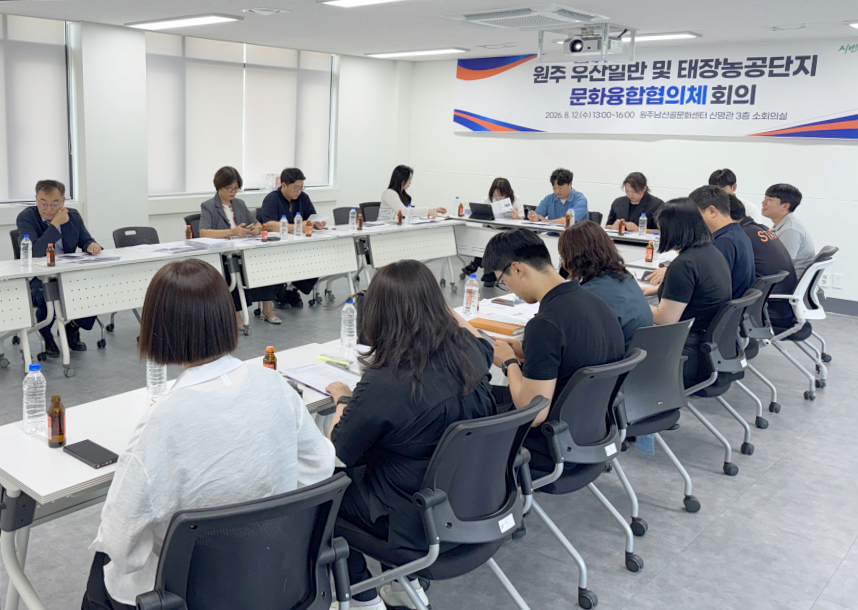
At the public-private council meeting, participants shared feedback from evaluators representing the Ministry of Trade, Industry and Energy, the Ministry of Culture, Sports and Tourism, and the Ministry of Land, Infrastructure and Transport, and discussed concrete ways to incorporate that feedback into the project plan.
Discussions focused particularly on diversifying Wonju's distinctive industrial and cultural content and broadening participation by local businesses, building on the project's core vision of creating "the world's No. 1 K-food and youth-centered culture-leading industrial complex."
"This project is not simply about renovating aging industrial complexes — it is a starting point for building a new industrial complex model where industry, culture and young people grow together," said Eom Byeong-guk, head of Wonju city's investment attraction division. "We aim to raise the competitiveness of the complexes by creating world-class cultural content centered on K-food and a youth-friendly industrial environment, and we will work to draw in a wide range of companies and expand cooperation and exchange among them to build a differentiated K-food cultural industry ecosystem that is uniquely Wonju's own."
abc@heraldcorp.com