![[Getty Images Bank]](https://wimg.heraldcorp.com/news/cms/2026/08/19/news-p.v1.20260818.338c148e655645fc900203819a259eae_P1.jpg)
AI-related patent filings in South Korea have grown nearly sevenfold over eight years, emerging as a key driver of domestic technological innovation, according to a new report.
The number of companies entering AI development has also surged from roughly 900 to more than 6,000, signaling a broadening of the field beyond large conglomerates to small and medium-sized enterprises and startups. However, the pace at which AI is converging with other technologies varies significantly by industry, and analysts say tailored support strategies that account for sector-specific conditions are needed.
The Korea Economic Research Institute, an affiliate of the Federation of Korean Industries, released the findings Wednesday in a report titled "Sector-by-Sector Structural Diagnosis of Korea's AI Technology Innovation and Its Implications." The institute analyzed about 1.88 million patents filed domestically between 2015 and 2024 and identified approximately 99,000 as AI-related.
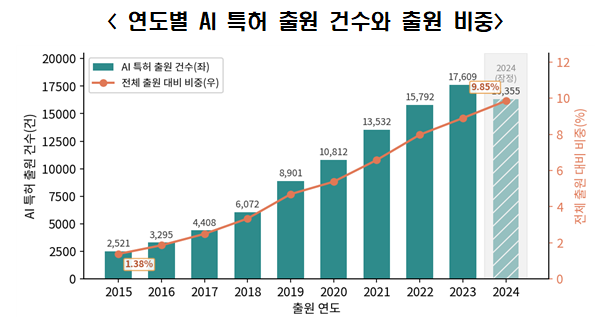
AI patent filings rose from 2,521 in 2015 to 17,609 in 2023 — an approximately sevenfold increase — with an average annual growth rate of 27.4 percent. Over the same period, total patent filings grew just 8.7 percent, from 182,072 to 197,837.
As a result, AI patents' share of all filings climbed from 1.38 percent in 2015 to 8.90 percent in 2023, meaning roughly 1 in 11 patents filed domestically that year was AI-related. The institute noted that with non-AI patent filings in effect stagnant, AI has accounted for most of the overall growth in domestic patent applications.
The range of companies pursuing AI development has also widened. The number of firms filing AI patents rose 6.8 times, from 921 in 2015 to 6,293 in 2023, while the average number of filings per company remained nearly flat — edging up from 2.74 to 2.80 over the same period. The institute concluded that new entrants among small and mid-sized firms and startups, rather than a handful of large companies dramatically expanding their portfolios, drove the overall increase in AI patents.
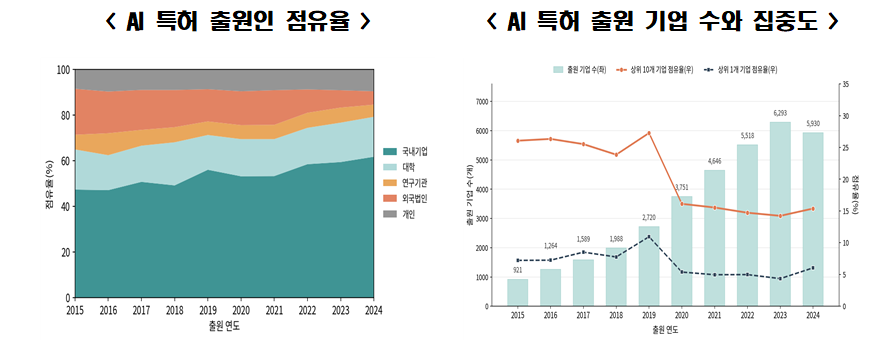
Concentration at the top has also eased. The combined share of the top 10 AI patent filers fell from 26.1 percent in 2015 to 14.2 percent in 2023. Samsung Electronics ranked first in annual AI patent filings in nine of the 10 years covered by the analysis; LG Electronics claimed the top spot in 2019.
Growth in AI patents varied sharply by sector. In 2023, the image and vision field led all categories with 7,495 AI patent filings, followed by finance and business with 5,195 and language and text with 2,335. Together, image and vision and finance and business accounted for 63.8 percent of all AI patents filed during the analysis period.
Not all sectors advanced at the same pace, however. When the institute analyzed 12 sub-fields by AI patent share and the speed of technology convergence, it found a clear gap — ranging from "leading" sectors where both development and integration are highly active, to "immature" sectors where progress has been comparatively slow.
The life sciences, medicine and health sector posted the highest quantitative growth, with AI patent filings rising 18.8 times over the analysis period, yet it recorded the slowest pace of new technology convergence among the 12 fields examined.
For sectors such as language and text and voice and audio — where both AI development and new technology integration are highly active — the institute recommended standardizing Korean-language AI performance benchmarks and securing an early lead in international AI standards. For sectors including agriculture and food, energy and environment, and security and authentication — which are in the early stages of AI adoption but show rapid technology convergence — it said support should focus on building sector-specific training datasets and cultivating and recruiting interdisciplinary talent.
"We must not be misled by the simple fact that patent filings have increased," said Lee Jun-hyeong, a visiting research fellow at the institute. "To sustain the current momentum of AI innovation, the government and companies must move away from a one-size-fits-all approach and design tailored policies and strategies that account for the innovation structure and bottlenecks specific to each sector."
go@heraldcorp.com