
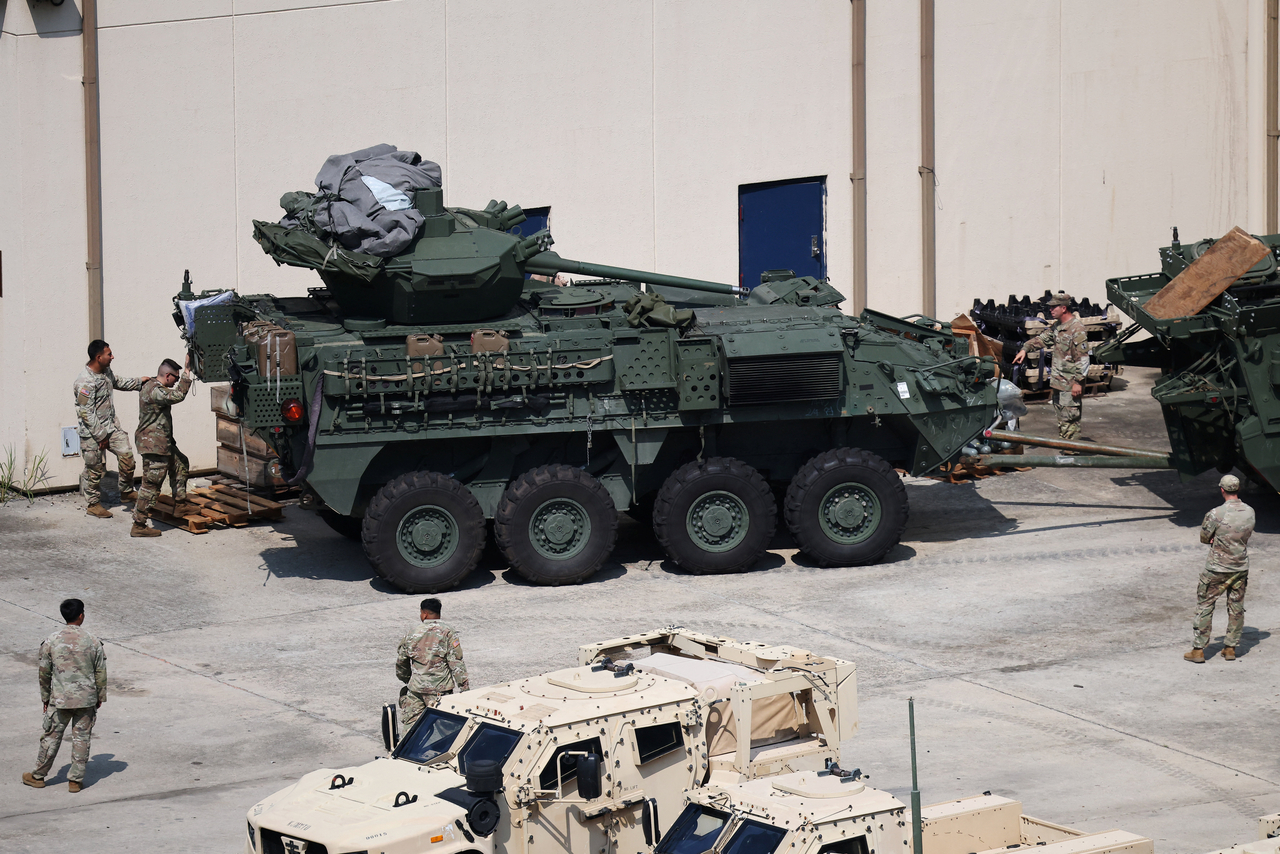
Analysts say Donald Trump's order to scale back joint US-South Korea military exercises reflects frustration over a grinding war with Iran — and that South Korea has become the latest "scapegoat" for that frustration.
Axios, the US political news outlet, published a report Tuesday headlined "As US shows limits of hard power against Iran, Trump lashes allies," arguing that Washington has spent six months trying to force Iran into submission through "hard power" — its overwhelming military and economic might — and, having failed, is now turning on its partners.
Axios added that since beginning his second term, Trump has battered allies and insulted their leaders, using security relationships to settle personal and political scores. That impulse, the outlet said, has intensified as the Iran war has dragged on, deepening his anger toward allies who have not joined the fight.
Axios said South Korea — a country Defense Secretary Pete Hegseth had praised as an "exemplary ally" — had become "the most recent surprising scapegoat" in Trump's campaign of punishment against partners.
On Monday, Trump ordered a sharp reduction in Ulchi Freedom Shield, the annual combined exercise the two countries conduct to deter North Korea, saying, "We can't go around protecting all these countries — especially when they don't come out to help us." Axios said the remark offered a clear window into his anger at allies who have stayed out of the Iran conflict.
Axios argued that Trump is effectively signaling to allies that they cannot count on the United States when it matters most — an incentive for them to reduce their dependence on Washington and a slow erosion of the network of relationships that has underpinned American power for generations.
Axios described Ulchi Freedom Shield as "a key pillar of the deterrence architecture that has bound Washington and Seoul against a nuclear-armed North Korea for the past half-century." Even foreign-policy veterans from Republican administrations criticized Trump's decision to curtail the exercise as contrary to US national interests.
Dan Fried, who served as assistant secretary of state for European affairs under President George W. Bush, told the Associated Press he could see "no American national interest" in the decision to scale back the joint drills. "It makes no sense on any level," he said, adding that it "weakens South Korea and Japan, terrifies Taiwan, unsettles NATO, and emboldens North Korea as well as China."
Charles Kupchan, a senior fellow at the Council on Foreign Relations who served on the National Security Council under both Bill Clinton and Barack Obama, said Trump was not wrong to want South Korea and Europe to contribute more to their own defense — but that his unpredictable approach undermined cohesion "because it comes out as insulting allies."
CNN reported that Trump's statements about South Korea, made to reporters at the White House, were "all wrong."
On Trump's claim that 39,000 US troops are stationed in South Korea, CNN noted that the Defense Ministry said the actual figure as of late March was 26,589. Trump has repeatedly misstated the size of the US Forces Korea contingent since his presidential campaign: in October 2024 he put the number at 40,000, and in June he claimed it was 45,000. Some analysts say the persistent inflation of the figure is a deliberate exaggeration intended to pressure Seoul into paying more for its defense.
Trump also claimed that South Korea had never paid its share of defense costs until he secured a $3 billion commitment during his first term (2017–2021), and that former President Joe Biden later scrapped the burden-sharing agreement at Seoul's request following what Trump called a fraudulent 2020 election. CNN said all of those claims were false.
The Herald Business International Desk publishes a daily newsletter and series tracking the latest Trump developments.
kate01@heraldcorp.com




