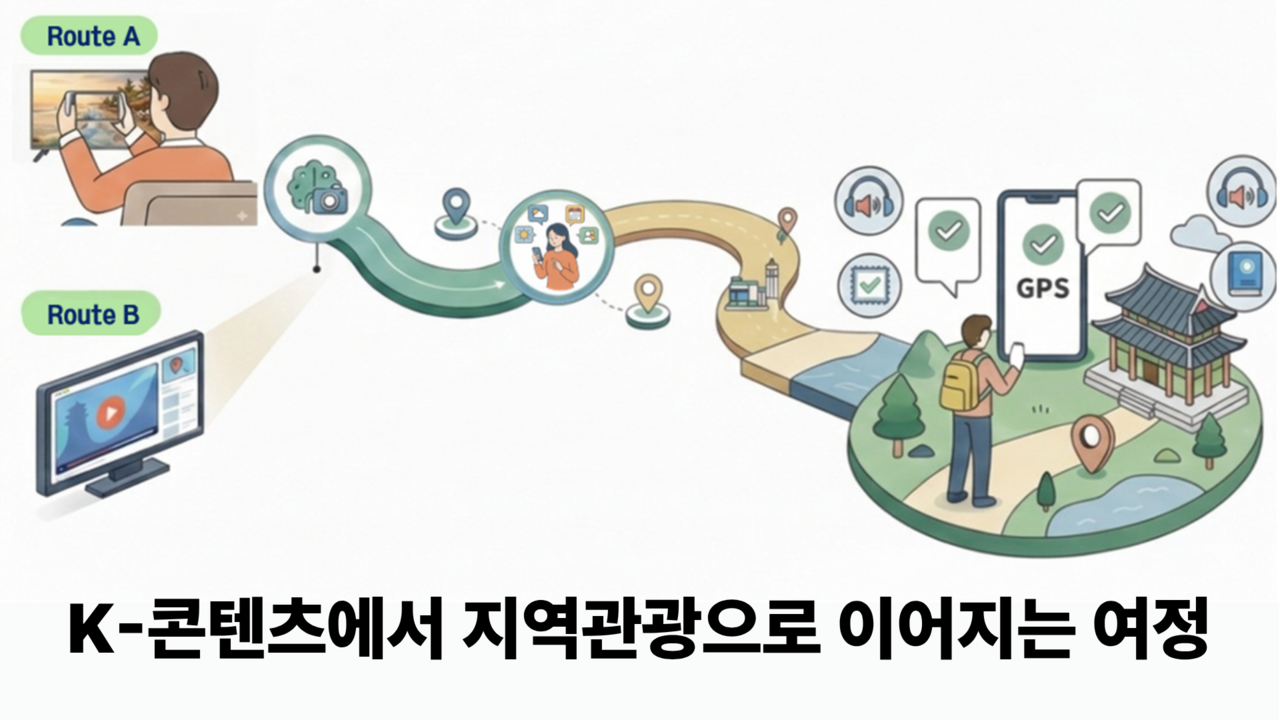
![An illustration of technology linking scenes from broadcast and video content to tourism destination information [Provided by IsPMP]](https://wimg.heraldcorp.com/news/cms/2026/08/18/news-p.v1.20260818.8dd6e3f062fe4f0589e21210b451693a_P1.png)
Development is now underway on a tourism platform that uses AI to identify filming locations from K-dramas and other video content, then connects users to travel itinerary recommendations and bookings.
MICE specialist IsPMP said Tuesday it has been selected as the lead research institution for a new 2026 Ministry of Culture, Sports and Tourism research and development project titled "Development of AI Agent Service Technology for Broadcast and Video Location-Based Tourism to Revitalize Regional Tourism."
The project aims to integrate the fragmented process — from information search and travel planning to booking and payment — for foreign tourists visiting South Korea through K-content, while channeling tourism spending into local neighborhood commercial districts.
Users can capture a scene while watching a K-drama, or share a video link, to identify where it was filmed. They can then receive tourism recommendations tailored to their nationality, preferences and travel schedule, and book or purchase accommodations, transportation, restaurants and tourism products directly through the app.
IsPMP will form a consortium with Solidio, Kona I, iWay and Kyung Hee University's Industry-Academic Cooperation Foundation to develop five core AI technologies over the next three years. The targets are: an AI for automatic filming-location recognition, a hyper-personalized recommendation AI engine, a hallucination-minimizing tourism-specialized AI agent, a personalized route-guidance AI, and an augmented reality immersive experience.
IsPMP also plans to offer discounts and reward points linked to local currencies so that tourist spending flows into regional commercial districts. The company envisions redirecting K-content tourism demand — currently concentrated in Seoul — toward regional areas and population-declining zones, boosting sales for local small businesses and neighborhood shops.
Central to the technology development is building a dataset that accurately links scenes from broadcast and video content to real-world tourism destinations. That requires integrating location metadata containing filming-site coordinates and scene information, data on tourism facilities, content and accessibility, and data on tourists' visit, booking and spending behavior.
IsPMP said it has accumulated relevant data through building smart tourism platforms for seven local governments. The data and operational experience gained in that process form the foundation for pursuing this government-designated project, the company said.
Twenty application programming interfaces and three plug-ins developed during the project will be distributed free of charge to small and midsize IT companies in regional areas, enabling them to build their own tourism services and expand the local AI tourism service ecosystem.
Through these efforts, the company said it aims to contribute to the government's goal of attracting 30 million foreign tourists by 2030, while also helping revitalize tourism in population-declining regions and counter local community decline.
"The data and experience we have built up through developing smart tourism platforms are accelerating the development of these five core technologies," said Choi Hak-chan, chief commercial officer of IsPMP. "We will create a virtuous cycle in which the reach of K-content translates into real spending in local neighborhood districts, and go beyond executing this government project to expand into a commercialization structure — positioning ourselves as a market-leading AI tourism technology company."
terry@heraldcorp.com