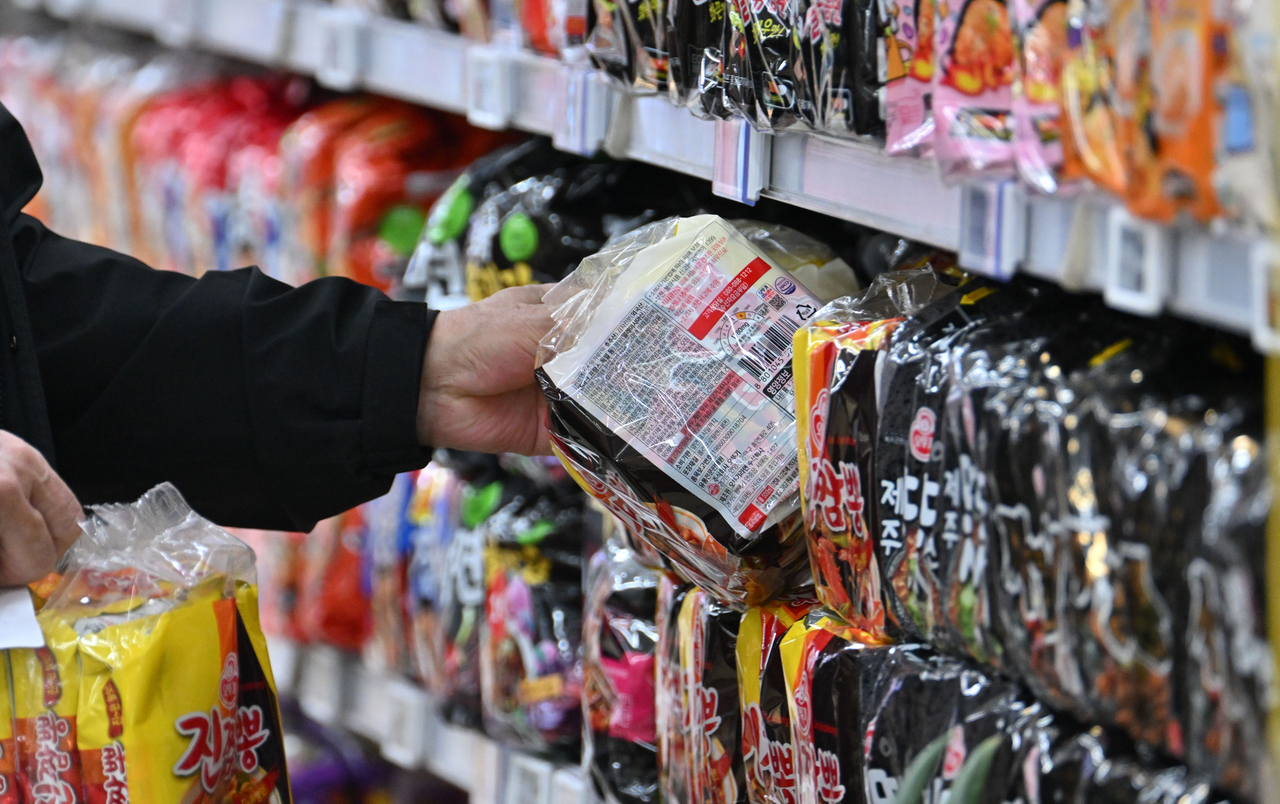
South Korea's ramyun makers posted solid first-half growth on the back of strong overseas demand, but mounting raw-material costs have pushed them to raise cup ramyun prices in quick succession.
Industry sources said Nongshim recorded consolidated sales of 1.89 trillion won ($1.34 billion) in the first half, up 7.3 percent from the same period last year. Overseas sales drove the gain, jumping 26.8 percent to 641.4 billion won as global appetite for K-ramyun expanded. Domestic sales edged down 0.5 percent to 1.25 trillion won, reflecting a broader contraction in the home market. Exports and overseas subsidiaries were also the main contributors to first-half operating profit growth, which rose from 96.2 billion won a year earlier to 126.7 billion won.
Samyang Foods posted even sharper growth, with first-half consolidated sales jumping 37.2 percent year-on-year to 1.48 trillion won. Exports surged 42.4 percent to 1.23 trillion won, while domestic sales rose 25.3 percent to 207 billion won. The contrast was especially stark in noodle snacks: export growth reached 7.9 percent against a domestic gain of 41.7 percent. Driven by its ramyun business, Samyang Foods also crossed the 600 billion won mark in overseas sales for the first time in the second quarter, reaching 646.8 billion won.
Ottogi also saw a wide gap between its overseas and domestic growth rates. First-half consolidated sales rose 4.2 percent to 1.9 trillion won, with overseas sales climbing 12.3 percent to 220.5 billion won. Domestic sales grew just 3.2 percent to 1.68 trillion won. First-half operating profit came in at 104.6 billion won, with a growth rate of only 2.0 percent.
Despite the solid top-line performance, all three companies have recently raised cup ramyun prices. Nongshim increased the factory price of its cup ramyun products by an average of 6.0 percent this month — the first price increase since March last year, a gap of one year and five months. The price of its Yukgaejang Sabal Ramyun will rise from 1,100 won to 1,200 won as a result. Ottogi plans to raise prices on 29 products across 11 cup ramyun brands — including Jin Ramen, Yeol Ramen and Chamkkae Ramen — by an average of 6.7 percent starting Sept. 7.
The companies cite rising input costs as the reason. They point to higher prices for raw materials such as flour and palm oil, as well as packaging, driven by a weak won and swings in international oil prices. Data from the Korea Agro-Fisheries and Food Trade Corporation show that the average price of hard red winter wheat — the main ingredient in flour — on the Chicago Mercantile Exchange this month was $266.31 per ton, up 39.1 percent from the same month last year. The year-to-date average of $231.79 per ton is the highest in three years, since 2023, when the effects of the war in Ukraine were still being felt.
Earnings reports confirm the cost pressure. Nongshim's average purchase price for imported wheat in the first half was $214 per ton, up 9.2 percent from last year, while palm oil rose 9.2 percent over the same period to $1,139 per ton. Ottogi saw its import price for edible oils — including soybean and palm oil — jump 15.7 percent, from $1,120 per ton last year to $1,296 per ton in the first half. Samyang Foods has not adjusted its domestic ramyun prices, but its palm oil procurement cost rose 3.9 percent year-on-year to 1,845 won per kilogram in the first half.

spa@heraldcorp.com