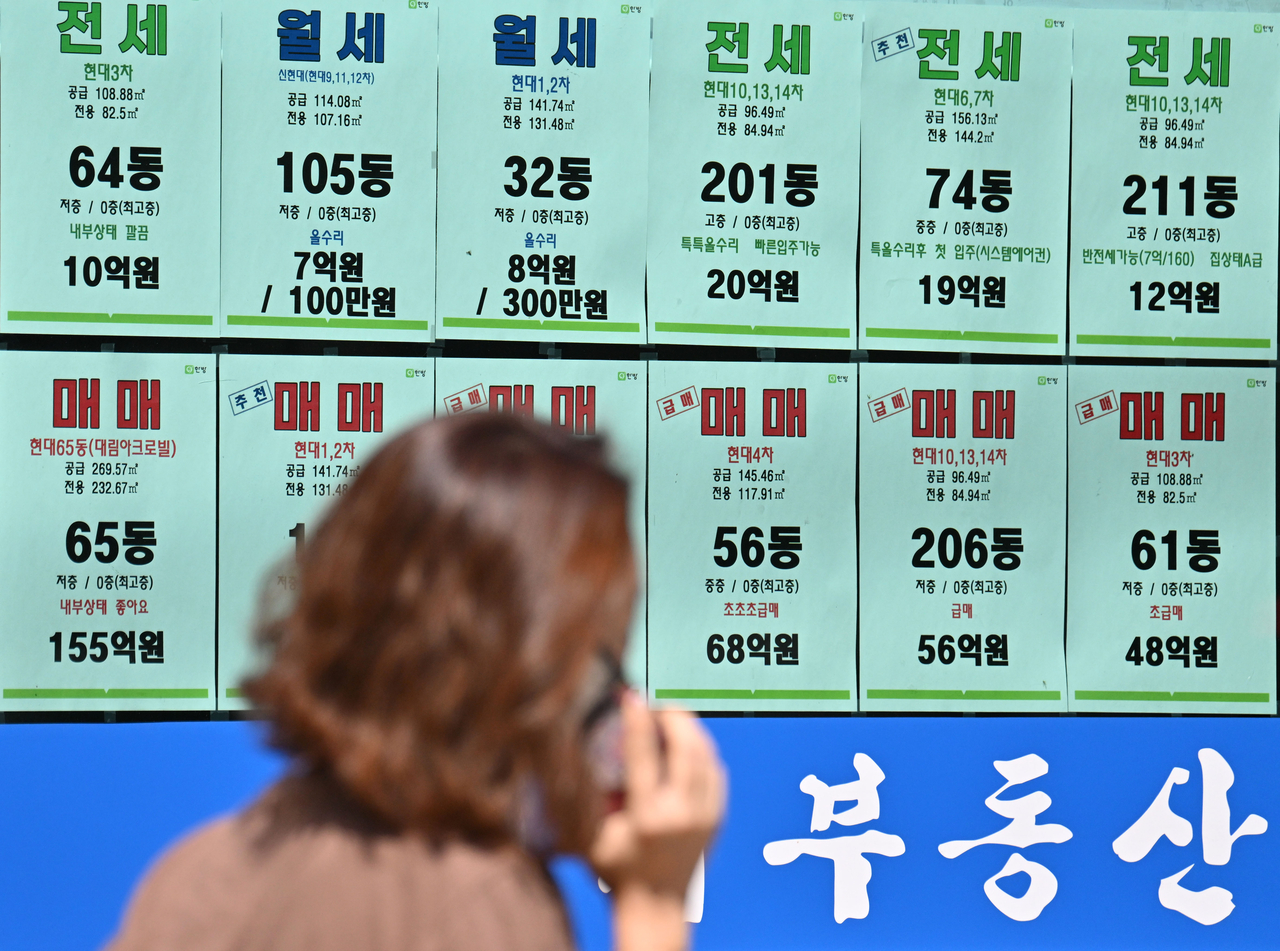
The shift from jeonse to monthly rent in Seoul's apartment market is accelerating, as growth in monthly-rent households is outpacing the decline in jeonse households even as the overall renter population has grown only modestly. Over the past seven years, the number of Seoul apartment households on jeonse contracts fell by more than 30,000, while those on monthly rent — including semi-jeonse arrangements — rose by more than 50,000.
According to an analysis of microdata from the Korean Statistical Information Service (KOSIS) residential survey released Monday, jeonse households accounted for 371,972, or 61.9 percent, of Seoul apartment renters in 2024, while monthly-rent households — with or without a deposit — numbered 229,029, or 38.1 percent.
When the survey began under the current sampling framework in 2017, jeonse households stood at 406,855, representing 69.7 percent, and monthly-rent households at 177,269, or 30.3 percent.
Over the seven-year period, the jeonse share fell 7.8 percentage points while the monthly-rent share rose by the same margin. In absolute terms, monthly-rent households increased by 51,760 while jeonse households declined by 34,883.
Over the same period, total renter households in Seoul apartments grew only modestly — from 584,124 to 601,001, an increase of roughly 17,000.
Looking at the trend by year, the monthly-rent share hit its lowest point during the COVID-19 pandemic in 2020 at 28.8 percent, or 172,876 households, before surging nearly 10 percentage points to 38.4 percent in 2021.
It then eased to 37.2 percent in 2022 and 35.6 percent in 2023, before climbing back to 38.1 percent in 2024.
An official at the Korea Research Institute for Human Settlements, which compiles the statistics, said fluctuations can occur from year to year depending on market conditions such as interest rates and broader social sentiment, but that the overall trend points toward fewer jeonse contracts and more monthly-rent arrangements.
Some market observers expect the shift toward monthly rent to intensify further. Recent proposed changes to real estate tax policy emphasizing owner-occupancy could further dampen the jeonse market, they say. As the tax burden rises for multi-home owners and non-resident single-home owners, more landlords may choose to sell their properties or switch from jeonse to monthly-rent contracts.
Meanwhile, the government announced Aug. 13 a rapid housing supply plan aimed at stabilizing the jeonse, monthly-rent and sales markets, including more than 230,000 additional units — among them new residential sites in the greater Seoul area. The plan also calls for introducing a publicly supported private rental model with lease terms of 20 years or more to help young people, newlyweds and other younger households achieve housing stability.
gil@heraldcorp.com