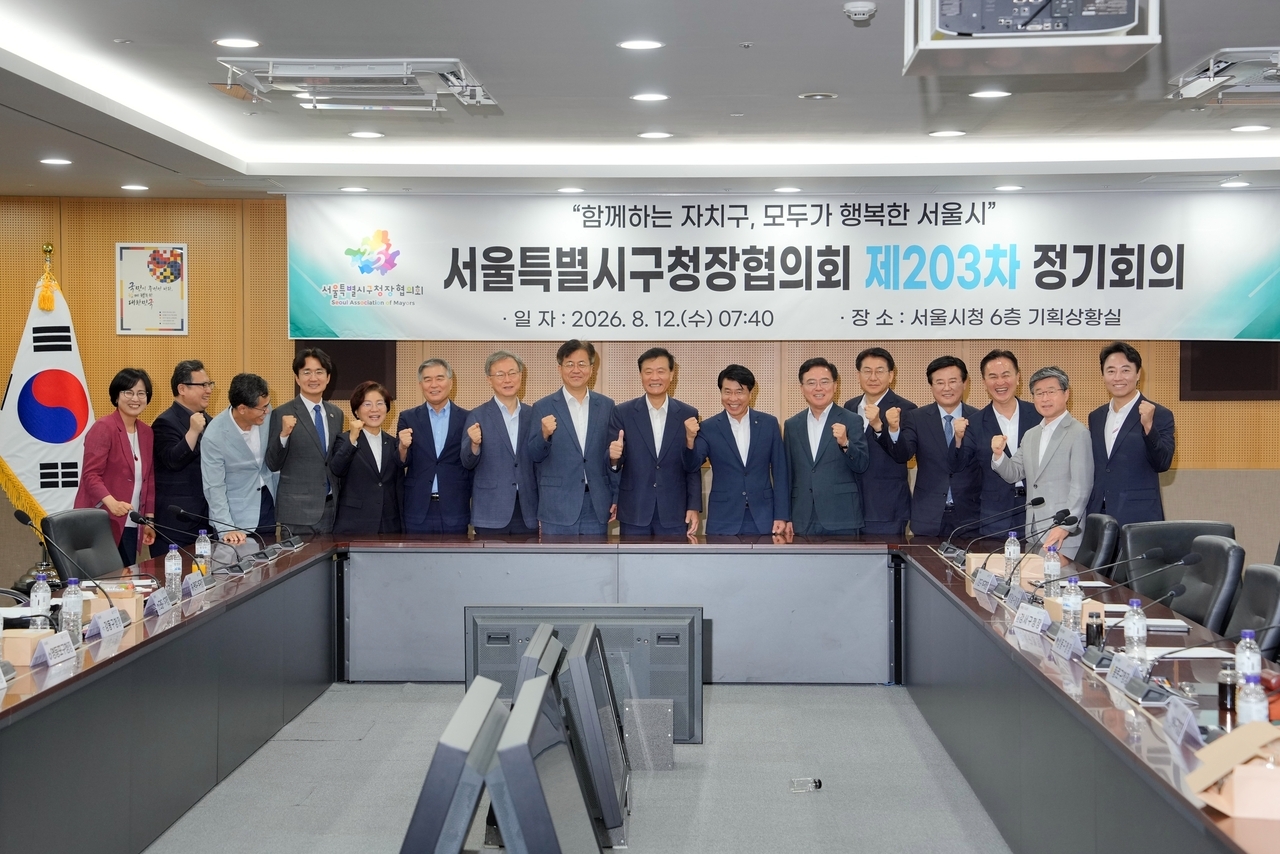
First-term district mayors elected in the June 3 local elections have been racing to get up to speed on local issues and communicate with staff since taking office.
Particularly for those without prior experience in Seoul city or district administration, navigating complex bureaucratic procedures and organizational management has posed no small challenge.
Amid that backdrop, Yeongdeungpo-gu District Mayor Cho Yu-jin and Dongjak-gu District Mayor Ryu Sam-young drew attention by making a successful policy debut — each putting forward concrete reform proposals on local issues at the Seoul District Mayors' Council.
Cho proposed regulatory changes to prevent data centers, whose construction demand has surged in the AI era, from being built indiscriminately in residential areas.
Ryu called on Seoul to delegate to district offices the authority to designate improvement zones for small-scale redevelopment and reconstruction projects involving fewer than 500 households, in order to accelerate such projects.
To be sure, both proposals face significant hurdles before they can become actual policy, including amendments to Seoul Metropolitan Government ordinances and relevant national laws.
Still, first-term mayors barely a month into office have already identified key local issues and put forward specific reform measures through the council — a fact that has drawn notice.

Cho Yu-jin: restrict data centers in second- and third-class general residential zones
Yeongdeungpo-gu District Mayor Cho Yu-jin has moved to reform regulations to protect residents' living environment from data centers being built indiscriminately in residential areas.
As the AI industry grows rapidly, data centers have emerged as essential infrastructure. But concerns among residents are mounting over power and water shortages caused by massive electricity consumption and coolant use, as well as noise and heat generation.
Eight data center construction projects have been completed, are underway or are planned in Yeongdeungpo-gu — one completed, two under construction, one scheduled for construction, and four that have applied for building permits or architectural review.
The district has determined that if additional construction applications continue beyond the projects already underway, the seven substations within Yeongdeungpo-gu may be insufficient to meet power supply needs. That shortfall could affect not only general buildings but also redevelopment and reconstruction projects.
Under current law, however, data centers are classified as broadcasting and communications facilities and face virtually no construction restrictions outside first-class general residential zones.
Local governments also lack a legal basis to restrict building permits for data centers based on local power supply conditions or residents' opinions.
In response, Cho submitted a formal proposal on data center construction regulations to the 203rd regular meeting of the Seoul District Mayors' Council on Wednesday. The proposal passed unanimously.
Yeongdeungpo-gu plans to first ask the Seoul Metropolitan Government to revise the operating guidelines of the Seoul Metropolitan Architecture Committee to require mandatory district-level architectural review before any data center construction.
The district will also pursue an amendment to Seoul's urban planning ordinance to allow restrictions on data center construction in second- and third-class general residential zones.
Over the longer term, the district intends to push for amendments to the Building Act to allow building permit restrictions — based on local conditions — for data centers in quasi-residential, quasi-industrial and commercial zones as well.
"Residents have serious concerns about data centers being built in densely populated residential areas," Cho said. "Relevant laws and ordinances must be revised urgently, taking into account the climate crisis and issues of power and water supply, and district offices should be empowered to decide whether to grant building permits based on local conditions."
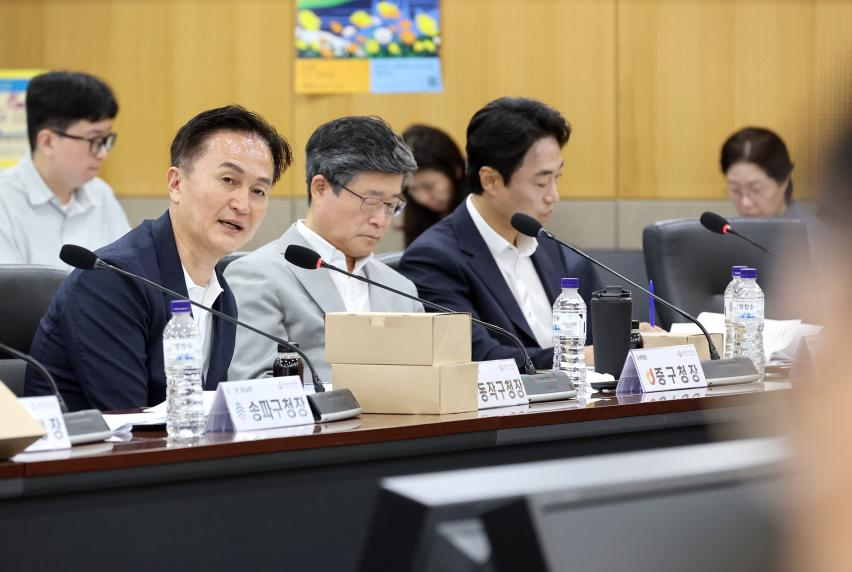
Ryu Sam-young: give district offices authority to designate improvement zones for projects under 500 households
Dongjak-gu District Mayor Ryu Sam-young has formally proposed that Seoul delegate to district offices the authority to designate improvement zones for small-scale urban renewal projects, so that such projects can move forward more quickly in line with local conditions and residents' needs.
Ryu submitted "Delegation of Authority to District Offices for Designation and Modification of Improvement Zones" as a formal agenda item at the 203rd regular meeting of the Seoul District Mayors' Council, held Wednesday at Seoul City Hall.
Ryu's assessment is that while redevelopment and reconstruction projects — including those under the city's fast-track integrated planning scheme — continue to grow in Seoul, key authority over urban renewal remains concentrated in the central government and the Seoul Metropolitan Government. That concentration limits district offices' ability to respond swiftly to residents' demands.
Under the current Act on the Improvement of Urban Areas and Residential Environments, the authority to designate improvement zones rests with the Seoul Metropolitan Government. District offices are also limited to making minor modifications of up to 10 percent to improvement plans — covering factors such as area, building coverage ratio and floor area ratio — on their own.
To address these constraints, Ryu proposed delegating to district offices the authority to designate improvement zones for small-scale projects involving fewer than 500 households, and expanding the range of minor modifications that districts can handle independently from the current ceiling of 10 percent to less than 20 percent.
The rationale is that small-scale renewal projects are more closely tied to residents' daily lives than large-scale developments, and district offices — which best understand local conditions and residents' needs — should be able to reflect neighborhood characteristics from the earliest stages of a project.
Delegating zone designation authority to district offices is expected to reduce unnecessary administrative steps, shorten project timelines, and improve both the pace of renewal as experienced by residents and the responsiveness of district administration.
"Pushing forward urban renewal projects with real momentum can be the most visible and tangible achievement that residents feel most quickly," Ryu said. "Dongjak-gu will actively pursue regulatory reform so that projects can move forward at a pace that satisfies our residents."
The policies put forward by Cho and Ryu each target a distinct challenge: the new urban problems arising from the spread of AI, and the redevelopment and reconstruction issues that rank among residents' top concerns.
Whether the two first-term mayors' debut policy proposals will ultimately lead to amendments to Seoul ordinances and national legislation remains to be seen.
seouldream01@heraldcorp.com