
Editor's note: Chip Chip Fab Fab is a series that explores the semiconductor industry powering the AI era — in depth and in plain language. The name connects the "chip" at the heart of the AI revolution with the "fab" that makes it, and echoes the rhythmic chug of a train in motion, capturing the semiconductor industry's relentless advance. The series breaks down complex technology into accessible reporting while digging into the stories behind the headlines and the forces shaping the industry, tracking the present and future of the semiconductors driving the AI age.
![An AI-generated image depicting Samsung Electronics and YMTC. [Image generated via ChatGPT]](https://wimg.heraldcorp.com/news/cms/2026/08/14/news-p.v1.20260814.a83e95f8ba6243aab8278e344ce0059b_P1.png)
Welcome to Chip Chip Fab Fab. Today, we turn to the NAND market.
Just two weeks ago, we reported that China's CXMT had captured fourth place in the global DRAM market by shipment share, trailing only Samsung Electronics, SK hynix and Micron.
Today, we look at the remarkable rise of another Chinese memory chip maker — Yangtze Memory Technologies Co., known as YMTC — which is shaking up the NAND market in ways the industry is only beginning to reckon with.
YMTC claims historic No. 3 ranking, upending the NAND market
![NAND flash shipment market share for the second quarter of 2026. [Counterpoint Research]](https://wimg.heraldcorp.com/news/cms/2026/08/14/news-p.v1.20260814.25e0ddec63aa4c5d8b97a3934e95e263_P1.png)
Market research firm Counterpoint Research released its second-quarter NAND shipment share data on Thursday. Samsung Electronics led with a 25% share, while SK hynix — including its subsidiary Solidigm — held a combined 22% to retain second place, with SK hynix at 13% and Solidigm at 9%.
Below that, the rankings told a more dramatic story. YMTC claimed third place for the first time with a 14% share, edging out Kioxia, which also held 14%. Micron trailed at 13% and SanDisk at 11%.
YMTC posted growth of 22% year-on-year and 5% quarter-on-quarter. A supply shortage among Korean chipmakers opened the door.
"Samsung Electronics prioritized higher-margin DRAM production amid limited manufacturing capacity, which weighed on its NAND shipments," Counterpoint Research said. "YMTC benefited from the resulting supply gap."
![NAND flash revenue market share trend over the past eight quarters. Source: Counterpoint Research. [Image generated via ChatGPT]](https://wimg.heraldcorp.com/news/cms/2026/08/14/news-p.v1.20260814.0fd17b70c2ac499fb30a25f32fcd9b85_P1.png)
Counterpoint Research's quarterly NAND revenue share data tells the same story in starker terms: the share Samsung Electronics has lost — falling from 35% in the second quarter of 2024 to 29% in the first quarter of 2026 — has gone almost directly to YMTC, which rose from 6% to 13% over the same period.
YMTC's profitability, however, remains limited. As the AI industry shifts from model training toward inference, the most lucrative segment of the NAND market is enterprise solid-state drives, or eSSD. YMTC's production is still concentrated in PC and mobile NAND — meaning it is selling a lot without making much money.
Measured by revenue, YMTC ranks fifth, behind Samsung Electronics, SK hynix, Kioxia and Micron. Even so, capturing 14% of total NAND shipments — in a market where eSSD already accounts for 48% of volume — using relatively low-margin PC and mobile products alone signals a pace of growth the industry cannot ignore.
Capacity expansion to rival Samsung and SK hynix — IPO to fund the push
![The YMTC NAND flash factory in Wuhan, China. [YMTC website]](https://wimg.heraldcorp.com/news/cms/2026/08/14/news-p.v1.20260814.6a8a58cbb5084075b8bde80a1a8df32e_P1.png)
YMTC's expansion pace is equally striking. The company is building its third NAND factory in Wuhan, with operations set to begin by year-end and full-scale production expected next year. In April, reports emerged that YMTC plans to build two additional factories. Once all three facilities run at 100,000 wafers per month each, YMTC would have a combined monthly capacity of 300,000 wafers.
For context, Samsung Electronics produces roughly 390,000 NAND wafers per month, while SK hynix — including Solidigm — produces around 240,000, according to industry sources. Samsung is configuring part of its new P5 line in Pyeongtaek for NAND production, and SK hynix has announced plans to build a new NAND fab, M17, in Cheongju. If YMTC's expansion proceeds as planned, its monthly capacity would reach 500,000 wafers — surpassing both Korean rivals.
To fund that buildout, YMTC is preparing an initial public offering targeting a valuation of 1 trillion yuan ($148 billion).
The recently listed CXMT carried a valuation of around 580 billion yuan at the time of its IPO. Its share price has since surged, pushing its market capitalization to roughly 3.54 trillion yuan as of Thursday — overtaking Alibaba, Tencent and other Chinese giants to become the most valuable listed company in China.
CXMT is widely regarded as technologically behind the top three memory chip makers, yet its market cap already stands at roughly 47% of Samsung Electronics' and about 64% of SK hynix's. YMTC is a different proposition — its technology is considered on par with Samsung Electronics and SK hynix.
'More threatening than CXMT' — YMTC seen locking in third place with enterprise push
![YMTC has launched a new enterprise eSSD product with specifications nearly identical to Samsung Electronics' enterprise eSSD NAND (PM1753). [YMTC website]](https://wimg.heraldcorp.com/news/cms/2026/08/14/news-p.v1.20260814.46650fec40b049f8a823a9e296e6f1df_P1.png)
A senior executive at one of the two leading memory chip companies put it bluntly in a recent conversation. "The real problem isn't CXMT — it's YMTC," the executive said. "With CXMT, Korean companies have roughly a three-year technology lead in HBM. But NAND has a relatively lower technology barrier than DRAM. Right now, YMTC is ahead of CXMT in both technology and production capacity."
Samsung Electronics and SK hynix recently showcased their next-generation NAND products at FMS 2026, one of the world's premier memory technology conferences. Samsung unveiled its 10th-generation V10 BV (Bonding Vertical) NAND, stacking more than 400 layers, while SK hynix presented its 10th-generation 4D NAND flash at 375 layers.
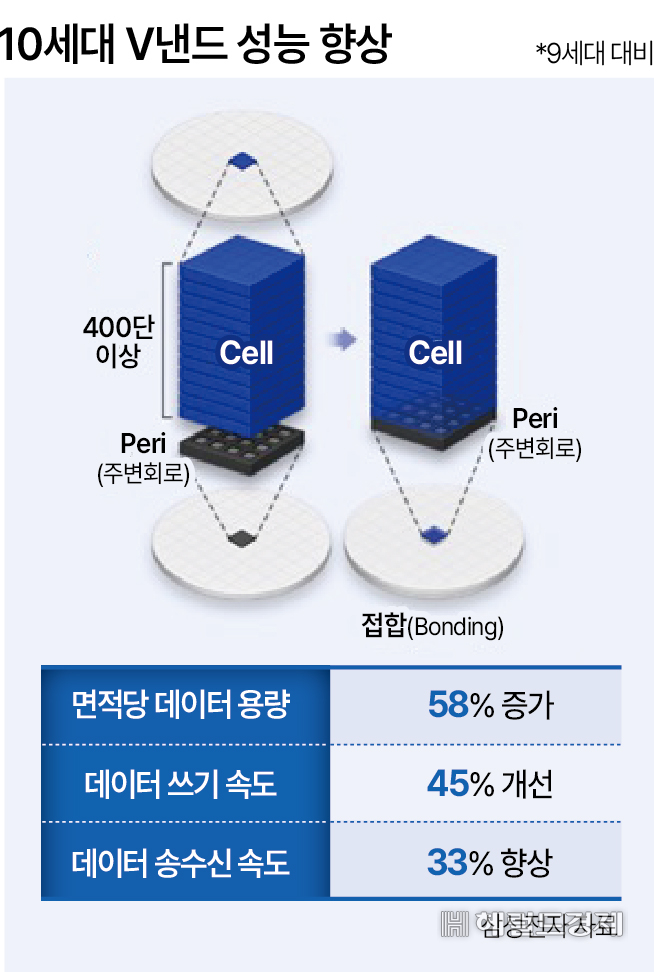
YMTC showed approximately 294-layer NAND at FMS 2025 last year. In raw layer count, Korean chipmakers appear to hold the edge — but YMTC has a technology called Xtacking that changes the calculus. Xtacking is a 3D NAND architecture that fabricates memory cells and peripheral circuits on separate wafers, then bonds them directly using wafer-to-wafer hybrid bonding. YMTC has used this approach for years to achieve superior area efficiency.
Samsung Electronics licensed hybrid bonding patents from YMTC last year to apply the technology to its latest NAND products — a recognition that stacking beyond 400 layers demands a fundamentally different approach.
Kim Jae-jun, executive vice president of Samsung Electronics' memory business, said at the company's second-quarter earnings call that Samsung plans to begin mass production of its 10th-generation V-NAND using bonding and three-stack technology starting this month — the first time Samsung will manufacture NAND using YMTC's patented technology.
![Trend in hybrid bonding technology patent disclosures by YMTC, Samsung Electronics and SK hynix. [KnowMade hybrid bonding patent landscape report, September 2024]](https://wimg.heraldcorp.com/news/cms/2026/08/14/news-p.v1.20260814.53bf7c3d3d22454a88f5aa89e74363e8_P1.png)
YMTC already leads Samsung Electronics and SK hynix in Xtacking-related intellectual property. According to KnowMade, a French firm specializing in semiconductor and advanced-technology patent analysis, YMTC holds 119 hybrid bonding patents filed between 2017 and January 2024, compared with 83 for Samsung Electronics (2015–2023) and just 11 for SK hynix (2020–2023).
YMTC also plans to shift its product mix toward eSSD in the second half of this year, aiming to improve both profitability and market share simultaneously.
TrendForce, in a NAND report published in January, projected "significant" market share growth for YMTC.
TrendForce also forecast that YMTC would establish itself as a major global player over the long term, driven by its entry into the server NAND market and a successful IPO. With Xtacking positioned as a key next-generation technology, YMTC no longer looks like a late entrant — it looks like a game changer with the potential to redraw the NAND market entirely.
go@heraldcorp.com




