
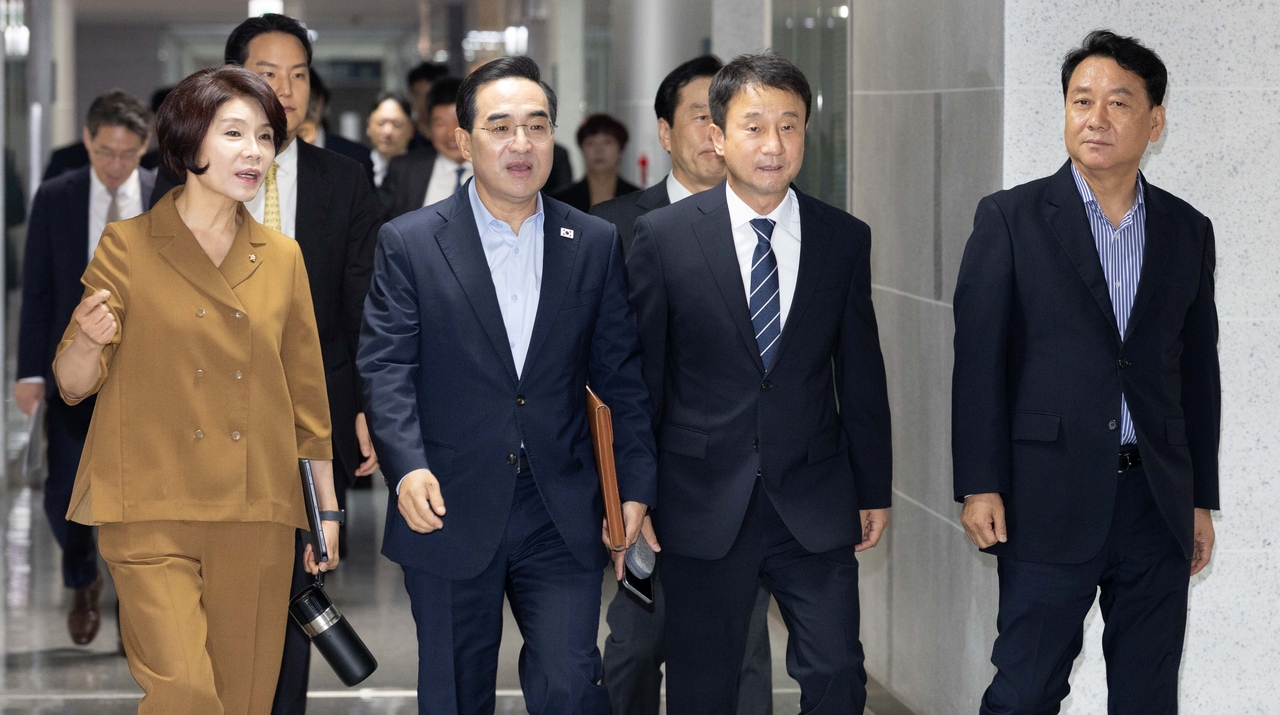
The Democratic Party of Korea and the government have launched final reviews for next year's budget proposal, which is set to exceed 800 trillion won ($565 billion) — a record high. The two sides plan to hold a separate consultation later this month to discuss the budget's overall scale and direction.
Han Jeong-ae, the Democratic Party's policy committee chairwoman, told reporters Friday after a working-level party-government consultation on the 2027 budget with the Ministry of Planning and Budget at the National Assembly that "we will hold a separate party-government meeting in late August to discuss the budget scale and direction again."
The consultation was attended by Han, Democratic Party senior policy vice chairman Park Sang-hyeok, National Assembly Budget and Accounts Special Committee Chairman Lee Gwang-jae, and Ministry of Planning and Budget Vice Minister Jo Yong-beom, among others. The meeting reviewed the extent to which the Democratic Party's earlier demands had been reflected before the government finalizes the budget's size and details.
Han said the party received an explanation from the government on "how the demands made at the time are being reflected." The two sides had previously discussed drafting next year's budget at a record level exceeding 800 trillion won, along with plans to restructure expenditures.
Meanwhile, a closed-door party-government consultation on the creation of a new "Future Response Fund" that had been scheduled for Friday was postponed. The delay stemmed from unresolved coordination within the government over a proposed overhaul of the local education finance grant system, which is to be included in the fund's establishment plan.
Minister Park wrote on Facebook on Thursday that he was "in final consultations with the Ministry of Education on the grant formula overhaul to be included in the upcoming Future Response Fund plan," adding that he would "do his best to reach a reasonable conclusion that most citizens will find satisfactory."
The Ministry of Planning and Budget and the Ministry of Education are at odds over whether to revise the formula that automatically allocates 20.79 percent of domestic tax revenue to local education grants. The planning ministry argues that factors such as the nominal growth rate and school-age population should be reflected, while the education ministry maintains that the current system linking grants to domestic tax revenue should be preserved.
The Democratic Party's national convention on Monday, at which new party leadership is to be elected, also appears to have influenced the scheduling of the consultations. A Democratic Party official said the delay likely reflected a judgment that "since this is a matter that requires consultation with the National Assembly, it would be appropriate to discuss it with those who will be responsible for taking it forward."
thanks@heraldcorp.com




