![The CATL logo at the company's Tech Day event in Beijing, China, on April 21. [Yonhap-Reuters]](https://wimg.heraldcorp.com/news/cms/2026/08/14/rcv.YNA.20260710.PRU20260710271601009_P1.jpg)
South Korea's National Pension Service increased its investment in mainland China-based companies by more than 3.4 trillion won over the past year, an analysis shows. Even as the US-China rivalry remains a persistent variable for investors in Chinese equities, some stocks have rallied after being added to US restriction lists, drawing renewed attention to the investment appeal of the Chinese market.
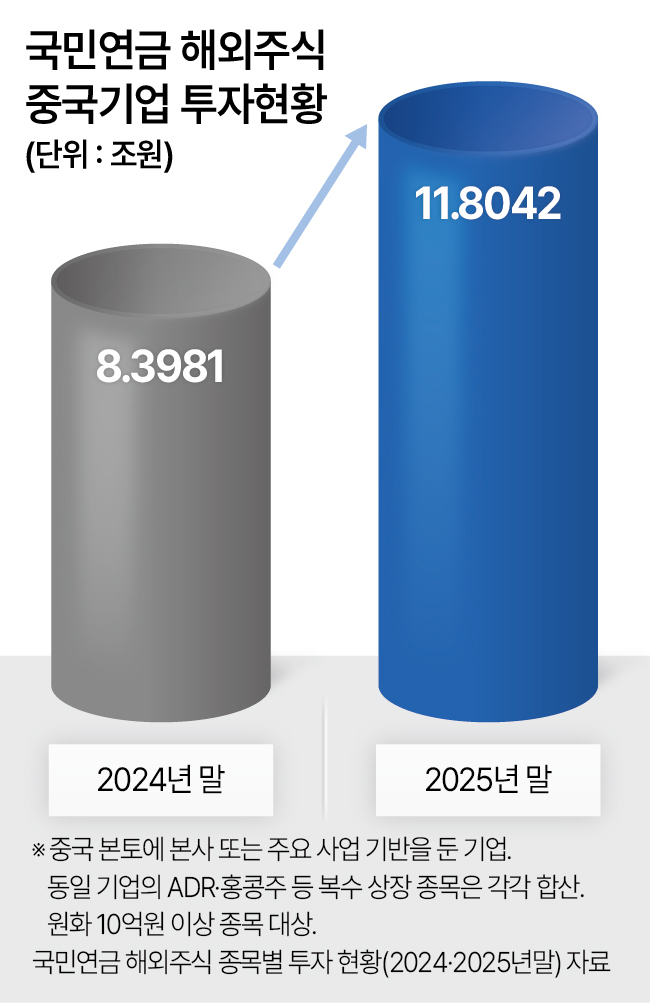
An analysis of overseas equity holdings that the National Pension Service disclosed Tuesday — based on end-of-last-year data — shows that the assessed value of companies headquartered or primarily based in mainland China reached about 11.8 trillion won. That marks a roughly 40 percent increase, or 3.41 trillion won, from 8.4 trillion won at end-2024. Chinese companies' share of the fund's total overseas equity portfolio also expanded from 1.98 percent to 2.24 percent over the same period.
Newly added China-related stocks in the year-end portfolio carried a combined assessed value of about 400 billion won. The largest single holding was CATL's Hong Kong-listed shares at 124.5 billion won, followed by gold producer Zijin Mining International at 53.3 billion won, pharmaceutical company Hengrui Medicine at 45.8 billion won, and power equipment maker Huaming Power at 37.6 billion won.
By sector, electric vehicle and battery stocks accounted for the largest share of newly added holdings at 139.7 billion won, comprising CATL, EV maker Leapmotor, and auto parts companies Shuanghuan Driveline and Xinquan Automotive. Semiconductor and AI technology stocks, along with power equipment and advanced manufacturing names, together exceeded 80 billion won — a group that includes Hua Hong Semiconductor, Shengxin Semiconductor, Nexchip Semiconductor, SMIC and Baidu.
Investment in Chinese companies has long been subject to persistent risk from US-China tensions and American regulatory measures. In June, the US Department of Defense added Alibaba, Baidu, BYD and Wuxi AppTec — all held by the National Pension Service — to its so-called 1260H list of companies deemed to have ties to the Chinese military. Even so, inclusion on the restriction list has not triggered a broad selloff in the affected stocks.
Industry analysts say regulatory risk stemming from US-China tensions has not uniformly undermined the investment case for Chinese companies. "Inclusion on the 1260H list does not mean financial sanctions or a blanket trading ban," said Baek Seung-hye, an analyst at Hana Securities. "Rather than a uniform contraction in investment opportunities across Chinese companies broadly, the impact will vary depending on each company's exposure to the US market and its competitive strengths."
Share price performance among the regulated stocks has been mixed. CATL, the largest Chinese holding in the pension fund's portfolio by assessed value, has gained nearly 30 percent since the start of the year. Wuxi AppTec, whose assessed value in the fund's portfolio rose by 178.6 billion won over the past year, has surged more than 75 percent year to date. Baidu has fallen 19.8 percent, Alibaba 14.6 percent and BYD 6.5 percent since the start of the year, but the pattern does not suggest that US regulatory pressure is broadly damaging Chinese equities as a whole.
Investor sentiment toward the Chinese market more broadly has also shown signs of improvement recently. During a domestic equity market correction in July, China-related exchange-traded funds listed in South Korea dominated the top performers. RISE China HSCEI (H), which invests in major large-cap Chinese stocks listed on the Hong Kong exchange, posted a return of 13.83 percent to rank fourth among all ETFs at the time. RISE China MSCI China (H) and TIGER China Hang Seng 30, which invests in 30 blue-chip Chinese companies listed in Hong Kong, also placed in the top 10.
The National Pension Service has continued investing in Chinese technology companies this year. The fund participated in the initial public offering of Zhongji Innolight, a fiber-optic component maker that recently listed on the Hong Kong exchange. Although Zhongji Innolight is subject to US restrictions on Chinese companies, it has attracted global investor interest on expectations that growing demand for fiber-optic components will be driven by expanding AI data center investment. According to SEIBRO, the Korea Securities Depository's disclosure system, domestic investors hold more than 65 billion won worth of the stock. Because the pension fund's Zhongji Innolight shares are subject to a lock-up period through Jan. 29 next year, the size of its IPO investment is expected to become public when the fund discloses its third-quarter portfolio next year.
kacew@heraldcorp.com