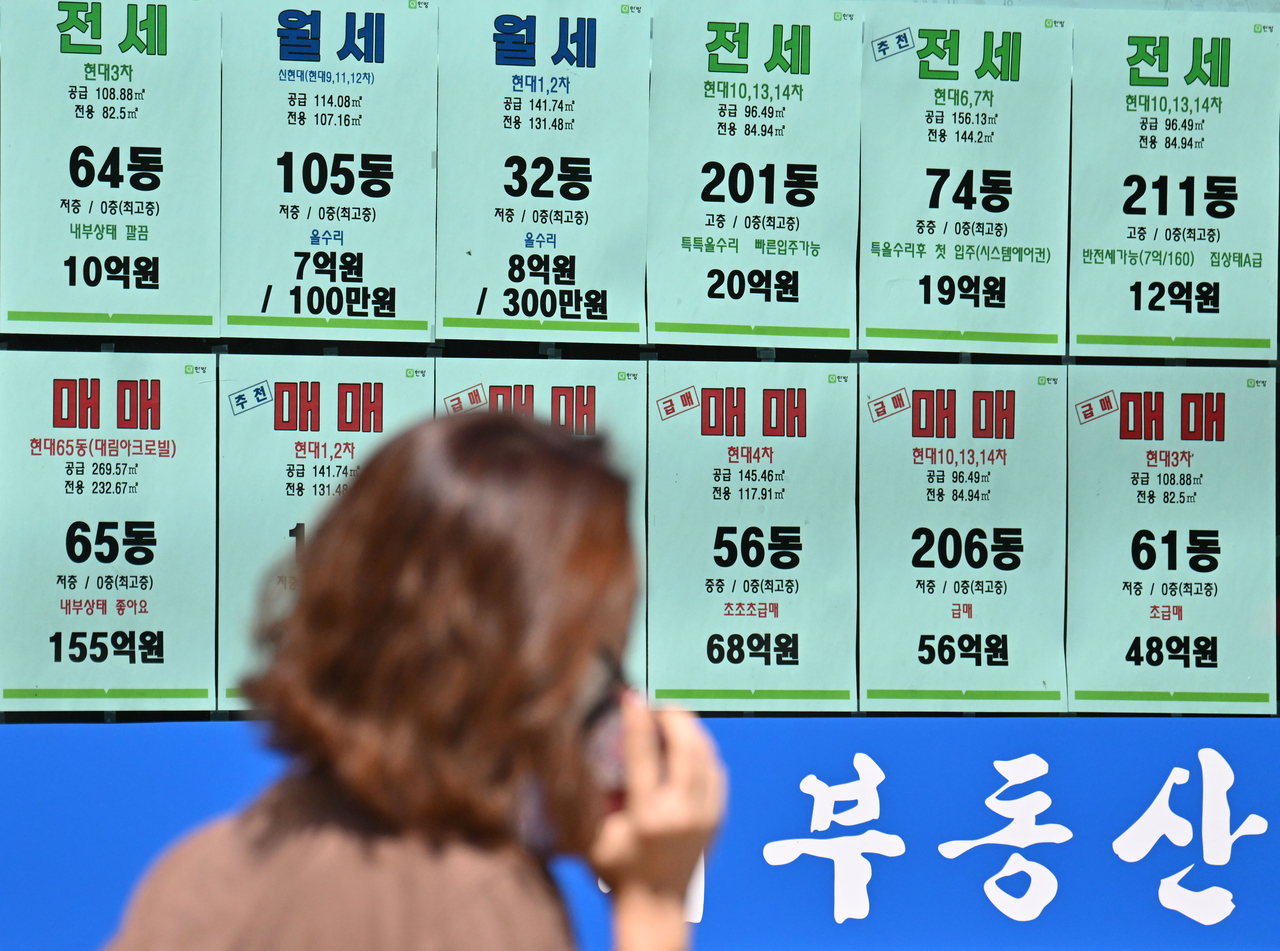
The government has announced plans to expand public rental housing and boost the supply of non-apartment units such as urban-type housing and officetels to ease the jeonse and monthly rent crunch — but the market is skeptical. With owner-occupancy requirements tied to the land transaction permit system keeping private rental listings off the market, experts say expanding public supply will do little to address the underlying shortage. History backs that concern: when the Moon Jae-in administration rolled out the Lease Three Laws in 2020 and jeonse prices surged, a similar push to expand public rentals failed to bring prices down.
Aug. 13 measures mirror Moon's Nov. 19 playbook — will this time be different?
The Ministry of Land, Infrastructure and Transport on Friday unveiled what it calls the "Aug. 13 measures" — a rapid housing supply plan to stabilize the jeonse, monthly rent and sales markets. The stabilization package covers five areas: supplying equity-accumulation and profit-sharing public housing; expanding and restructuring publicly supported private rentals; creating a new "universal" public rental category with better quality and locations; introducing a new jeonse rental program for young people covering officetels and similar units; and expanding specialized housing supply.
In announcing the measures, the government said rising homeownership costs have raised the barrier to entry for young people and low-asset households, while climbing jeonse and monthly rent prices have increased the housing cost burden. It added that expanding owner-occupancy opportunities and the supply of quality rental housing for genuine end-users is now essential. The thrust of the plan is to use public rental supply to douse the jeonse and monthly rent crisis.
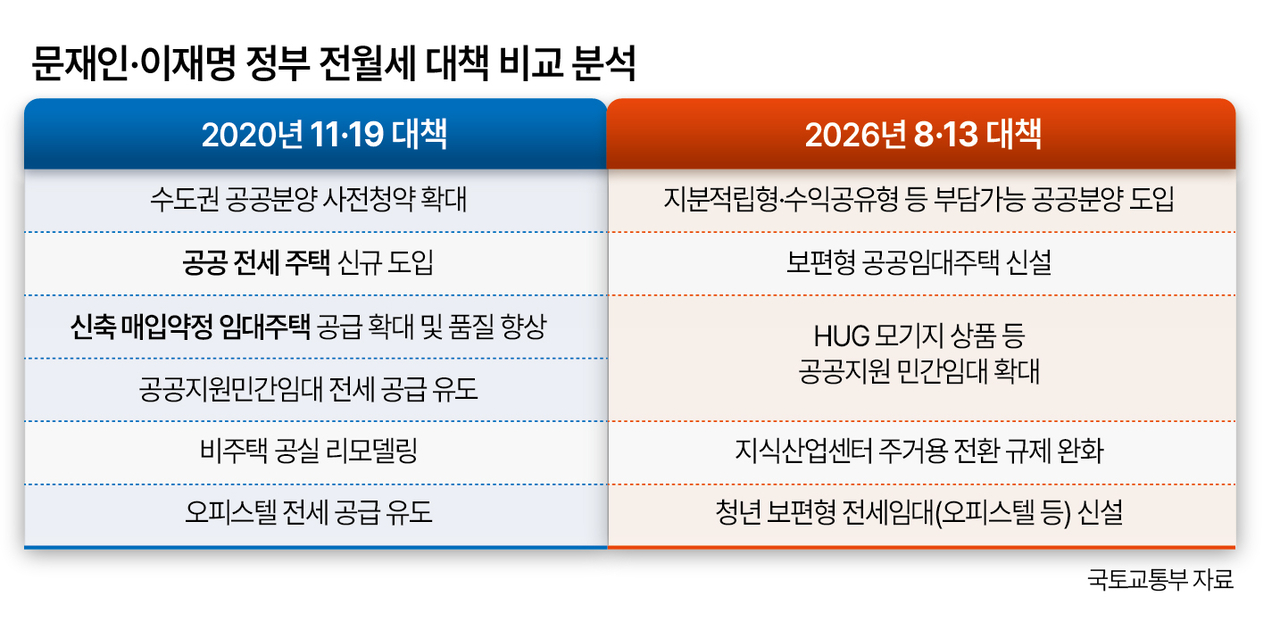
The approach closely mirrors the Moon administration's "Nov. 19 measures" — formally the Support Plan for Residential Stability of Working and Middle-Class Households — announced in 2020. After the Lease Three Laws (comprising the contract renewal right, jeonse and monthly rent cap, and housing lease registration system) sent rental prices soaring, the Moon government unveiled its own stabilization package, which was also built primarily around expanding public rental housing.
That plan included supplying jeonse-type units by using vacant public rental stock, accelerating move-in timelines for public housing, and expanding short-term supply. It also called for building youth housing and public rentals in urban areas, encouraging publicly supported private landlords and officetel owners to offer jeonse units, and expanding the purchase-and-lease program for newly built homes.
The Moon government also pledged to differentiate its newly supplied row houses and officetels from existing stock to boost demand, promising to secure housing quality alongside public jeonse supply. The Aug. 13 measures contain a strikingly similar passage, vowing to build universal public rental housing that matches private-sector standards — designing preferred layouts such as three-bay floor plans in prime locations including transit-oriented areas in the third-generation new towns and central Seoul, and upgrading interior finishes.
The problem is that the 2020 measures largely failed. According to the Korea Real Estate Board, Seoul's apartment jeonse price index stood at 101.26 in November 2020 when the Nov. 19 measures were announced, then rose for 14 consecutive months through January 2022, reaching 108.75 — a cumulative gain of 7.49 percentage points. Prices did not fall until February 2022, when interest rate hikes began in earnest, marking the first monthly decline in 32 months since June 2019. In effect, the short-term supply push had no impact whatsoever.
Experts: private rental supply shrinking faster than public supply can fill the gap

Experts broadly agree that while expanding public rentals may address some immediate demand, it cannot be a fundamental solution as long as private rental supply remains suppressed. Even if the government offers more incentives to rental business operators and relaxes eligibility requirements for prospective tenants, analysts say private rental listings — which make up the bulk of the rental market — will remain scarce unless the Lease Three Laws and the land transaction permit system are eased.
Yun Ji-hae, head of the research lab at Real Estate R114, said demand for public rentals is undeniably strong, with competition ratios consistently running into double digits. "But supplying only public rentals without revitalizing the private rental market will produce limited results," she said.
She added that no matter how much the government increases the supply of newly built non-apartment private rentals, listings are disappearing from the existing private rental sector far faster, making the measures inherently contradictory.
According to real estate big data firm Asil (Apartment Actual Transaction Price), the number of jeonse listings in Seoul stood at 20,940 as of Wednesday — down 10.7 percent from a year earlier, when 23,458 units were available on Aug. 15, 2025. Compared with two years ago, when 31,100 units were listed, the figure has fallen 32.7 percent. In Gyeonggi Province, listings dropped 42 percent from the same date last year. Taken together, Seoul and Gyeonggi Province lost a combined 12,000 private rental units over the past year.
Industry voices say public housing should play a role in helping low-income households secure a place to live, but that stabilizing housing costs for the middle class requires expanding private rental supply. "It is the public sector's role to supply housing products for low-asset populations with limited purchasing power," one industry official said. "But more than 70 percent of the market is driven by private supply — expanding public rentals alone cannot be the answer."
hss@heraldcorp.com