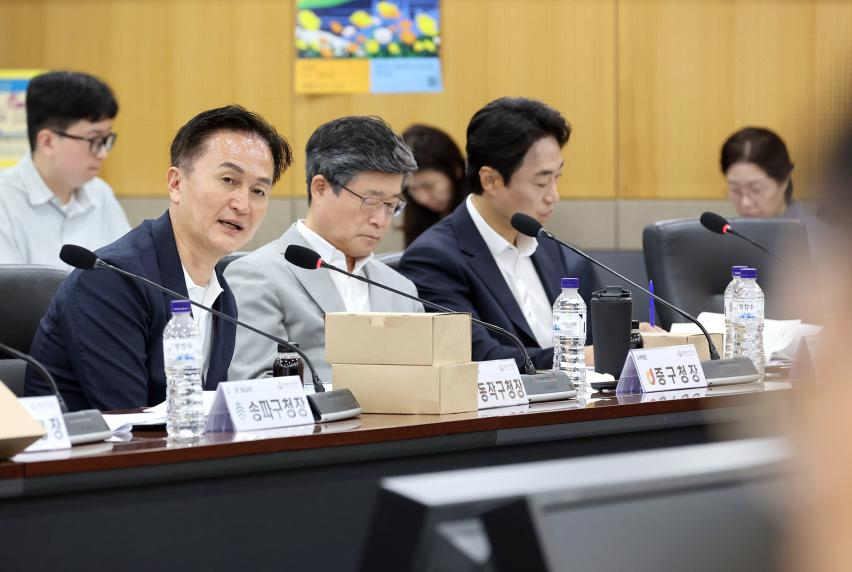
Dongjak-gu has formally proposed to the Seoul Metropolitan Government that authority to designate redevelopment zones for small-scale urban renewal projects be transferred to autonomous districts, in a bid to accelerate projects that better reflect local conditions and residents' needs.
District Mayor Ryu Sam-young submitted the proposal as an official agenda item — titled "Transfer of Authority Over Redevelopment Zone Designation and Modification to Autonomous Districts" — at the 203rd regular meeting of the Seoul Special Metropolitan City District Mayors' Council, held Wednesday at Seoul City Hall's planning situation room. Ryu said autonomous districts must be given greater authority over renewal projects that directly affect residents' daily lives.
Redevelopment and reconstruction projects, including those under the city's fast-track integrated planning scheme, have been growing steadily across Seoul. However, most authority over urban renewal remains concentrated at the central or metropolitan level, making it difficult for autonomous districts to respond quickly to residents' needs.
Under Article 8 of the Act on the Maintenance and Improvement of Urban Areas and Dwelling Conditions for Residents, the Seoul Metropolitan Government holds jurisdiction over redevelopment zone designation. Even minor modifications to a zone — such as changes to floor area, building coverage or floor area ratios — that districts could otherwise handle themselves are capped at under 10 percent.
In response, Ryu proposed two measures: transferring authority to designate project zones for small-scale renewal projects involving fewer than 500 units to autonomous districts, and expanding the range of minor modifications that districts can process independently to under 20 percent.
Small-scale renewal projects are more closely tied to residents' living environments than large-scale developments. Autonomous districts — best positioned to understand local conditions and community needs — should therefore be able to designate redevelopment zones directly from the earliest stages of a project, incorporating neighborhood characteristics from the outset.
Transferring the authority is expected to reduce unnecessary administrative procedures, shorten project timelines and improve the pace of renewal projects and administrative responsiveness as felt by residents.
The Seoul District Mayors' Council agreed to respond proactively to proposals for expanding autonomous district authority, including forming a task force to pursue meaningful changes such as amendments to relevant laws and regulations.
The council also plans to continue identifying systemic limitations that emerge during the renewal process and to work actively with the Seoul Metropolitan Government and the central government to strengthen the implementation of related institutional reforms.
As part of its "Redevelopment and Reconstruction Project Acceleration Plan" — the first official initiative approved under the ninth elected-term administration — Dongjak-gu is set to hold the inaugural meeting of its Urban Renewal Promotion Committee on Wednesday, stepping up efforts to advance renewal projects at the pace residents want.
"Driving urban renewal projects with real momentum can deliver visible results that residents will feel most quickly," Ryu said. "Dongjak-gu will take the lead and work actively to improve the system so that projects move forward at a pace our residents find satisfactory."
seouldream01@heraldcorp.com