Seoul's Nowon-gu has stepped up efforts to strengthen cooperation with the central government as it works to boost the competitiveness of what it calls a "future economic city" — with a focus on business and jobs, residential environment, and metropolitan transportation networks.
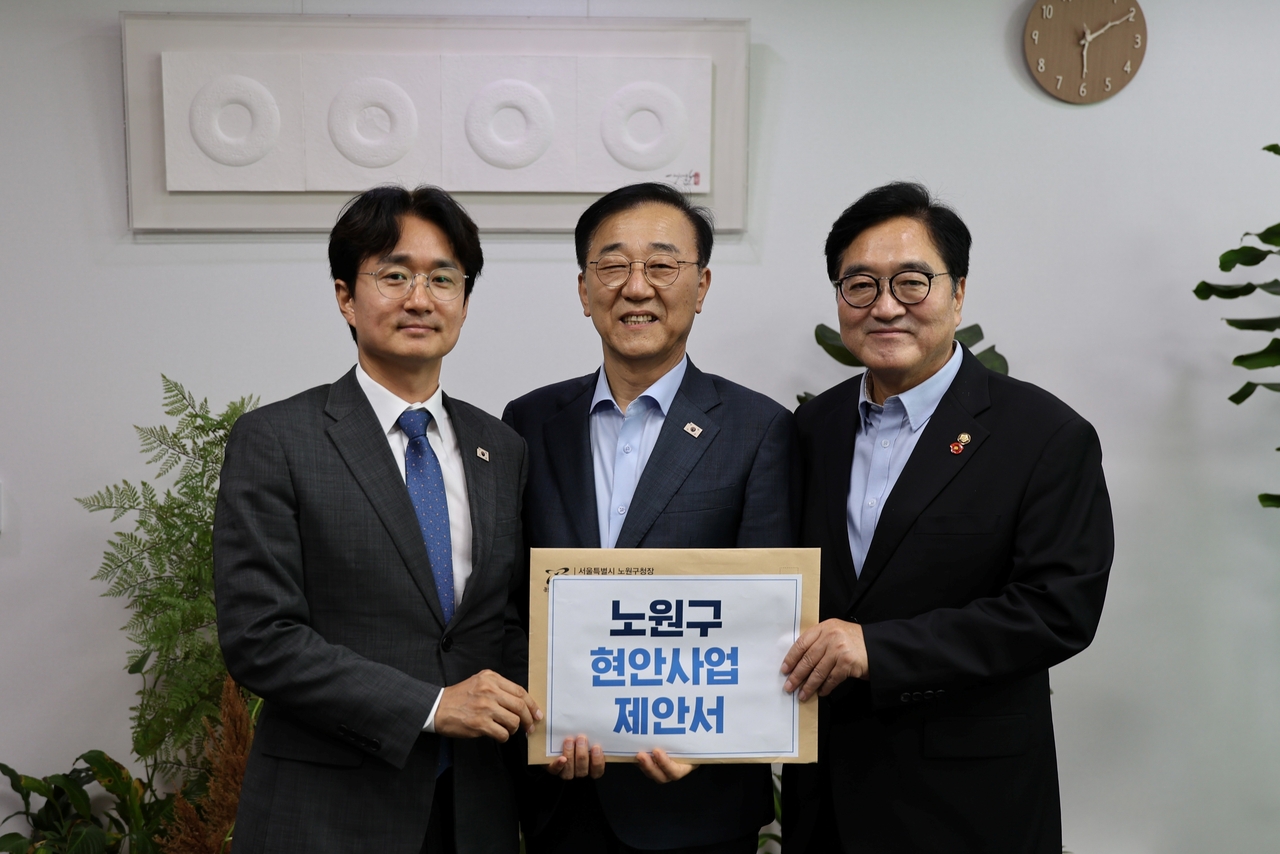
District Mayor Seo Jun-o met with Minister of Land, Infrastructure and Transport Kim Yoon-deok at the National Assembly members' office building on Wednesday, in a meeting arranged by Assembly member Woo Won-shik (Nowon-gap, former Assembly Speaker). Seo said he used the occasion to present key priorities for Nowon's future development.
The agenda covered four areas: building Nowon into a future economic city with businesses and jobs, laying the groundwork for a better residential environment, proactively expanding and connecting metropolitan transportation networks, and resolving everyday inconveniences for residents. The requests centered on the three pillars — business and jobs, residential environment, and metropolitan transportation — that Seo has emphasized as core tasks for raising Nowon's urban competitiveness since the launch of the ninth elected-term administration, calling on the government for support and regulatory improvements in each area.
On the business and jobs front, Seo requested government cooperation to keep the S-DBC (Seoul Digital Bio City) project on track. The project involves developing a 247,000-square-meter site — freed up by relocating the Changdong vehicle depot and the Dobong driver's license testing center — into an advanced biotech industry cluster. Linked to the Seoul Arena being built in Changdong, it is the largest-scale development project set to reshape the economic landscape of Seoul's northeastern metropolitan area. A pending Ministry of Land, Infrastructure and Transport review — covering the designation of an industrial complex and the replacement designation of industrial zones — represents a critical milestone for S-DBC. Minister of Climate, Environment and Energy Kim Sung-hwan, who also serves as the Assembly member for Nowon-eul, has separately been requesting cooperation from related ministries on the matter. The district said it will be able to move swiftly on subsequent steps, including land compensation and site preparation, once that review is complete.
Improving the residential environment is another issue drawing strong attention from local residents. Regarding the plan to develop a residential district on the Taereung Country Club site, Seo conveyed his position that "a development plan reflecting residents' demands and the area's characteristics is needed for the government to supply housing quickly and advance the project smoothly," and said the district agreed to continue consultations with relevant government ministries toward that end.
The district also requested regulatory improvements related to reconstruction and other redevelopment projects. It asked for a relaxation of the mandatory green space requirement that applies when building 1,000 or more housing units. Nowon already has a high ratio of parks and green space adjacent to its residential complexes, and the high household density per unit area in large apartment complexes has made it difficult to secure additional parkland. Easing the standard is expected to improve the viability of reconstruction projects.
On metropolitan transportation, the district asked for proactive expansion of rail and road networks to meet Nowon's future development needs. In connection with the Taereung CC development, Seo outlined the need to widen Hwarang-ro and the Taereung–Guri IC corridor, extend subway Line 6 (from Hwarangdae Station to a tentative Taereung CC Station and on to Byeollae Station on Line 8), and build a metropolitan road between Nowon and Namyangju — the Baeksa Tunnel. A request for SRT trains to stop at Gwangwoon University Station, to maximize the impact of the Gwangwoon University transit-oriented development project, was also among the key items. Seo additionally explained the need to include the above-ground section of the Gyeongwon Line (Line 1) in the ministry's comprehensive plan for integrated underground rail development currently being drawn up.
The meeting also covered a range of issues closely tied to residents' daily lives, with both sides exchanging views on practical improvement measures. The district said it plans to follow up with the Ministry of Land, Infrastructure and Transport and other relevant agencies on each project, with the aim of ensuring the proposals translate into actual regulatory changes and project progress rather than remaining as requests.
"Close cooperation with the central government is essential to advancing at pace the key projects that will redraw Nowon's future map and transform the economic landscape of Seoul's northeastern metropolitan area," Seo said. "We will work actively with the Ministry of Land, Infrastructure and Transport and related agencies to deliver results that residents can feel — more businesses and jobs, and dramatically improved living conditions and transportation — as Nowon becomes the future economic city it is meant to be."
seouldream01@heraldcorp.com