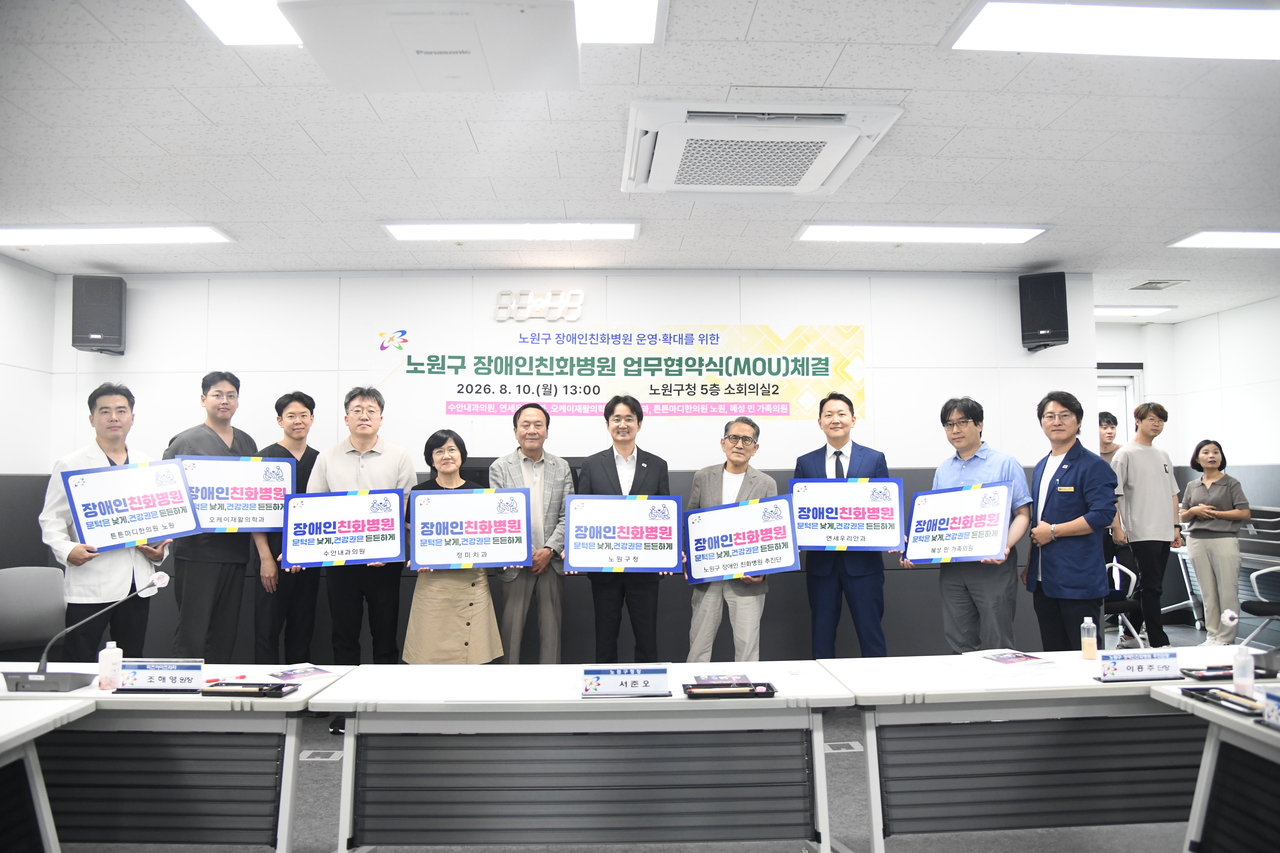
Nowon-gu in Seoul is expanding its disability-friendly hospital program to improve medical access for people with disabilities and help them navigate daily life without barriers, district mayor Seo Jun-o said.
The district signed MOUs with six local medical institutions Monday at the Nowon-gu office to bring them into the disability-friendly hospital network. The newly designated facilities will work with the district to promote the health rights and medical accessibility of people with disabilities.
The six institutions joining the network are Jeongmi Dental Clinic (Hagye-dong), Yonsei Woori Eye Clinic and Hyeseong Min Family Clinic (both in Junggye-dong), Suan Internal Medicine Clinic, OK Rehabilitation Medicine Clinic and Tuntunmadi Korean Medicine Clinic's Nowon branch (all in Sanggye-dong).
With the new additions, the total number of district-designated disability-friendly hospitals has grown to 17. The program began in 2024 with two medical institutions, establishing what the district calls the "Nowon-model" disability-friendly hospital framework, and has since expanded rapidly to broaden medical access.
For people with disabilities, the expansion of specialties on offer is as welcome as the increase in the number of facilities. The program started in 2024 with an obstetrics and gynecology clinic and a neighborhood clinic, then added secondary care institutions, pediatrics, dentistry, otolaryngology, urology, ophthalmology and orthopedics when nine more facilities joined last year. This year's additions go a step further — notably, the network now includes a Korean medicine clinic and a rehabilitation medicine clinic, two specialties absent from the original 11 facilities.
The district will install certified plaques at all participating disability-friendly hospitals and conduct disability-awareness training for medical staff.
Alongside this, the district will provide equipment needed for treating patients with disabilities and support accessibility facilities at hospitals when people with disabilities visit for consultations or treatment.
The program's rapid growth owes much to a dedicated task force — the Disability-Friendly Hospital Expansion Promotion Team — made up of diverse stakeholders. The district's disability welfare division has run a consultative body that includes welfare organizations, disability groups and medical institutions. The team has analyzed user needs, identified suitable medical facilities and secured expert medical advice to strengthen the program's professional foundation.
The program's quality was recognized in 2025, when the Seoul Metropolitan Government selected it as part of its "Walking Together with the Vulnerable" support project, and it was later cited as a best-practice case in the project's performance evaluation. Seoul has since designated the disability-friendly hospital program as a formal initiative under the same framework for 2026, extending it to other autonomous districts in recognition of its effectiveness and the need for wider adoption. The district has also secured 50.5 million won ($36,500) in Seoul Metropolitan Government subsidies toward this year's project costs.
The district plans to survey users of the disability-friendly hospitals to gauge satisfaction with actual clinic visits and assess their health-related needs, feeding the findings back into how the program is run.
"I sincerely thank the medical institutions and task force members who have joined us in promoting the right of people with disabilities to good health," district mayor Seo said. "We will spare no effort in supporting those who share our vision, so that they too can find meaning in building a city where people with disabilities can thrive."
seouldream01@heraldcorp.com