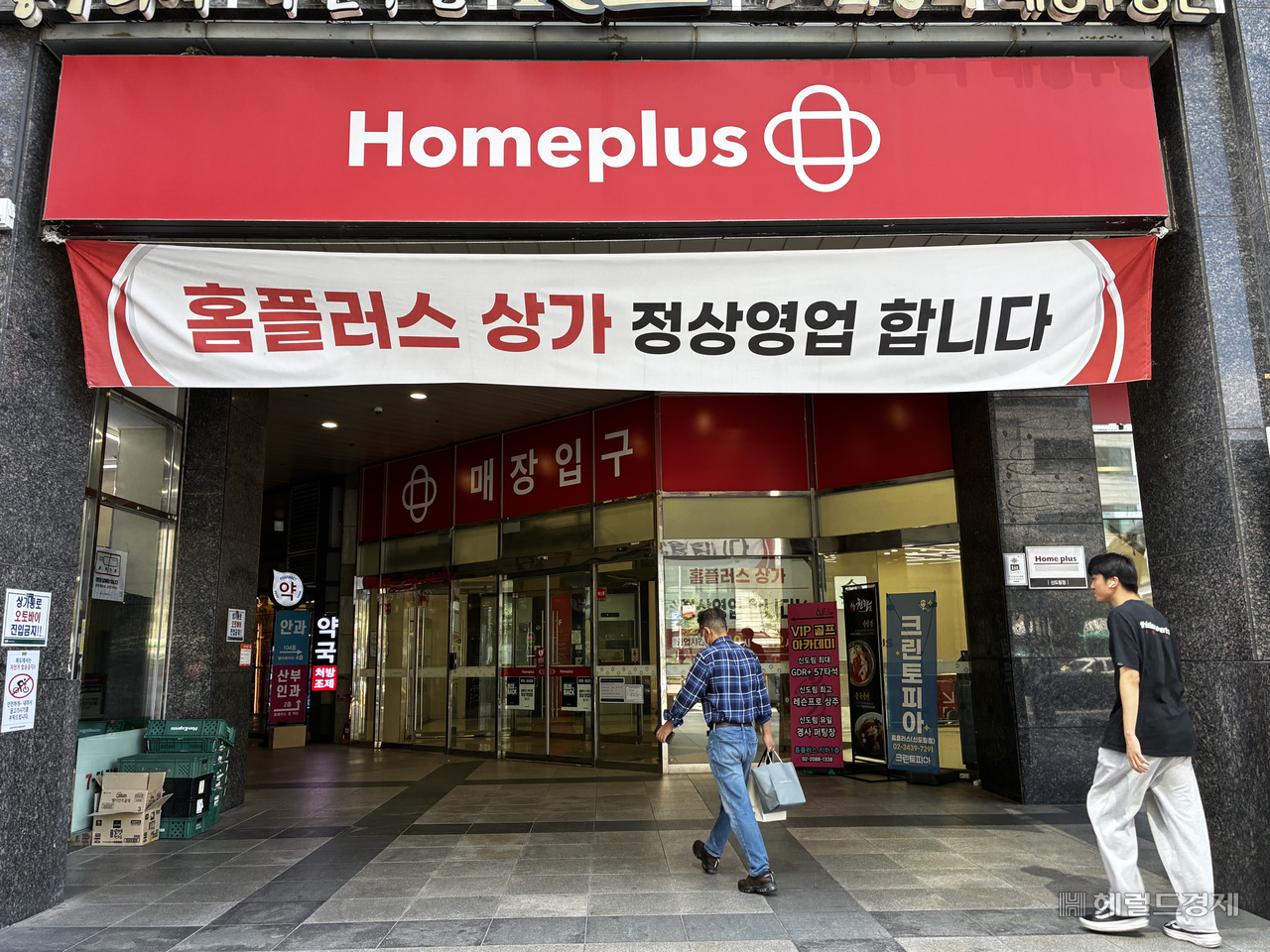
"Is the supermarket open?"
A visitor posed that question Tuesday afternoon to a clothing stall owner standing near the first floor of the Homeplus Yeongdeungpo branch in Yeongdeungpo-gu, Seoul. "Yes, the basement food section is open," the owner replied — and the visitor promptly stepped onto the escalator and headed downstairs. Foot traffic that day was thin, and the few customers who did come in walked past the clothing, bedding and accessories stalls without a glance, making straight for the basement grocery floor.
About 25 private stalls selling clothing, bedding, jewelry and accessories occupy the first and second floors of the Yeongdeungpo branch. Around 15 kept their doors open throughout Homeplus's suspension, while about 10 shut down or cleared out entirely. Three of the five food-court operators also closed. Notices advertising new tenant opportunities were posted across the vacant units. Having secured 200 billion won ($141 million) in emergency operating funds, Homeplus soft-opened 67 of its key stores on Friday and is preparing to resume full operations Thursday.
Among the vendors who stayed, optimism ran high. Kim Yeong-suk, 54, who has run a clothing stall at the branch for 10 years, said loyal customers were the reason she held on. "After the supermarket closed, regulars came in on purpose and bought at least a pair of trousers, saying they couldn't let this place go under," she said. She added that the ordeal had brought the remaining vendors closer together. "When the cleaning crew disappeared along with the supermarket staff, the Homeplus branch manager and his deputy rolled up their sleeves and cleaned the bathrooms themselves — that really moved us," she said.
The relative optimism at the Yeongdeungpo branch stems partly from its track record: the store ranked among Homeplus's top performers by sales before the chain ran into trouble. Another clothing stall operator said the location draws customers from as far as Gimpo, Mokdong and Incheon. "The accessibility is great and the cultural center here has always been a big draw," the operator said. "A lot of people think that if the Homeplus brand itself recovers, Yeongdeungpo will be just fine."
Signs of returning confidence were visible. Kwon, 57, who runs a children's clothing stall, said some tenants who left in a hurry are now eyeing a comeback. "Some stores rushed out because they thought Homeplus itself was going to collapse, but I understand some of them want to come back if the rehabilitation plan is approved on Sept. 4," Kwon said. "Even if there are grievances over the abrupt lease terminations, Homeplus would be grateful to have those stores return."
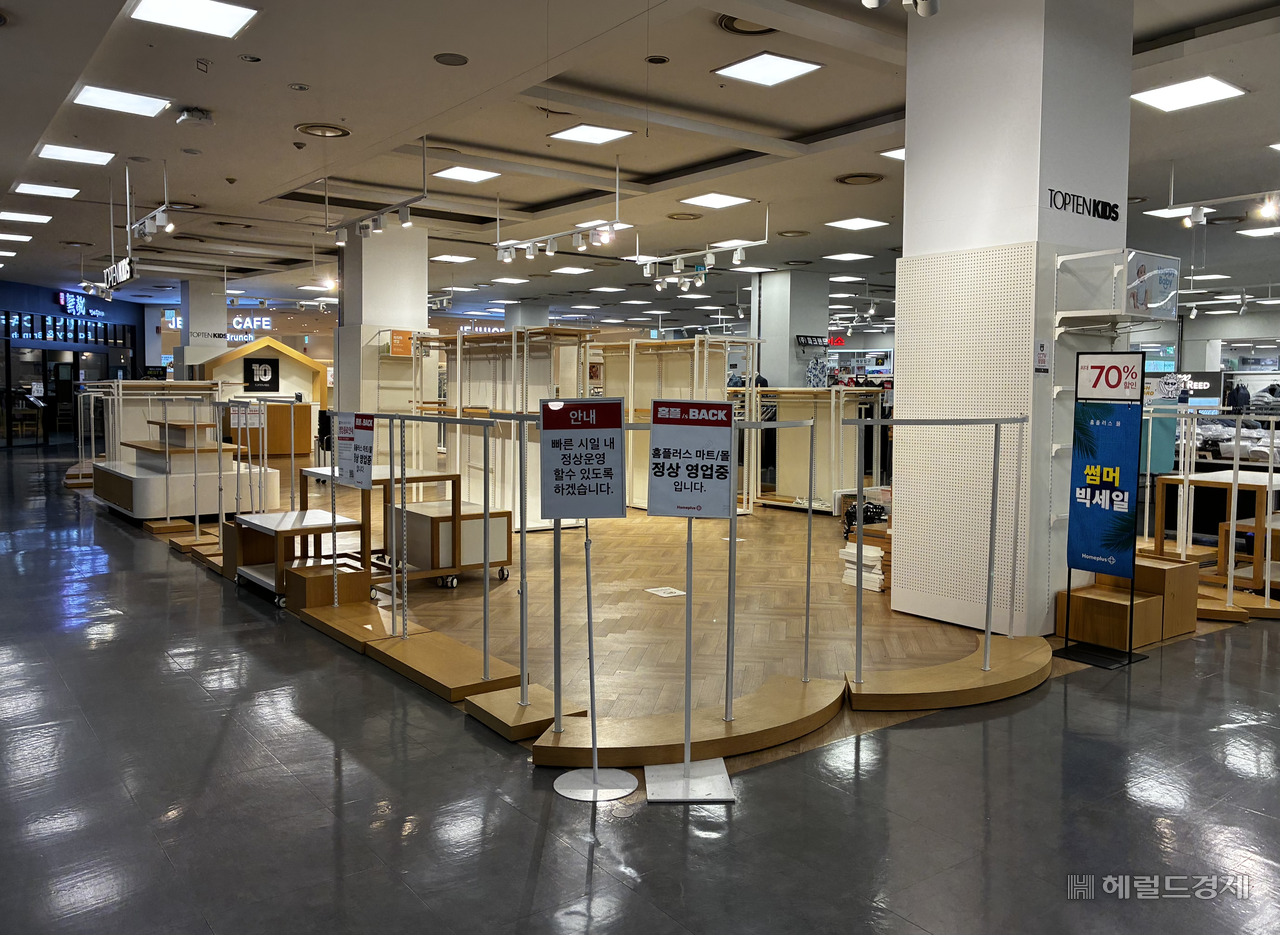
Whether the reopening will translate into a sales recovery is far from certain. Outside a bedding stall, summer cooling comforters brought in ahead of the warm season sat piled in a buy-one-get-one promotion. "Sales were almost nonexistent while the supermarket was closed," the stall owner said. "Our business depends on grocery shoppers noticing our products as they pass by — we only do well when the basement food floor is as busy as it used to be."
The Homeplus Sindorim branch in Guro-gu, Seoul, visited the same day, told a similar story. The branch is laid out with a long corridor leading to the food section, lined on both sides by restaurants, a photo studio, a nail salon, a flower shop, a veterinary clinic, an optician and a hair salon, among other private stalls. Seven of the 15 units — including clothing, accessories, jewelry and food outlets — had already shuttered. The corridor itself was nearly empty; most of the few passersby walked straight through to the supermarket inside.
Yun Jang-hyeok, 55, who has run an optician's shop at the branch for nearly a decade, said this was the hardest stretch he could remember. Sales had fallen more than 50 percent from before Homeplus's troubles began. To hold on to customers, he has been offering discounts even to those not entitled to them. "Just a moment ago a customer asked for contact lenses — they weren't eligible for a discount, but I sold them a 68,000-won pair for 52,000 won," he said. "There are just so few customers."
Yun said store management had in effect ground to a halt. He pays rent on a monthly basis, but Homeplus had sent no invoice for three consecutive months since June. He traced part of the problem to an earlier rent dispute. "The hair salon in the basement left in May — from early this year, as the supermarket grew chaotic and foot traffic dropped, they asked Homeplus to lower the rent, but no agreement was reached," he said. "There was room for flexibility, but the staff kept saying head office policy tied their hands. In the end, half the stalls left, and the ones that stayed aren't even being properly managed."
A pharmacy owner at the Sindorim branch said only a handful of destination businesses were keeping afloat. "Places people seek out on purpose — the gym, the indoor golf range, the kids' cafe — and our pharmacy, which gets customers coming from the clinic upstairs, are about the only ones hanging on," the owner said. "Even we've lost more than half our customers compared with normal operations last year, because of the drop in supermarket foot traffic." The owner added that most clothing stores, restaurants and jewelry shops running deficits had already left, and those still open were weighing their exit.
The biggest variable vendors cited was product supply. Even if the supermarket reopens, they said, customers will have no reason to return unless the shelves are adequately stocked. Homeplus has said it will prioritize fresh produce and groceries as it resumes operations, but normalizing supply relationships with vendors remains an unresolved challenge.
The pharmacy owner said sparse inventory was already keeping customers away. "Before, a lot of people came specifically to buy alcohol, which is hard to find online. Now the supermarket has reopened but liquor stock hasn't come back properly, so there's no particular reason for customers to make the trip to Sindorim," the owner said. "Outside fast-moving items like milk and fresh food, the shelves still aren't filled."
"People don't come to a supermarket to buy just one thing," the owner continued. "They come to browse, pick up one item and spot another — to do all their shopping in one trip. If there isn't much on the shelves, there's no reason to come to a physical store." The owner added: "No one buys one thing here and then goes somewhere else for the rest. Ultimately, what matters is whether Homeplus has enough variety to satisfy customers."
The same concern over supply echoed at the Yeongdeungpo branch. A bedding stall owner there said she was waiting for the basement food floor to get back to normal, but was not holding her breath. "Looking at how little stock has come in so far, it seems unlikely the store will be fully up and running by Thursday as Homeplus has planned," she said.
snsd@heraldcorp.com
hong@heraldcorp.com