![The Kospi and Kosdaq indexes are displayed on a board at Hana Bank's dealing room in Jung-gu, Seoul, on Monday. Kosdaq closed up 6.97 percent that day at 854.47. [Yonhap]](https://wimg.heraldcorp.com/news/cms/2026/08/11/rcv.YNA.20260810.PYH2026081014370001300_P1.jpg)
Kosdaq leveraged ETFs swept the top of the performance rankings this month, as a sharp selloff in large-cap Kospi semiconductor stocks and tightened regulations on single-stock leveraged products tied to Samsung Electronics and SK Hynix pushed trading flows toward the secondary market. Still, with Kosdaq remaining roughly 30 percent below its peak, analysts say a sustained rally will require a fundamental improvement in the market's underlying health.
According to Korea Exchange, all five top-performing ETFs from the start of August through Monday were Kosdaq leveraged products. KIWOOM Kosdaq150 Futures Leverage led with a gain of 50.96 percent, followed by TIGER Kosdaq150 Leverage at 49.65 percent, RISE Kosdaq150 Futures Leverage at 49.27 percent, KODEX Kosdaq150 Leverage at 48.47 percent, and HANARO Kosdaq150 Futures Leverage at 44.99 percent.
The Kosdaq index, which had been pushed down to the 600 level on July 30, surged 32.52 percent to 854.47 by Monday. The immediate catalyst for the rebound was a shift in supply-demand dynamics. Trading funds that had been concentrated in single-stock leveraged products fell sharply after financial authorities introduced corrective measures on July 31, easing the supply-demand imbalance in the Kosdaq market.
Even accounting for the rebound, the damage has not been fully repaired. Kosdaq's market cap stood at 679.55 trillion won ($480 billion) on April 27, when it hit its all-time closing high of 1,226.18, but had shrunk 30.92 percent to 469.44 trillion won by Monday.
Trading volume has also contracted. Monday's daily trading value of 7.12 trillion won was less than a third of the record 25.33 trillion won posted on Jan. 26. The lowest trading day of the year so far was July 27, when the figure fell to just 4.46 trillion won.
Daily trading value — the total value of shares changing hands in a session — is widely read as an indicator of market liquidity and investor sentiment. Kosdaq's performance looks even more disappointing against the Kospi. As of Monday, Kosdaq's year-to-date return stood at minus 7.67 percent, far behind the Kospi's 49.49 percent gain over the same period.
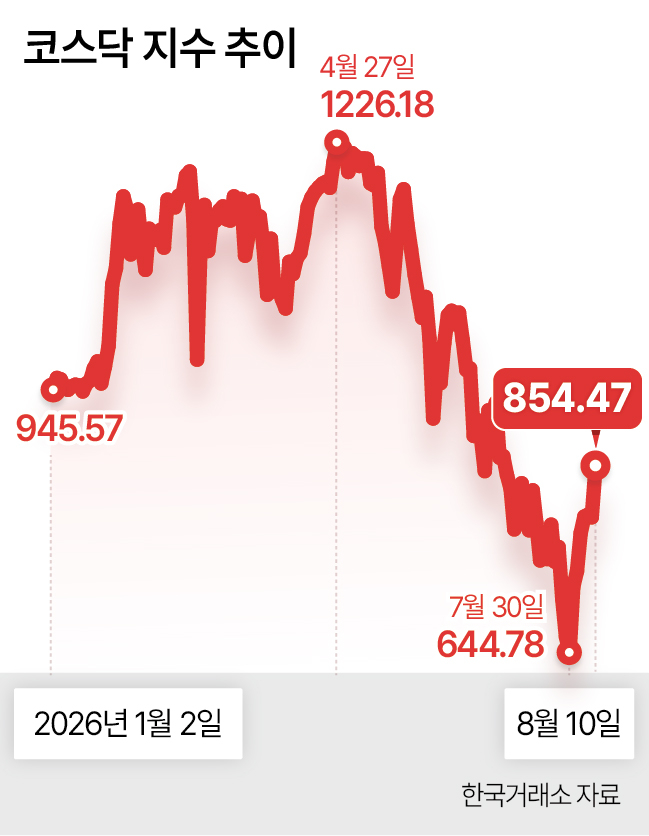
"Excluding the dot-com bubble era, there has never been a period in Korean stock market history when the performance gap between the Kospi and Kosdaq was as wide as it is this year," said Lee Sang-jun, a researcher at NH Investment & Securities. "Kosdaq has only just managed to recover to the level it was at before the current administration took office, and it is still posting a negative return for the year."
Market analysts say Kosdaq's underperformance cannot be explained simply by the absence of large-cap semiconductor stocks or limited capacity for shareholder returns. They point to more fundamental causes: weak underlying fundamentals and a perception that valuations are stretched relative to earnings, both of which have eroded investor confidence.
According to NH Investment & Securities, Kosdaq's operating profit margin stands at 4.9 percent — roughly a third of the Kospi's 15.0 percent — while its return on equity of 1.8 percent also trails the Kospi's 5.4 percent by a wide margin. The share of financially distressed companies on Kosdaq is 28.1 percent, compared with 15.5 percent on the Kospi, and loss-making firms account for 41.7 percent of Kosdaq listings versus 21.5 percent on the Kospi.
In response, the government has proposed a tiered market structure and stricter delisting rules to improve Kosdaq's overall quality. The plan separates stronger companies from weaker ones through a tiering system while tightening exit requirements to raise the market's overall health.
Specifically, the proposal calls for dividing Kosdaq into three segments — Select (premium), Standard and Watch — with a final plan expected to be confirmed between September and October and implemented next year. The industry is closely watching how many companies will be placed in the top Select tier. While early discussions centered on 80 to 170 companies, the top segment is now expected to include around 70 firms.
To strengthen delisting enforcement, the minimum market cap requirement for Kosdaq was raised from 15 billion won to 20 billion won effective July 1, with a further increase to 30 billion won planned for January next year. For the Kospi, the threshold is 30 billion won this year, rising to 50 billion won next year. Stocks trading below 1,000 won — so-called penny stocks — are also subject to delisting.
Leaders Index, a corporate research firm, analyzed 2,578 listed companies — 833 on the Kospi and 1,745 on Kosdaq — covering market cap, share price, financial condition and disclosure penalty points as of the end of July. It found that 192 companies, or 7.4 percent of the total, had average July market caps below the listing maintenance threshold. Of those, 152 were Kosdaq-listed firms — 8.7 percent of Kosdaq companies — with market caps below 20 billion won, while 40 Kospi-listed firms, or 4.8 percent, fell below the 30 billion won threshold.
The number of at-risk companies is expected to grow next year. Applying the tightened standards to average July market caps, 479 companies — 18.6 percent of all listed firms — would fail to meet listing maintenance requirements. Kosdaq accounted for 367 of those, or 21.0 percent of its listings, meaning more than one in five Kosdaq companies would be at risk, while the figure for the Kospi was 112, or 13.4 percent. Penny stocks with average July closing prices below 1,000 won numbered 156 on Kosdaq (8.9 percent) and 44 on the Kospi (5.3 percent), totaling 200 companies, or 7.8 percent of all listed firms.
"In the current environment of unprecedented volatility and severe supply-demand imbalances, we need to think carefully about whether it is appropriate to immediately apply strict delisting standards to small- and mid-cap stocks," said Eom Su-jin, a researcher at Hanwha Investment & Securities. "The government introduced the technology-based listing exception regime in 2005 to help companies with strong technology and growth potential access the market even without immediate sales or profits — trying to delist them solely on the basis of market cap or a share price below 1,000 won undermines the very purpose of that system."
jiyun@heraldcorp.com