![[Generated with ChatGPT]](https://wimg.heraldcorp.com/news/cms/2026/08/11/news-p.v1.20260810.233996d1bfac4129beb2526eb4242cc7_P1.png)
There was an "AI whale" who posted returns of more than 400% in the first half of the year alone. The fund was a hedge fund founded by Leopold Aschenbrenner, a former OpenAI researcher. It deployed leverage of up to four times on AI infrastructure companies — semiconductors, data centers and power — and SK hynix was among its holdings.
In a rising market, that leverage amplified gains explosively. But when the market turned, the same mechanism worked in reverse. As AI-related stocks wobbled in July, prime brokers began issuing margin calls in rapid succession, and the fund was ultimately forced to unwind its positions on a massive scale.
For investors who had no way of detecting any of this, a wave of sell orders appeared with no apparent explanation. Earnings outlooks for domestic chipmakers had not deteriorated significantly, yet share prices fell relentlessly.
The Kospi, which had briefly flirted with the 9,000 level in June, tumbled nearly 30% over the course of July before staging a rebound of more than 17% in a single day — the steepest monthly decline since 1990 and the largest single-day gain on record, both occurring within the same month.
The market's mood shifted dramatically in just a few months. The talk went from "I envy you for owning stocks" to "I envy you for not owning any."
The numbers make the volatility even more visceral. In July alone, the sidecar circuit-breaker mechanism was triggered 15 times on the Kospi and 12 times on the Kosdaq — 27 activations in total. A sidecar halts program trading for five minutes when an index moves beyond a set threshold. The previous annual record since the system was introduced was 26 activations, set during the 2008 global financial crisis. That full-year record was surpassed within a single month.
So how did high-net-worth investors navigate this market? The answer from private banking centers was surprisingly straightforward. They were frightened too, and inquiries about selling flooded in. But actual selling was limited. The difference was not whether investors felt fear — it was whether they had built a portfolio in advance that would not force them to sell when fear arrived.
The contrast between the investor who generated 400% returns using leverage of up to four times and the wealthy clients who entered the downturn with 20 to 30 percent of their portfolios in cash illustrated, in the starkest possible terms, what separates the two approaches.
The most painful observation from the field is that as volatility rises, more investors abandon the principles they had set for themselves — and that excessive leverage leaves some unable to hold positions they actually want to keep. With conflicting anxieties crossing each other several times a day, the goal here is to examine what principles are worth defending, through the lens of how disciplined major investors have been charting their course.
Building a portfolio that can withstand the shocks
The notion that "big-money investors don't flinch even in a crash" was only half right this time around. During the July plunge, private banking centers were inundated with calls asking whether to sell.
The common assessment from the field, however, was that few of those inquiries translated into actual sales. Even as the index corrected more than 30% from its peak within a month — an extraordinary move — most wealthy investors chose to watch and wait rather than act. Inquiries about new positions or additional purchases also dried up sharply.
The resilience wealthy investors showed this time was less about "not panicking" and more about "not reversing decisions already made." When prices fell to levels they had been targeting, major investors used a portion of the 20 to 30 percent cash they had kept in reserve to buy at lower prices. Further declines followed and caused pain, but they were still able to hold on.
By contrast, among so-called latecomers — wealthy investors who had only recently entered the rally — something closer to panic selling emerged. Those who had liquidated real estate or bank deposits to buy large-cap Kospi stocks not long before the drop proved most vulnerable to fear, according to accounts from the field.
In the end, "big-money investors didn't flinch because they're big-money investors" is less accurate than "only those who had prepared their principles and their cash in advance were able to hold on."
Because the July plunge was attributed more to the forced unwinding of leveraged positions concentrated in specific stocks — and the resulting supply-demand imbalance — than to any deterioration in corporate fundamentals, investors who judged that the underlying business outlook remained intact were generally reluctant to close their positions.
What is telling is the distinction these investors draw between "not selling in a panic" and "holding on no matter what." Prepared major investors move according to pre-set rules — target return levels, stop-loss thresholds — even in a falling market, rather than reacting emotionally while watching a price screen. This stands in sharpest contrast to the pattern of retail investors who take on margin or leverage in a single stock and get forced out by automatic sell-offs.
Attitudes toward single-stock leveraged products have also shifted markedly. Products that had attracted some interest among wealthy investors through the first half of this year lost considerable credibility after being identified as a source of the July plunge. Having witnessed firsthand how selling begets more selling, investors are now broadly reluctant to touch them.
Earnings held up — it was the supply-demand picture that broke down
In the early days of the July sell-off, the phrase heard most often in the market was "this is a buying opportunity." Long-term earnings forecasts for chipmakers were actually being revised upward, and there was no clear negative catalyst.
Yet daily losses kept setting new records. Even among professionals, there was a sense that "something is wrong," but no one could identify what it was. The honest assessment at the time was that there was nothing to do but watch the losses mount and hold on.
The case of Leopold Aschenbrenner explained a significant part of the puzzle that only came together later. A young researcher who had left OpenAI and drawn Wall Street's attention with a report titled "Situational Awareness," he founded a hedge fund of the same name and applied borrowed leverage of up to four times to AI infrastructure stocks — semiconductors, data centers and power companies.
SK hynix was among those holdings. The fund generated returns of more than 400% in the first half alone, growing its assets under management to $45 billion. But when AI-related stocks began to wobble in July, prime brokers including Goldman Sachs and JPMorgan simultaneously issued margin calls. With no room to wait for a recovery, the fund transferred most of its equity portfolio to Citadel, and its assets under management shrank to around $10 billion.
This forced liquidation, which unfolded quietly without the market's knowledge, explains much of why domestic semiconductor stocks were hit so disproportionately hard relative to their fundamentals. As one large leveraged position was silently unwound, a steady stream of invisible sell orders kept hitting the market — the hidden force that distorted domestic supply and demand.
The stocks that had fallen most sharply began rebounding almost simultaneously right after the fund transferred its positions, and the point at which the liquidation was largely complete nearly coincided with the market's low. In retrospect, it was not earnings but "someone's forced selling" that accounted for much of the decline — a fact that only came to light after the episode had run its course.
A structurally similar dynamic played out domestically in a different form. With a handful of large-cap semiconductor stocks accounting for more than half of the Kospi's total market capitalization, retail money poured into single-stock leveraged products listed in late May, amplifying volatility further.
Because leveraged products mechanically buy more when an index rises and sell more when it falls, a vicious cycle took hold in which declines fed further declines. Forced selling from margin-financed positions compounded the effect, widening the losses.
The July plunge was ultimately a dual structure: borrowed leverage from a hedge fund abroad and single-stock leveraged products at home distorted supply and demand in exactly the same way.
US-driven factors added to the pressure. Concerns about deteriorating cash flows surfaced in big-tech quarterly earnings, and news of China's technological advances in key semiconductor manufacturing equipment spread anxiety about the AI and semiconductor cycle. Uncertainty over Middle East tensions introduced oil-price and interest-rate variables as well. The broad consensus is that fear psychology amplified the decline well beyond what actual earnings damage would have warranted.
Amid all this, financial regulators moved up the implementation of tighter entry requirements for single-stock leveraged products, removing one source of amplified volatility. Among major investors, a growing number see this measure as an inflection point for market stabilization.
Wealthy investors have also been watching credit default swap premiums closely. CDS premiums on big-tech names such as Oracle and Meta have surged to record highs, and a growing number of data center projects are being financed upfront largely through bridge loans and credit facilities. Critics say the debt accumulating beneath the surface poses a greater risk than the share prices visible above it. Wariness about sudden market shocks has grown accordingly.
The global private credit market has already swelled to the trillions of dollars, and the fact that lending terms and collateral structures are not transparently disclosed is another concern for major investors. Having seen firsthand how the unwinding of a single fund's leverage can distort supply and demand across the entire market, there is a growing conviction that the leverage quietly building in places that are hard to see deserves more vigilance than the share-price volatility that is easy to observe.
Interest in the bond market remains relatively subdued. With the possibility of rate increases resurfacing at home and abroad, trading in long-term government bonds has quieted. Investors are instead building up short-term instruments and cash-equivalent assets to have ammunition ready for an aggressive response during any correction. The fact that long-term US Treasury yields have climbed to their highest levels in more than a decade is also dampening appetite for bonds.
The won's strengthening is another variable worth watching. The won-dollar exchange rate has fallen sharply in a short period, driven by foreign-exchange demand tied to a domestic large-cap semiconductor company's overseas depositary receipt issuance and a narrowing of the Korea-US interest rate differential. Among investors who had been waiting for the right moment to convert currencies, the won's current strength is prompting some to treat this as an opportunity to increase their dollar-denominated asset holdings.
The principles every crash burns into memory — and into portfolios
The central focus in portfolio construction right now is holding quality assets while keeping one's guard up. Because interest rate increases play a decisive role in dampening AI investment and pushing CDS premiums higher, a temporary correction in the US market is possible — but the overall assessment is that fundamentals remain far more solid.
The approach, then, is to use the recent decline as an opportunity to build the largest possible position in growth assets — primarily large-cap semiconductor and AI-related stocks, the sectors that generate returns — while also considering an increase in US market exposure alongside domestic holdings. The won's recent appreciation, combined with the US market's comparatively resilient performance, supports that direction.
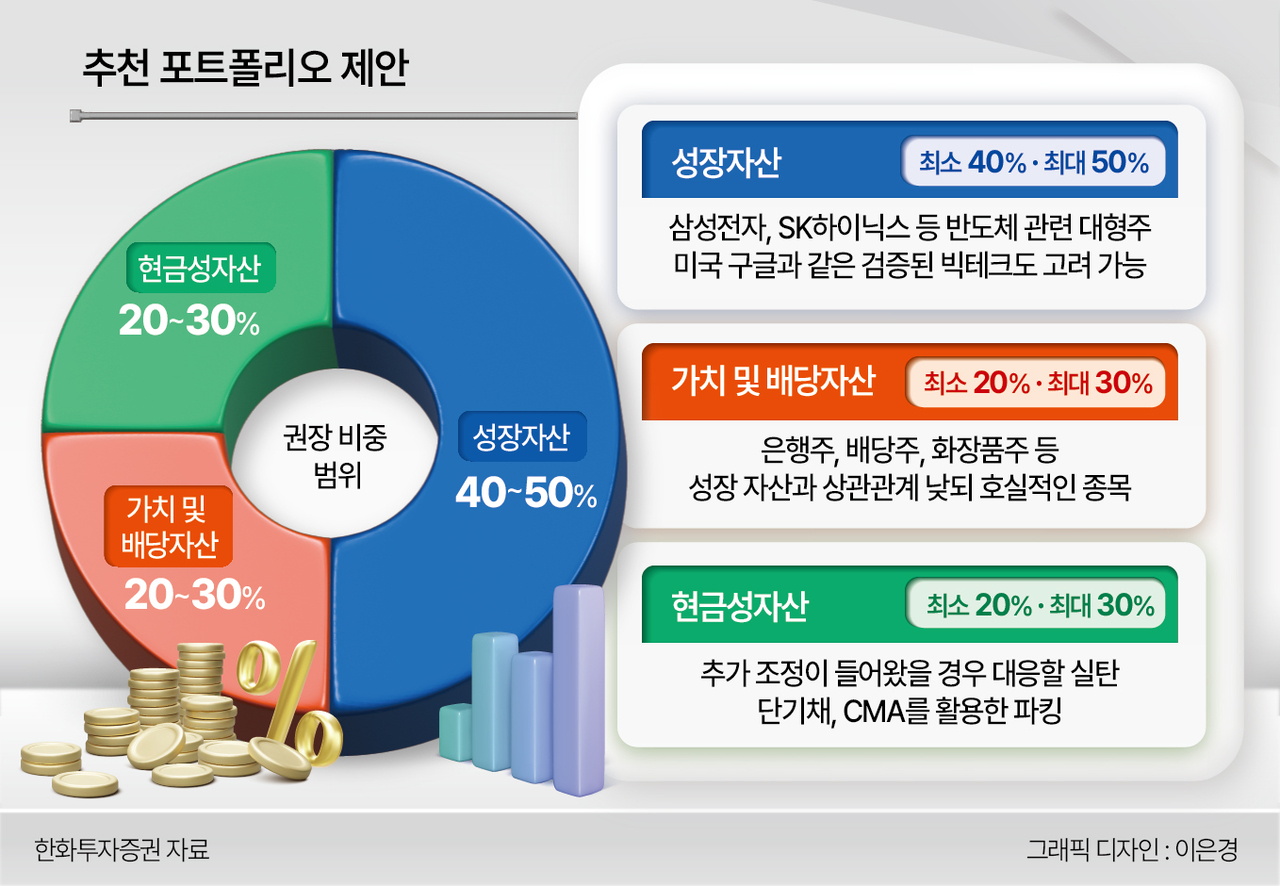
Growth assets should make up 40 to 50 percent of the total portfolio, anchored by domestic large-cap semiconductor and AI names — Samsung Electronics, SK hynix and Samsung Electro-Mechanics — alongside proven US holdings such as Google.
Value and dividend assets should account for 20 to 30 percent, diversified across sectors with low correlation to growth assets and strong earnings track records — bank stocks, dividend-paying shares and cosmetics companies among them. The remaining 20 to 30 percent should be kept in cash-equivalent assets, primarily short-term bonds or cash management accounts, held in reserve as ammunition to deploy when a correction arrives.
Three principles for retail investors to keep in mind bear repeating. They do not change. They must be remembered in a crash just as much as in a rally.
The first is to avoid leverage. Nothing is more dangerous than entering a structure you do not fully understand. Survival matters more than speed.
The second is to keep a designated portion of cash as dry powder. In a market with extreme volatility, having funds available to respond to unexpected variables is what determines success or failure. Cash is the most powerful tool that makes waiting possible — and it is why wealthy investors and retail investors can experience the same market and consistently end up with different returns.
The third is to rebalance mechanically when a target return is reached. When a pre-set target is hit, set aside the temptation to hold for more, realize at least a portion of the gains, and then exercise the patience to wait for the next opportunity. This is the practical action plan that keeps cash available as a weapon.
These principles may have seemed unremarkable during the last bull market. After living through a market this unprecedented, they feel like hard-won lessons. In hindsight, the absence of principle is the greatest risk of all. When prices rise, you see only reasons to rise; when they fall, you see only reasons to fall.
Sticking to the principles you have set for yourself — that is ultimately how major investors navigated this roller-coaster market. The more volatile the environment, the more it is the unglamorous principles, not the sophisticated strategies, that protect wealth. That is worth remembering.

th5@heraldcorp.com